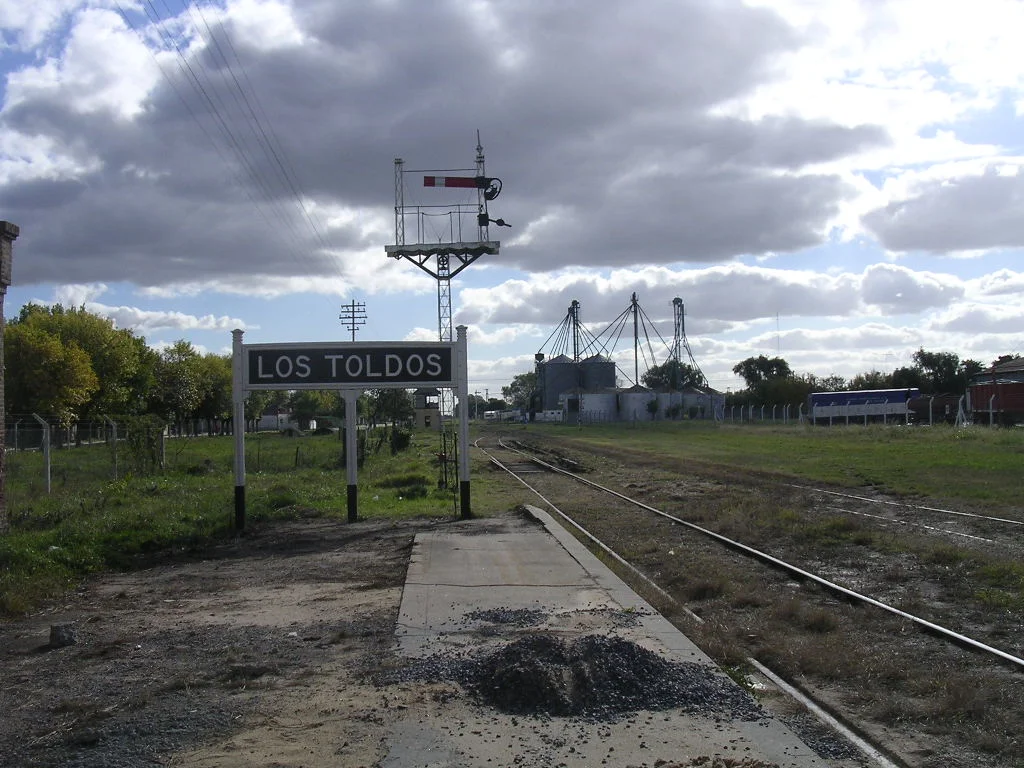

Los Toldos
The town's name means 'the tents.' It comes from the Mapuche word for the hide-covered dwellings that once stood on this stretch of the Buenos Aires pampas - not a metaphor but a literal description of how the place began. Los Toldos exists because a Mapuche chief named Ignacio Coliqueo led his people here in the 1860s and was granted land to settle. A generation later, in 1919, a girl was born into poverty on the edge of this town who would become Eva Perón, the most beloved and most divisive woman in Argentine history. Two beginnings, one small town, both larger than the place that holds them.
The Chief Who Chose to Stay
Ignacio Coliqueo was a lonco - a Mapuche chief - originally from the Araucanía region of Chile. In an era when the Argentine state was driving relentlessly across the southern frontier, crushing Indigenous resistance by force, Coliqueo made a different calculation. He arrived in 1861, and the following year the government of Bartolomé Mitre ceded him land; by 1866 his tribe held some 15,000 hectares on which to live. He chose to endure rather than be destroyed. His gamble holds to this day: the community he founded survives as the only ethnically distinct Mapuche community within Buenos Aires Province, its people still here, still weaving on the loom, still keeping a language and a memory their ancestor risked everything to preserve.
Born Into Poverty
Eva María Ibarguren entered the world here in 1919, the youngest of five children. Her birth was, in the language of the time, illegitimate: her father, Juan Duarte, was a rancher already married to another woman, and her mother, Juana Ibarguren, raised the children alone after he abandoned the family when Eva was barely a year old. They were poor - genuinely, grindingly poor - and stigmatized by both the father's absence and the law that branded the children. Juana sewed clothes for neighbors to keep food on the table. The family soon moved to nearby Junín, but Los Toldos was where it all began, in a region the writers of the day called dusty and desolate. From this, a national legend would grow.
A Wound That Shaped a Woman
When Juan Duarte died in 1926, his legal family forbade Juana and her children from entering the church for his funeral mass. They were permitted only to follow the procession to the cemetery, kept at a 'respectable' distance from the official heirs. Eva was seven years old. It is impossible to read her later life - her fierce championing of the poor, the shirtless, the overlooked, the ones society pushed to the margins - without remembering that morning when she was made to stand apart at her own father's grave. The girl who was once kept at a distance would spend her power closing exactly that kind of distance for others.
Two Memories, Side by Side
Today Los Toldos, a town of around 13,000 people on the railway line west of Buenos Aires, honors both of its histories. The house where Eva was born is preserved as a museum, drawing visitors who come to stand where Evita's story started. Elsewhere in town, a Monumento al Indio and an ancestral Mapuche cemetery - whose existence the community fought to have officially recognized - mark the deeper, older presence on this land, and weavers still keep the loom traditions of Coliqueo's people alive. A Benedictine monastery, the spirited Carnaval de Los Toldos, and the quiet Laguna La Azotea round out a place far larger in meaning than in size. Los Toldos asks its visitors to hold two truths at once: the survival of a people who would not be erased, and the rise of a woman who would not be ignored.
From the Air
Los Toldos sits in the northwest of Buenos Aires Province at 35.00°S, 61.04°W, roughly 310 km west of Buenos Aires and about 130 km southwest of the city of Junín. From altitude, look for the small grid of the town set in flat agricultural pampas, organized historically around the railway station of the old Buenos Aires Western Railway. The Aeroclub General Viamonte serves light aircraft locally. The nearest sizable airport is Junín (SAAJ) to the northeast; for major service, Buenos Aires Ezeiza (SAEZ) and Aeroparque Jorge Newbery (SABE) lie well to the east. The surrounding terrain is open and featureless farmland, offering long visibility in clear weather but few navigational landmarks beyond the scattered lagoons of the region.
Nearby Stories
- The Pampas 44 km away
- San Antonio de Areco 111 km away
- Lobos 126 km away
- Aerolíneas Argentinas Flight 644 132 km away
- Battle of Cepeda (1859) 163 km away
- Azul 192 km away
- Villa Epecuén 231 km away
- Battle of Quebracho Herrado 368 km away