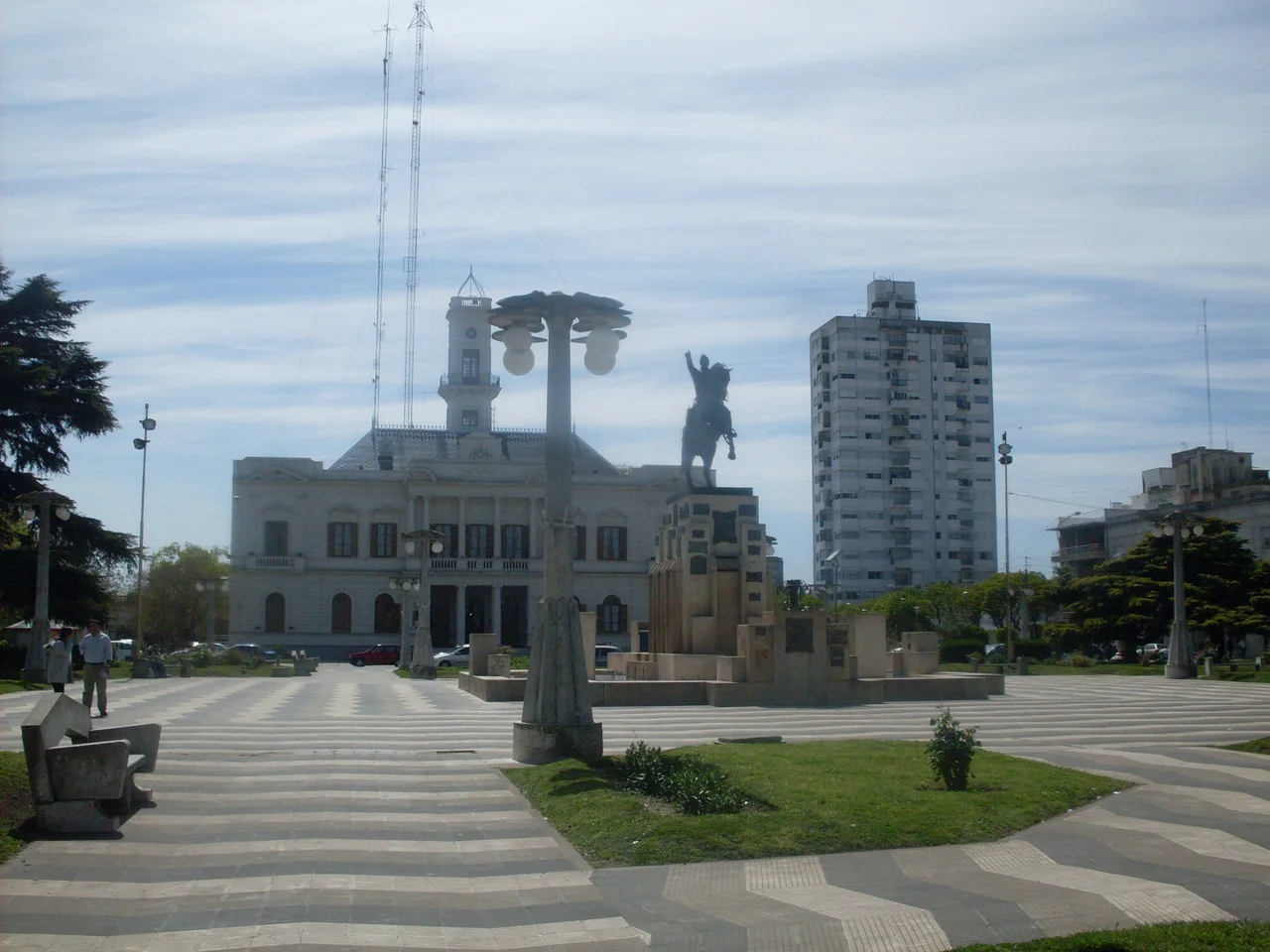

Azul
Don Quixote tilted at windmills on the dry plains of La Mancha. Four centuries later and an ocean away, the dreaming knight found a second home on the flat grasslands of the Argentine pampas - in a cattle town called Azul. UNESCO named it Argentina's official City of Cervantes in 2007, and a private library here holds one of the finest collections of the writer's work anywhere in the country. It is an unlikely literary capital: a place named for the blue of a local stream, where the real business has always been beef and leather, and where the most arresting monument is not a statue of an author but a towering white gateway built for the dead.
A Fort Against the Frontier
Azul was founded as a frontier defense. On 16 December 1832, on the orders of Governor Juan Manuel de Rosas, a fort named San Serapio Martir del Arroyo Azul rose on the open pampas to guard the settled lands against indigenous raids. The name came from the stream that runs through the area - azul, Spanish for blue. Around the fort, land grants drew settlers, and a stable community grew on ground that was, and remains, some of the richest cattle country on earth. Today around 63,000 people live in Azul, 300 kilometers south of Buenos Aires, its economy still built on agriculture and the raising of cattle for meat and leather, with a cathedral, Nuestra Senora del Rosario, consecrated in 1906 at its heart.
The Architect of the Pampas
In the late 1930s a singular vision descended on the small towns of the Buenos Aires countryside. The architect Francisco Salamone, Italian-born and Argentine-raised, built more than sixty municipal buildings across some twenty-five rural communities in just a few years - town halls, slaughterhouses, and above all cemetery gates, rendered in a bold, almost cinematic Art Deco that looked like nothing the pampas had ever seen. In Azul he designed both the town's slaughterhouse and the portal of its cemetery: a soaring white archway, severe and luminous, a piece of high modern design dropped onto the grasslands and pointed, fittingly, toward the gates of death. These were among the first works of modern architecture in rural Argentina, and they still stop travelers in their tracks.
Cervantes on the Grasslands
Azul's literary life is the gift of one obsessive collector. Bartolome Ronco assembled an extraordinary trove of editions and ephemera connected to Miguel de Cervantes and his Don Quixote, and the antiquarian library and museum that bears his name, Casa Ronco, now holds the country's best Cervantine collection. That legacy earned Azul its UNESCO designation as the City of Cervantes in 2007, and each spring since that year the town has hosted a Cervantes festival in his honor. The cultural ambition runs deeper still: the Teatro Espanol, founded in 1897, ranks among the most important theaters of the central pampas, and in 1992 its stage held the dancers of the Bolshoi Ballet - Russian ballet in a frontier cattle town, another of Azul's quiet improbabilities.
Light and Shadow
Not every chapter is gentle. Azul was the birthplace of Mateo Banks, remembered as Argentina's first notorious mass murderer, who killed eight people - six relatives and two family employees - in 1922. Half a century later, on 19 January 1974, the town's outlying army barracks were stormed by far-left ERP guerrillas in what was then the most violent assault of its kind in the country, a grim marker on the road to Argentina's years of political terror. Yet Azul keeps producing brighter names too: footballer and manager Matias Almeyda, tennis player Federico Delbonis, and most recently Franco Mastantuono, a teenage prodigy now playing for Real Madrid - new talent carried out of an old cattle town that learned, somewhere along the way, to dream like a knight.
From the Air
Azul lies near the center of Buenos Aires Province at roughly 36.78 S, 59.85 W, about 300 km south of the capital on the flat humid pampas. From the air it reads as a compact, orderly grid set in a vast checkerboard of cattle pasture and cropland, with the Arroyo Azul threading through and Salamone's stark white cemetery portal a notable man-made landmark on the town's edge. Azul has its own aerodrome (Azul Airport / Pampa de Azul). A relaxed viewing altitude of 2,500-4,000 feet AGL keeps the grid and the surrounding rangeland in frame; the terrain is nearly featureless and broadly cultivated, so the town stands out cleanly against it on a clear day. Tandil Airport (ICAO: SAZT) is roughly 100 km to the south-southeast, Mar del Plata (SAZM) about 250 km southeast, and Buenos Aires Ezeiza (SAEZ) some 290 km to the north-northeast.
Nearby Stories
- Piedra Movediza 33 km away
- Aerolíneas Argentinas Flight 644 53 km away
- Tandil 60 km away
- Coronel Suárez 136 km away
- Tres Arroyos 145 km away
- Lobos 156 km away
- Los Toldos 182 km away
- Pigüé 191 km away