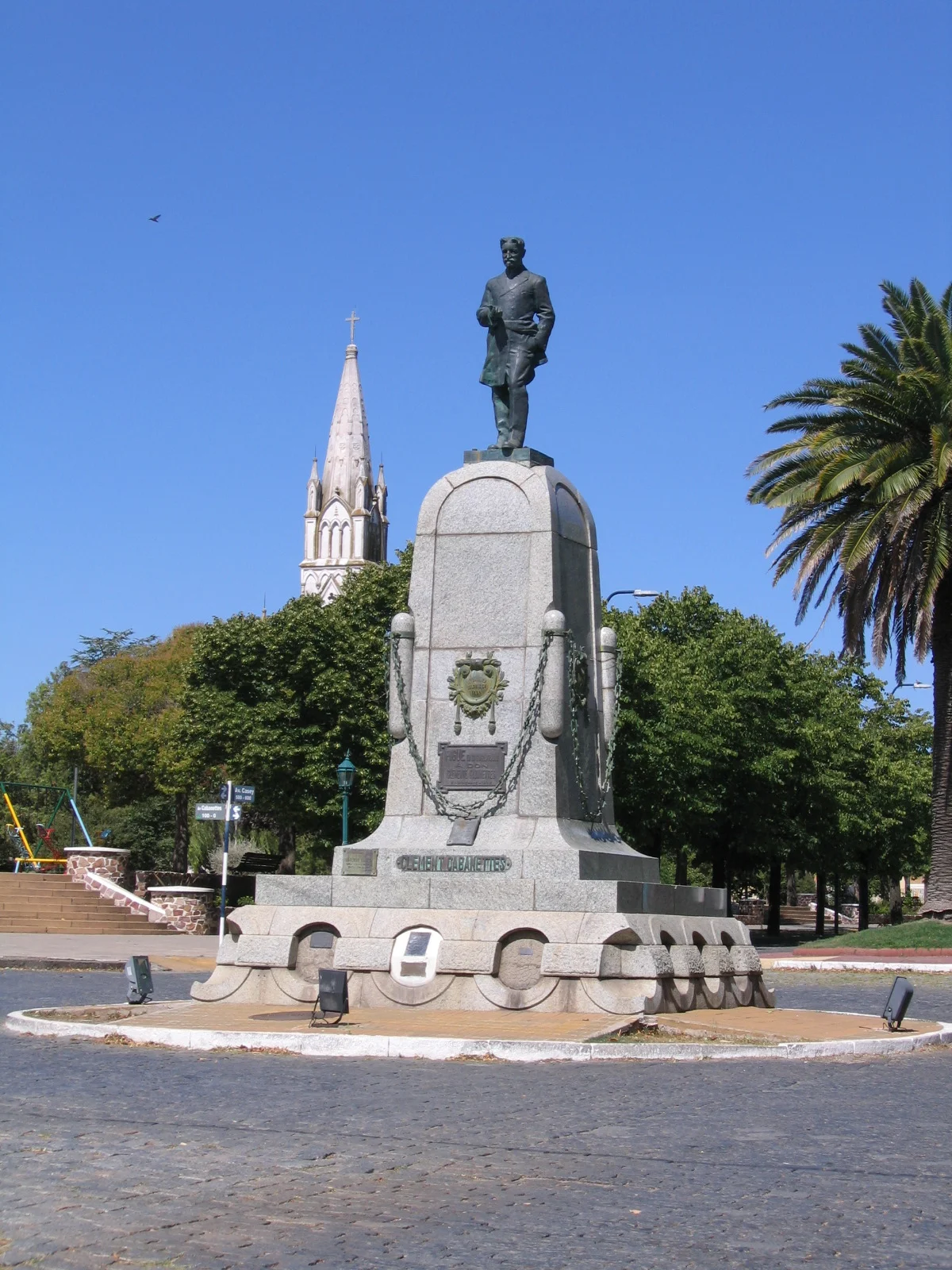

Pigüé
In October 1884, a few dozen poor farming families boarded a train at Rodez, in the rural heart of southern France, and did not come back. Phylloxera had ruined the vineyards, the Decazeville mines were shedding jobs, and a former army lieutenant named Clément Cabanettes had made them an extraordinary offer: land of their own, in a place across the ocean called Pigüé. They sailed from Bordeaux on a ship named the Belgrano and, 38 days and many doubts later, stepped off at a brand-new railway station on the open Pampas on 3 December 1884. There were 165 of them, almost all Occitan speakers from the Aveyron, and the colony they founded has been likened to a Mayflower of the grasslands. More than a century later, Pigüé still speaks their language.
The Man Who Imagined a Town
Pigüé exists because of one stubborn, generous, and ultimately ruined man. Clément Cabanettes was born in 1851 in the tiny hamlet of Ambec, near Saint-Côme-d'Olt in the Aveyron. He first came to Argentina in 1879 to drill troops, then started the country's first telephone company before falling out with its board and drifting into the wheat-machinery business. When he bought 270 square kilometers of empty land in the south of Buenos Aires Province, the rolling country reminded him so powerfully of his native Aubrac that he resolved to fill it with his own people. With the financial backing of his friend Eduardo Casey, an Argentine of Irish parents, he had the Pigüé station added to the planned southern railway, dug a well, and built a great silo and lodgings for settlers who had not yet arrived. Then he went home to Aveyron to find them.
A Gathering Place
The name fit the project with eerie grace. Pigüé comes from the Mapuche, the indigenous people of these plains, and means gathering place. To the Aveyronnais who answered Cabanettes's call, it became exactly that. The terms were demanding but fair: each family received two square kilometers to farm for six years, giving half the harvest to the community, after which the land became theirs outright regardless of how the crops had fared. Among the 165 who arrived that first December were a schoolteacher, a blacksmith, a cartwright, a tradesman, and a priest. The very first teacher was 18-year-old Julie Bras, eldest daughter of a family of eight from Aurelle-Verlac. These were not adventurers or fortune-seekers. They were ordinary working people, average age under 25, who had wagered everything they had on a patch of grass they had never seen.
Faith Through Famine
The promised land did not yield easily. The settlers farmed the way they had in Aveyron, but the climate, the soil, and the lie of the land were all wrong, and the first wheat harvest disappointed. The second year was worse: drought ran from March to September, and some families sowed maize and potatoes over the failing corn in case nothing came up at all. Autumn rains finally saved a meager crop. Through it all, not one family gave up and returned to France. Instead, more came. They wrote letters home insisting the sacrifice was worth it, that, as one put it, Monsieur Cabanettes could not be accused of promising more butter than bread. Their faith outlasted the hunger, and the colony slowly took root and, in time, prospered into one of the most successful settlements in the Pampas.
A Piece of Aveyron in the Pampas
The men who made it possible were not rewarded for it. Cabanettes could never repay Casey, who twice extended his deadlines and finally forgave the debt outright. In the end the provincial government bought back the struggling settlement at the price of bare land, ignoring the buildings and crops, and both Cabanettes and Casey died poorer than many of the families they had rescued. But their gift endured beyond them. Around 20,000 people now live in and around Pigüé, and an estimated third to forty percent of them trace their roots to the Aveyron. Remarkably, many still speak Occitan, the old language of the Rouergue, kept alive across an ocean and a century. Cultural associations link Pigüé to its sister communities in France to this day. The town remains, in the truest sense, a grateful piece of Aveyron in South America.
From the Air
Pigüé lies at 37.60°S, 62.40°W on the Pampas of southern Buenos Aires Province, roughly 584 km southwest of the city of Buenos Aires, set where the Cura Malal and Bravard chains of low hills approach one another. The town has its own small Pigüé Airport; the nearest major airport is Comandante Espora (ICAO: SAZB) at Bahía Blanca, about 130 km to the south, with Coronel Suárez (ICAO: SAZC) closer to the east. The terrain is flat to gently rolling farmland, so even a modest cruising altitude gives a wide view; in clear, dry conditions look for the regular grid of the town, the converging railway lines that brought the first settlers, and the surrounding patchwork of wheat and grazing land running up to the nearby hills.
Nearby Stories
- The Works of Francisco Salamone 33 km away
- Club Hotel de la Ventana 54 km away
- Monte Hermoso 142 km away
- Yellow Fever in Buenos Aires 169 km away
- Tres Arroyos 169 km away
- Lihué Calel National Park 239 km away
- Chimpay 335 km away
- San Luis 539 km away