
The Works of Francisco Salamone
Drive the empty roads of southern Buenos Aires Province and the land gives you almost nothing to look at. Grass to the horizon, wind, the occasional windmill. Then a town appears, and rising from its center is a tower so strange it seems beamed in from another planet: a soaring concrete slab, sharp-edged and severe, a clock face glowing near its summit, taller than the church beside it. This is a Salamone. Between 1936 and 1940, an Italian-born architect named Francisco Salamone scattered more than sixty of these monuments across the pampas, then disappeared so completely that he died in 1959 nearly forgotten by the country he had reshaped.
The Four-Year Whirlwind
Salamone (1897-1959) was not a man who worked slowly. He had begun in Córdoba in 1933, paving roads and building a slaughterhouse, before a change in local politics pushed him east to Buenos Aires Province. There he found his patron: Manuel Fresco, the conservative governor who ruled the province during what Argentines call the Infamous Decade. Fresco wanted public works to announce that civilization had arrived on the frontier, and he handed Salamone full powers and full funding. What followed was an explosion of building unlike anything in rural Argentine history. Town halls, cemetery portals, slaughterhouses, plazas, lampposts, sidewalks, even the furniture inside the municipal palaces, all of it designed in a single sweeping vision, all of it built in roughly four years across some two dozen small towns.
Towers Over the Grass
The town halls were Salamone's boldest statement. He gave each one a tower that deliberately overtopped the local church steeple, a sculptural shaft of concrete meant to symbolize the advance of the modern state across the plains. The style borrowed from Italian Futurism and the monumental civic architecture of Mussolini's Italy, where Salamone had roots, but transplanted to the silent pampas the effect is dreamlike rather than oppressive. In Coronel Pringles, the slaughterhouse tower takes the form of an enormous knife blade. The buildings rewarded ambition with drama, casting hard geometric shadows across towns of a few thousand people who suddenly possessed architecture worthy of a capital city.
Gates for the Dead
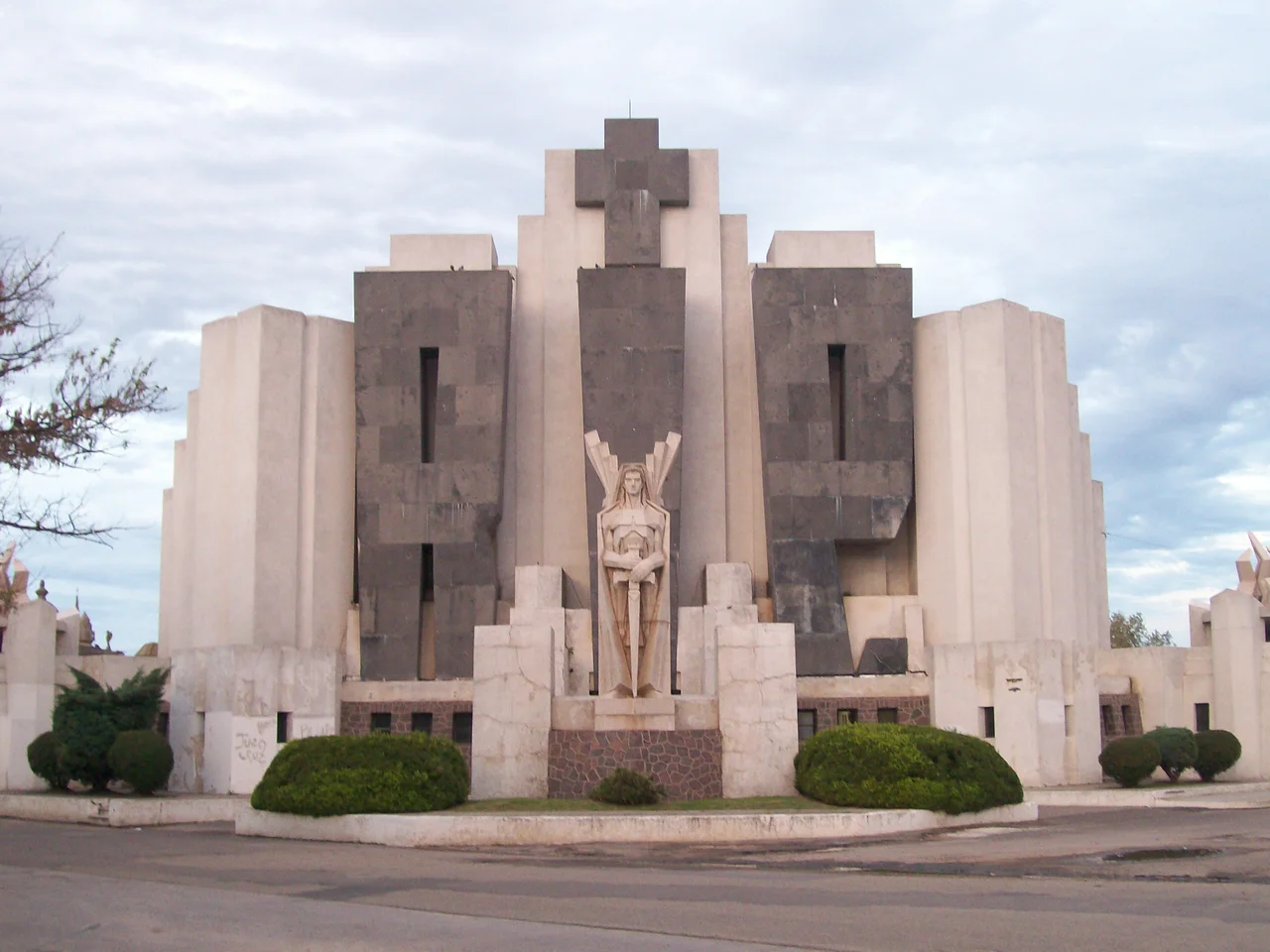
Salamone reserved some of his most haunting work for the places where the living rarely linger. His cemetery portals at Saldungaray, Laprida, Azul, Balcarce, and Salliqueló turn the entrance to the graveyard into theater. The 1938 gate at Saldungaray is the most famous: a vast wheel roughly twenty meters across, framing a cross with the figure of Christ at its center, the whole composition rising from flat ground like a piece of cosmic machinery. Approaching it on foot, you feel the architecture working on you before you can name why. These were monuments to mortality built for farming villages, and they treat the death of an ordinary pampas family with the gravity once reserved for cathedrals. To enter the cemetery, the bereaved had to pass beneath a structure that turned grief into something monumental, a gesture both grandiose and strangely tender for towns of such modest means.
Fall and Resurrection
When Fresco was removed from power in 1940, Salamone's pampas career ended almost as abruptly as it began. He moved to Buenos Aires, was accused of corruption over a paving contract, went briefly into exile in Uruguay, and after the charges were dropped he never built at that scale again. For decades his towers stood weathering in towns most Argentines never visited, admired by locals but unknown beyond them. Only later did photographers, filmmakers, and architects rediscover him, and the strange concrete giants of the grasslands became a pilgrimage for anyone who loves the collision of bold design and empty space. Salamone left behind a single, scattered masterwork that no museum can hold, because it is the size of a province.
From the Air
The Salamone trail is centered on southern Buenos Aires Province, with the marker coordinate near Coronel Pringles at 37.18°S, 62.76°W; major works lie in a rough arc through Saldungaray, Laprida, Azul, Balcarce, Guaminí, and Carhué. The flat pampas offer unobstructed views, and the towers are best appreciated at low altitude (1,500-3,000 ft AGL) where their height above surrounding rooftops reads clearly. The nearest major field is Comandante Espora Airport at Bahía Blanca (ICAO: SAZB), roughly 100-150 km southwest of the core cluster; Buenos Aires Ezeiza (ICAO: SAEZ) lies to the northeast. Visibility on the plains is typically excellent, though spring and summer thunderstorms can build quickly.
Nearby Stories
- Coronel Suárez 26 km away
- Pigüé 36 km away
- Club Hotel de la Ventana 106 km away
- Azul 212 km away
- Lihué Calel National Park 216 km away
- The Pampas 223 km away
- Chimpay 334 km away
- San Luis 489 km away