
Lobos
In October 1953, Juan Domingo Perón - three times president of Argentina, the most powerful man in the country - traveled out to a quiet farming town a hundred kilometers from Buenos Aires and stood in front of a small house on a residential street. He had been born there in 1895 and had lived in it only until the age of five. Now he opened it as a museum. There is something disarming about a leader of such reach returning to so plain a beginning, and the town of Lobos has guarded that beginning ever since, the way a family guards an old photograph.
The House on Perón Street
The Casa Natal de Juan Domingo Perón still stands at the address that now bears his name, its rooms filled with photographs, documents, furniture, and personal belongings of the Perón family. In the patio grows a fig tree planted around 1890, declared a Historic Tree of Buenos Aires Province - the same tree, the museum holds, under which a small boy once played before his family moved on toward the Patagonian frontier. Perón himself inaugurated the house in 1953, and that same year it was declared a National Historical Monument. For the people of Lobos, who call it simply 'the house of Perón,' it is less a shrine to power than a record of where a local child started out.
A Town Named for Wolves That Were Not
The name Lobos means 'wolves,' but no wolves ever roamed here. A 1772 map printed in London, drawn from the notes of a Jesuit explorer named Falkner, labeled the local lagoon Laguna de Lobos. The most repeated explanation is that early settlers saw river otters - lobos de agua, 'water wolves' - thriving in the reeds and gave the place their name. Others credit packs of wild dogs that looked wolfish from a distance. Either way, the lagoon came first and the town followed, founded in 1802 when José Salgado and his wife Pascuala were granted the land. Their first act was to raise a humble oratory of straw and mud, and that little chapel became the seed around which the streets grew.
Where a Gaucho Met His End
Lobos carries another, darker piece of Argentine memory. In 1874 the gaucho Juan Moreira died here, run down by the police after a life on the wrong side of the law. Moreira was a real man, but he became something larger - a folk hero of the pampas, the outlaw-gaucho immortalized in a wildly popular novel and stage drama, a symbol of the free horseman crushed by an encroaching state. His death, like Perón's birth, fixed Lobos in the national imagination. That a three-term president and a national legend of resistance both belong to the same small farming town is a coincidence the pampas seems to specialize in: enormous histories rooted in the smallest of places, a hundred kilometers from anywhere that thinks of itself as important.
The Lagoon and the Living Town
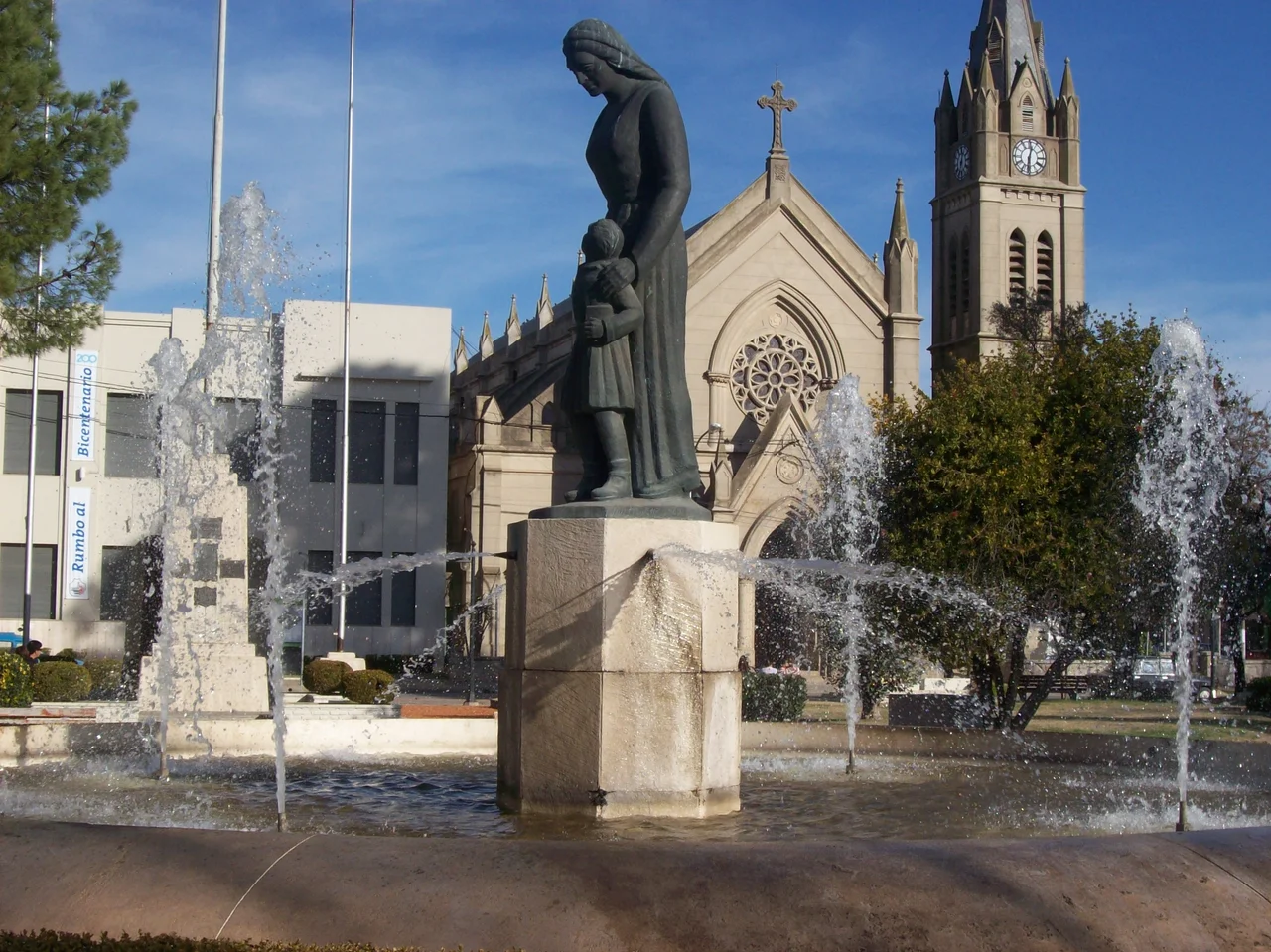
Life in Lobos still revolves around land and water. This is rich dairy country, its fields planted in wheat, maize, and soybeans, its hives producing a large share of Argentina's honey. Fifteen kilometers from town spreads the Laguna de Lobos, eight square kilometers of reed-fringed water where herons wade and anglers gather. Since 1988 the town has held an annual Sport Fishing Festival on its shores, complete with a music stage built out over the water and the crowning of a 'Queen of Fishing.' The grand Nuestra Señora del Carmen church, opened in 1906 with an altar of Carrara marble and a tower rising thirty-seven meters, watches over it all - the visible center of a town that has quietly held onto more history than its size suggests.
From the Air
Lobos lies on the open pampas at 35.19°S, 59.10°W, about 100 km southwest of Buenos Aires. From altitude, look for the compact urban grid set among the surrounding farmland, with the Laguna de Lobos - a broad oval lagoon roughly 15 km from town - as the most distinctive landmark. The thirty-seven-meter tower of the Nuestra Señora del Carmen church marks the town center. The Lobos local aerodrome serves light aircraft; the nearest major airports are Buenos Aires Ezeiza (SAEZ) and Aeroparque Jorge Newbery (SABE) to the northeast. The flat terrain offers clear sightlines for many kilometers in good weather, though the Río Salado to the south can flood the lowlands after heavy rain.
Nearby Stories
- Ezeiza Massacre 24 km away
- Luján, Buenos Aires 47 km away
- 1989 Attack on La Tablada Barracks 63 km away
- Chascomús 64 km away
- Aerolíneas Argentinas Flight 644 84 km away
- Los Toldos 119 km away
- Azul 142 km away
- Battle of Vuelta de Obligado 154 km away