
Battle of Vuelta de Obligado
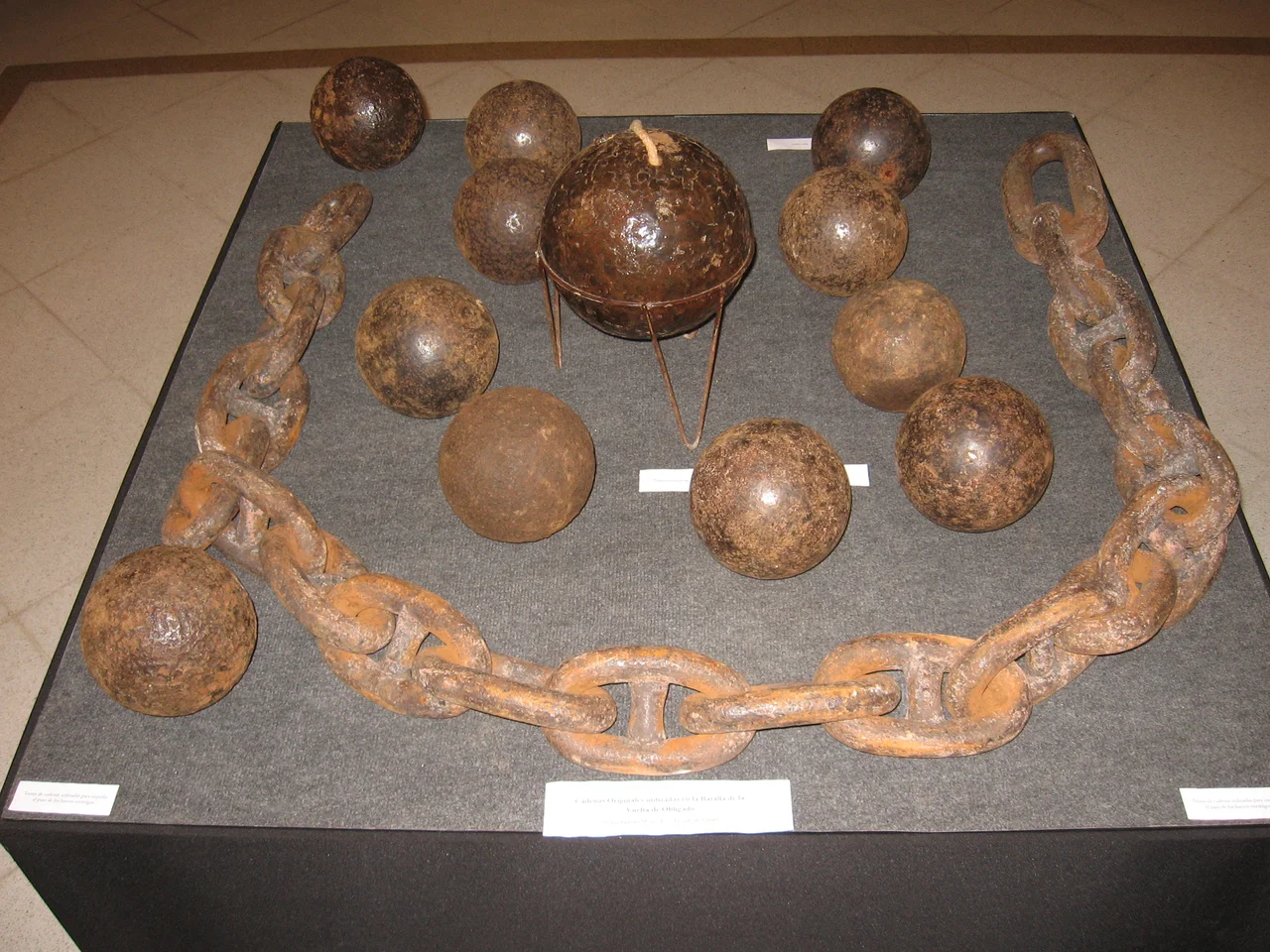
Three iron chains stretched across the Paraná here, lashed to two dozen boats and pulled taut from bank to bank. Behind them waited gaucho gunners on a clifftop, the blue-and-white flag flying, and a general who would tell his men to die before they saw it lowered. On 20 November 1845, the two most powerful navies in the world - Britain's and France's - came up this river to break that chain. They broke it. And in breaking it, they learned that forcing the Paraná against Argentina's will would cost more than the river was worth.
Why a River Became a Battlefield
The dispute was about trade, and trade meant power. Juan Manuel de Rosas, who governed Buenos Aires and ran the foreign affairs of the Argentine Confederation, insisted that commerce with the inland provinces pass through his custom house. Britain and France wanted to sail straight upriver to Santa Fe, Entre Rios, and Corrientes - and to Paraguay beyond - without asking his permission. When Rosas declared the Confederation's rivers closed to foreign warships, the two European powers simply did not recognize the claim. In 1845 they assembled a joint fleet and pointed it up the Parana. The question was no longer diplomatic. It was whether a young South American nation could control the water running through its own land.
The Bend Called Obligado
The Spanish word vuelta means a turn, and the Parana takes a hard one here. The river narrows to roughly 700 meters, and a cliff rises sharply above the right bank - high ground a defender could not ignore. General Lucio Norberto Mansilla, Rosas's brother-in-law, read the geography like a tactician. He strung three thick chains across the channel, suspended from twenty-four requisitioned barges, the work overseen by an Italian immigrant named Filipo Aliberti, whose own boat would sink in the fighting. Along the bluff Mansilla planted four batteries - thirty cannon, many of them bronze pieces throwing eight to twenty pounds of iron - served by 160 gauchos. Two thousand men waited in the trenches. The river itself had become a fortress.
The Day the Chains Broke
The allied squadron carried the most advanced machinery of the age: partially armored steamers, rapid-fire guns, Congreve rockets that arced down trailing smoke. For hours the Argentine batteries and the European broadsides hammered each other across the narrow water. The chains held longer than anyone expected, but sailors eventually hacked them apart under fire, and the fleet ground through. The cost was brutal and unequal. Roughly 150 Argentines were killed. Mansilla himself, leading a bayonet charge along the bank, took shrapnel in the chest and had to hand command to Colonel Francisco Crespo. The Europeans lost far fewer men and won the passage. By every tactical measure, it was a defeat for Argentina.
Losing the Battle, Winning the River
Yet the victory curdled. The fleet that forced its way upstream was attacked again and again on the way back - at Tonelero, at Angostura del Quebracho - and merchant ships were lost. Of ninety-two merchantmen waiting downstream, only about fifty bothered to continue. The arithmetic was plain: the Parana could be forced, but never cheaply, and never for long. Within four years Britain signed the Arana-Southern Treaty (March 1849) and withdrew its fleet; France followed with a treaty of its own (October 1850). Both powers acknowledged Argentine sovereignty over the inland rivers, subject only to Argentine law. The exiled liberator Jose de San Martin, hearing of the stand, wrote to his friend Tomas Guido that the invaders had learned Argentines were not empanadas to be swallowed whole. There is a small, telling coda: until 1948 the Paris Metro had a station named Obligado, renamed Argentine as a gesture of goodwill in the year after Eva Peron visited France. In 1974 Argentina made 20 November its Day of National Sovereignty, and in 2010 a national holiday.
From the Air
Vuelta de Obligado sits at 33.59 S, 59.81 W, on the right bank of the Parana in northern Buenos Aires Province, within the San Pedro district. From altitude the defining feature is the river's sharp bend and the cliff line on the western shore where Mansilla's batteries once stood. The nearest major field is Rosario - Islas Malvinas International (ICAO SAAR, IATA ROS), about 90 km upriver to the north-northwest; Buenos Aires lies roughly 175 km downstream, served by Aeroparque Jorge Newbery (SABE) and Ezeiza (SAEZ). Best viewing is from 2,500 to 4,000 feet in the clear, dry air of the southern autumn, when low sun rakes the bluffs and the brown Parana threads between green islands.
Nearby Stories
- Battle of Cepeda (1859) 11 km away
- Battle of San Nicolás 19 km away
- Atucha Nuclear Power Plant 20 km away
- San Antonio de Areco 57 km away
- Battle of El Espinillo 80 km away
- Gualeguaychú 95 km away
- Basilica of Our Lady of Luján 104 km away
- Los Toldos 130 km away