
Battle of San Nicolás
A Maltese privateer commanded the flagship. A Frenchman who would one day raid California ran the second ship. The crews were foreigners who barely spoke Spanish, the cannon were guns the navy had already retired as obsolete, and the whole enterprise had been assembled in a matter of weeks. On 2 March 1811, off San Nicolas on the Parana River, this improvised flotilla - the very first navy of revolutionary Buenos Aires - sailed straight into a stronger, faster Spanish squadron. It was destroyed. But the men who fought here became founders of the Argentine Navy, and their commander's courage was never in doubt.
A Revolution Needs a Navy
The trouble began in May 1810, when Buenos Aires deposed the Spanish viceroy and claimed the right to govern itself while Spain lay under Napoleon's heel. Across the river in Montevideo, royalist authorities refused to accept it and blockaded the new government's port. Montevideo had what Buenos Aires lacked: a real naval base and the Spanish Atlantic fleet. The revolutionary Junta Grande understood the danger at once. Whoever controlled the Rio de la Plata and the Parana controlled the whole region's trade and movement. So they resolved to build a fleet from nothing - and handed the job to a navy secretary named Francisco de Gurruchaga.
Five Ships and No Sailors
Gurruchaga bought five vessels from local owners and armed three of them: a schooner christened Invencible, a brigantine named 25 de Mayo for the revolution's birthday, and a sloop called America. The guns were largely cast-offs, withdrawn as obsolete. Crewing the ships was harder still. The people of the Pampas were horsemen, not sailors, so the officers hired foreigners who mostly could not speak Spanish and filled the lower ranks with locals. Command went to Juan Bautista Azopardo, a Maltese privateer who had once fought against the British invasions of 1806 and 1807. His second on the 25 de Mayo was Hipolito Bouchard - a French-born adventurer who, seven years later, would carry the Argentine flag around the world and briefly seize Monterey, California from Spain.
Ambush on the Paraná
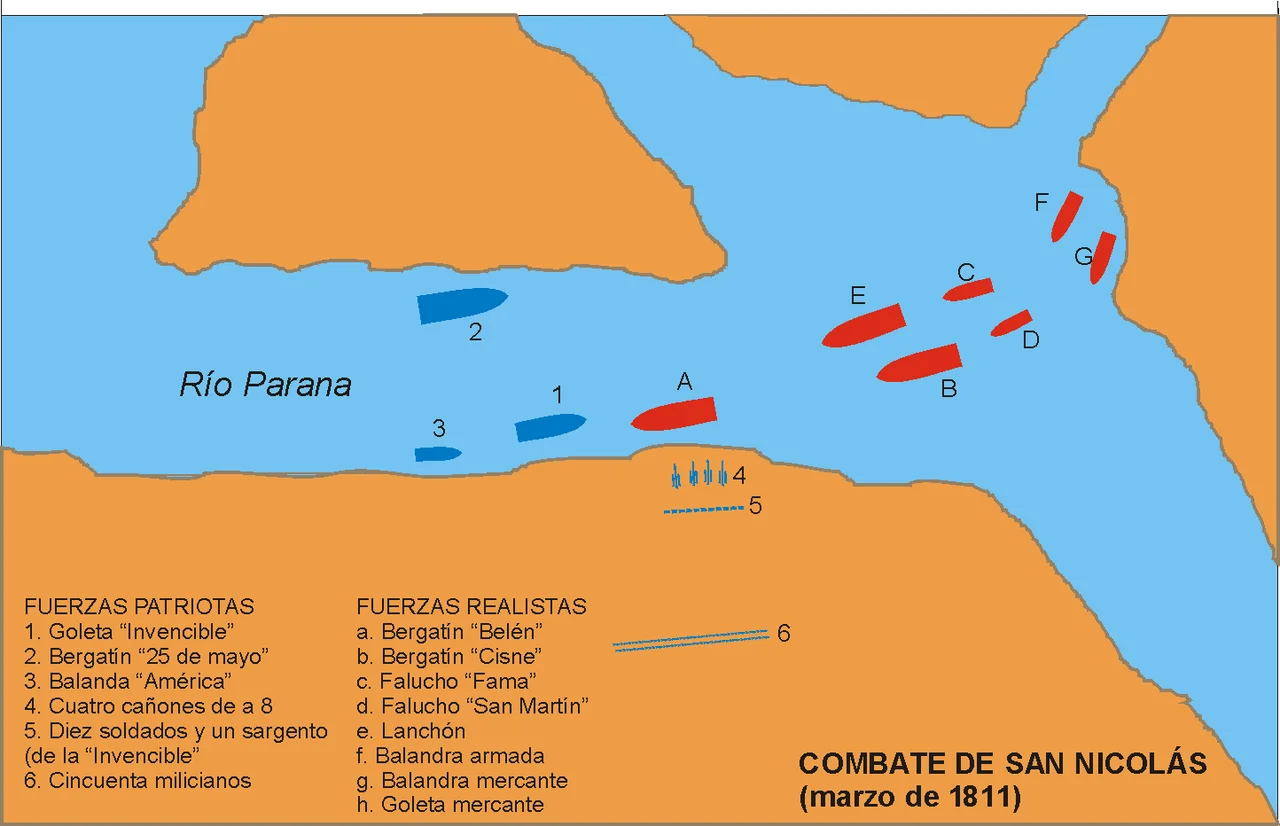
The fleet's first mission was a rescue. General Manuel Belgrano's army, sent to bring Paraguay into the revolution, had been beaten and needed reinforcements rushed upriver. Azopardo was ordered to carry troops and guns north. But Montevideo learned of the plan and sent the skilled officer Jacinto Romarate to intercept, with seven warships better armed than anything the rebels had. Near San Nicolas, Azopardo chose to fight rather than run. He landed some of his cannon on the bank and prepared his sailors and militia to fight from the shore - turning the riverbank into part of his line, the way defenders of the Parana would again decades later.
Courage Without Victory
The battle went badly almost from the start. Two royalist brigantines grounded near shore and took fire, but Azopardo could not board them, and they worked free. The America was holed at the bow and abandoned as she flooded. Aboard the 25 de Mayo, the green crew panicked and leapt overboard despite Bouchard's efforts to hold them. That left the Invencible fighting alone. Her crew held out for nearly two hours until the royalists boarded. Azopardo moved to blow up the magazine and take the enemy with him, but his own wounded begged him not to, and he surrendered. He was shipped as a prisoner to Ceuta in Spain, where he later faced a death sentence for his revolutionary loyalties before it was commuted. A Buenos Aires inquiry faulted his inexperience yet expressly recognized his bravery. Freed in 1820 when a liberal uprising in Spain opened the prisons, Azopardo returned to South America, and the following year Buenos Aires restored him to the navy he had helped to found. The defeat at San Nicolas had cost the revolution its fleet - and control of the rivers passed to Montevideo's royalists until William Brown rebuilt Argentine sea power in 1813 - but the men forged in that losing fight became the foundation of a naval tradition that endures.
From the Air
The battle was fought on the Parana off San Nicolas de los Arroyos, near 33.36 S, 60.14 W, where the Buenos Aires Province shoreline meets the river's islands and side channels. From altitude, look for the city of San Nicolas on the right bank and the braided green of the Parana delta islands opposite. The small San Nicolas airfield (SA31) lies just minutes away; the nearest major airport is Rosario - Islas Malvinas International (ICAO SAAR), about 60 km up the river to the northwest. Buenos Aires - Aeroparque (SABE) and Ezeiza (SAEZ) - is roughly 230 km to the southeast. The flat river plain shows best from 2,500 to 4,000 feet on a clear, still day.
Nearby Stories
- Battle of Cepeda (1820) 18 km away
- Battle of El Espinillo 31 km away
- Battle of Vuelta de Obligado 45 km away
- Atucha Nuclear Power Plant 68 km away
- San Antonio de Areco 108 km away
- Gualeguaychú 117 km away
- Los Toldos 159 km away
- Sa Pereira Rail Disaster 200 km away