
Gualeguaychú
Say the name aloud and it almost dances: Gualeguaychú. The word comes from Guaraní, and the old interpretations range from 'big-water river' to the wonderfully specific 'river of the small pig caves,' the pig in question being the capybara. For most of the year this is a calm city of about 110,000 on a tributary of the Uruguay River in the Argentine province of Entre Ríos. Then summer arrives, and for ten Saturday nights the whole place turns into the loudest, brightest stage in the country.
The Carnival of the Country
Argentines call it the Carnaval del País, the Carnival of the Country, and they mean it as a claim. Running from January into early March, Gualeguaychú's Carnival is the largest open-air spectacle in Argentina, surpassed in all the Americas only by Rio de Janeiro. The heart of it is a structure built for the purpose: the Corsódromo, inaugurated in 1997, a 500-meter parade avenue with grandstands that hold around forty thousand spectators. Five great comparsas, the local equivalent of samba schools, spend all year preparing. When their turn comes, hundreds of dancers in feathered costumes move down the avenue ahead of enormous themed floats, competing for the season's crown. Night after night through the summer, roughly thirty thousand people fill the stands.
Where the River Bends
The Carnival could not exist without the city that hosts it, and the city exists because of the river. Gualeguaychú grew up on the left bank of the river that shares its name, a slow waterway that feeds the Uruguay. It sits in the heart of Argentine Mesopotamia, the green country between the great rivers, about 230 kilometers northwest of Buenos Aires along National Route 14. Across the water lies Fray Bentos in Uruguay, linked by an international bridge. The two banks have shared centuries of history, and not always peaceably; in the 2000s, Gualeguaychú became the staging ground for mass protests against a Uruguayan pulp mill that locals feared would foul the river they love.
Hot Springs and Slow Days
When the floats are stored and the costumes packed away, Gualeguaychú settles into the easy pace of a resort town. It has beaches along the river, a casino, and thermal baths whose waters rise warm from deep underground; one complex offers pools heated to forty degrees Celsius, set in open countryside alive with birds. The Unzué Park, a green expanse of some 120 hectares with its own lagoon, spreads across the riverbanks and is reached by the Méndez Casariego Bridge. People come from across Argentina to soak, swim, and slow down. It is the same instinct that draws them to Carnival, just turned down to a simmer: the river, the warmth, the pleasure of being somewhere that knows how to enjoy itself.
Deep Roots
Long before the floats and the grandstands, this land belonged to the Chaná and Charrúa peoples, who lived along these rivers for generations. The arrival of Spanish settlers in the 17th and 18th centuries brought conflict, displacement, and campaigns that devastated the indigenous population; by the mid-1700s their numbers had collapsed. The Spanish crown, anxious about Portuguese incursions from across the river, sent the officer Tomás de Rocamora to organize the scattered settlers, and Gualeguaychú was formally founded on 18 October 1783. The city that grew here produced its share of notable Argentines, among them the 19th-century poet Olegario Víctor Andrade and the writer José S. Álvarez, better known by his pen name Fray Mocho.
Stone and Spire
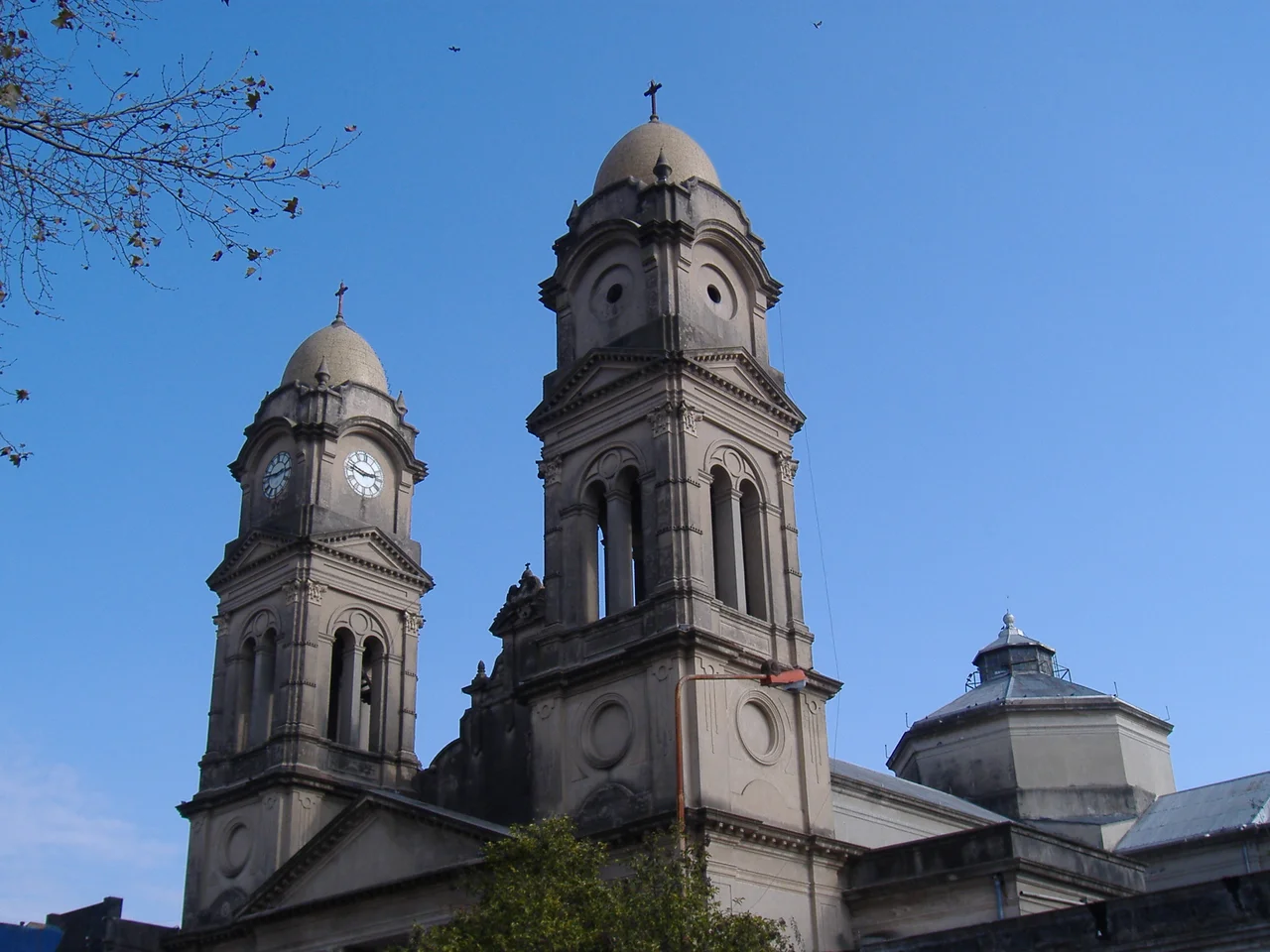
For a provincial city, Gualeguaychú built handsomely. Its cathedral, dedicated to Saint Joseph, was begun in 1863 at a cornerstone ceremony attended by the great Entre Ríos caudillo Justo José de Urquiza and designed by the Swiss architect Bernardo Poncini; the work dragged on until 1890, and when the towers were later judged unsafe they were taken down and replaced by the domes that crown it today. The Gualeguaychú Theatre, founded in 1910, was inspired by the Viennese Secession, its interior shaped like a horseshoe. These are the bones of a city that has always taken its public life seriously, the same city that, once a year, throws the biggest party in the country.
From the Air
Gualeguaychú lies at about 33.01°S, 58.51°W on the left bank of the Gualeguaychú River in Entre Ríos, southeastern Argentina, roughly 230 km northwest of Buenos Aires. From the air, look for the river winding past the city, the broad green of Unzué Park with its lagoon on the opposite bank, and, during the summer season, the long straight avenue of the Corsódromo. The international bridge to Fray Bentos, Uruguay, runs east across the Uruguay River. Gualeguaychú Airport (ICAO SAAG, IATA GHU) sits about 6 km west of the city; the larger Concordia 'Comodoro Pierrestegui' Airport (SAAC) lies well to the north in the same province. The flat Mesopotamian plain gives long visibility; for the spectacle of Carnival lights, the southern summer nights of January and February are unmatched, though daytime haze and summer thunderstorms can build over the river.
Nearby Stories
- San José Palace 30 km away
- Cry of Asencio 41 km away
- Battle of Vuelta de Obligado 80 km away
- Atucha Nuclear Power Plant 104 km away
- Abadía del Niño Dios 105 km away
- Battle of the Tonelero Pass 107 km away
- Salto, Uruguay 145 km away
- Anchorena National Park 147 km away