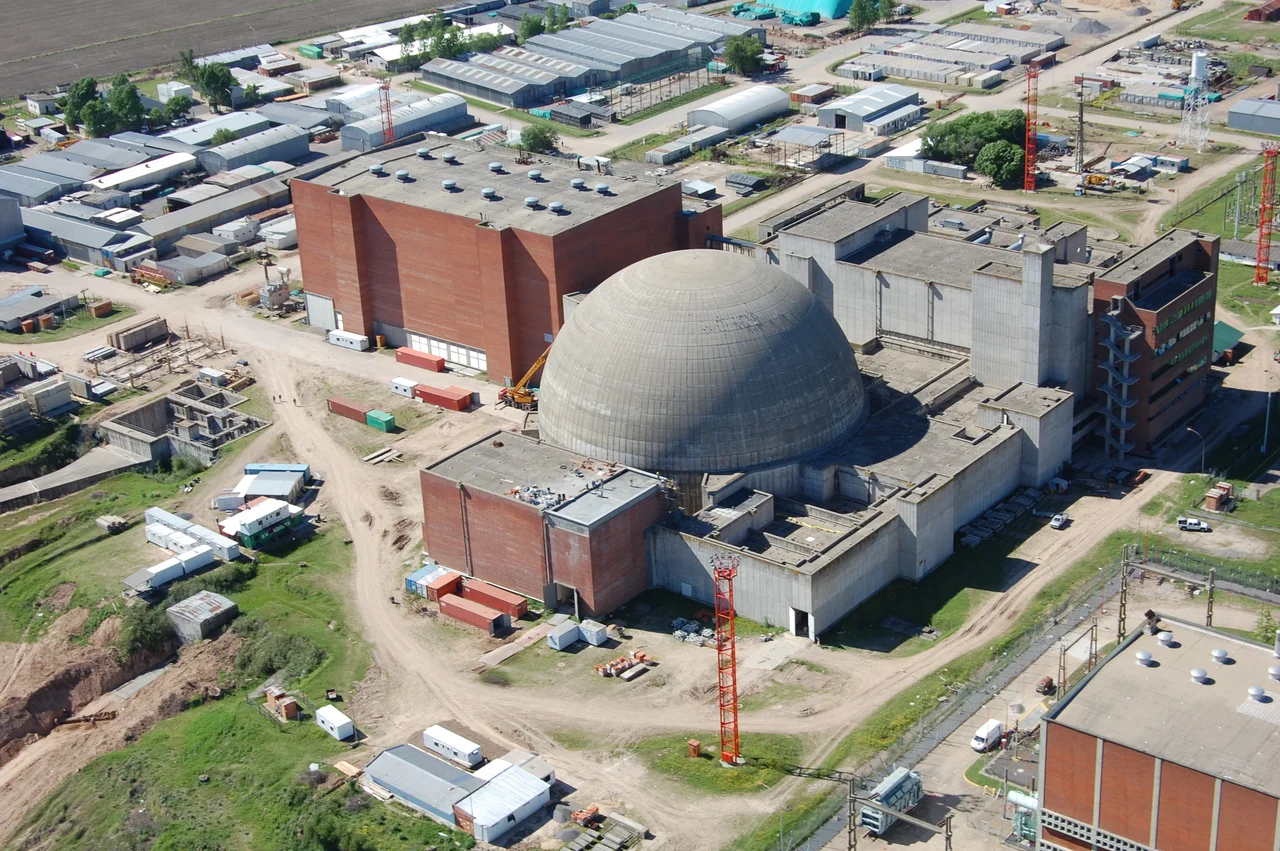

Atucha Nuclear Power Plant
In March 1973, the reactor was not yet finished when armed men walked into it. A guerrilla unit of Argentina's People's Revolutionary Army slipped into the half-built Atucha plant, seized a submachine gun and three pistols, then shot their way out past the police, wounding two officers. It was a bizarre overture for what would become a landmark of the atomic age: when Atucha I finally went online the following year, it was the first nuclear power plant to generate electricity anywhere in Latin America. The drama of its birth never quite matched the calm of the river it sits beside.
First in the Hemisphere
Construction began in 1968, and on the 19th of March 1974 Atucha I delivered its first power to the grid, with full commercial operation following that June. No other plant on the continent had done it. The reactor is an unusual machine even by nuclear standards: a German Siemens-KWU pressurized heavy-water design, cooled and moderated by heavy water and fueled by a mix of natural and slightly enriched uranium. When it was built, it held the largest reactor pressure vessel of any nuclear plant in the world. Modest in output by modern standards, it feeds about 362 megawatts into Argentina's grid, a small but steady contribution from a pioneer that has now run for half a century.
The Long Wait of Atucha II
Its sister reactor is a study in patience and frustration. Work on Atucha II began in 1981 under another Siemens contract, then stalled in 1994 as money and political will ran out. The half-finished plant sat for years, its components in storage, a monument to ambition deferred. Argentina's energy squeeze in the mid-2000s changed the calculation. President Néstor Kirchner signed a decree to revive it, budgets were rebuilt, and the reactor was symbolically restarted in 2011. It reached first criticality in June 2014 and, by February 2015, ran at full power for the first time. That single milestone lifted nuclear power from roughly 7 to 10 percent of Argentina's electricity mix.
A Rare Breed of Reactor
What makes Atucha genuinely unusual is its lineage. Almost every heavy-water reactor in the world descends from the Canadian CANDU family or its Indian cousins. Atucha's two reactors do not. They are among only a handful of heavy-water plants ever built to a different design, and Atucha II was the last nuclear power station Siemens completed before the company left the business. To stand near them is to stand beside an evolutionary dead end in reactor history, a branch of nuclear engineering that flourished briefly on this riverbank and almost nowhere else. Engineers from around the world still study these machines precisely because so few like them exist.
What Comes Next on the Paraná
The complex is not finished growing. In February 2022, Argentina signed a contract with the China National Nuclear Corporation for Atucha III, a Hualong One reactor expected to generate around 1,200 megawatts at a cost near eight billion dollars. It would be a break from the past in more ways than one: a light-water design, the country's first, requiring more highly enriched fuel and a different way of operating entirely. If built, it would outproduce the two older reactors combined. The river that once witnessed a guerrilla raid on an unfinished plant would then carry the cooling water for three generations of nuclear technology, lined up along the same shore.
From the Air
The Atucha complex sits at 33.97°S, 59.21°W, on the right bank of the Paraná de las Palmas River near Lima, in Zárate, about 100 km northwest of Buenos Aires. From the air it is easy to spot: the distinctive spherical containment dome of Atucha I and the larger structures of Atucha II stand out sharply against the flat green delta, with the wide braided channels of the Paraná snaking past. A viewing altitude of 5,000–7,000 ft AGL frames both the reactors and the river islands well. Note that airspace over nuclear facilities is often restricted; consult current NOTAMs before approaching. Nearest airports are San Fernando (SADF) and Buenos Aires–Ezeiza (SAEZ) to the southeast. Haze from the delta is common in humid weather.
Nearby Stories
- Battle of Vuelta de Obligado 18 km away
- Tigre 19 km away
- Basilica of Our Lady of Luján 34 km away
- Tigre, Buenos Aires 46 km away
- Ramallo Massacre 64 km away
- Frigorífico Anglo del Uruguay 79 km away
- Battle of the Tonelero Pass 84 km away
- Los Toldos 141 km away