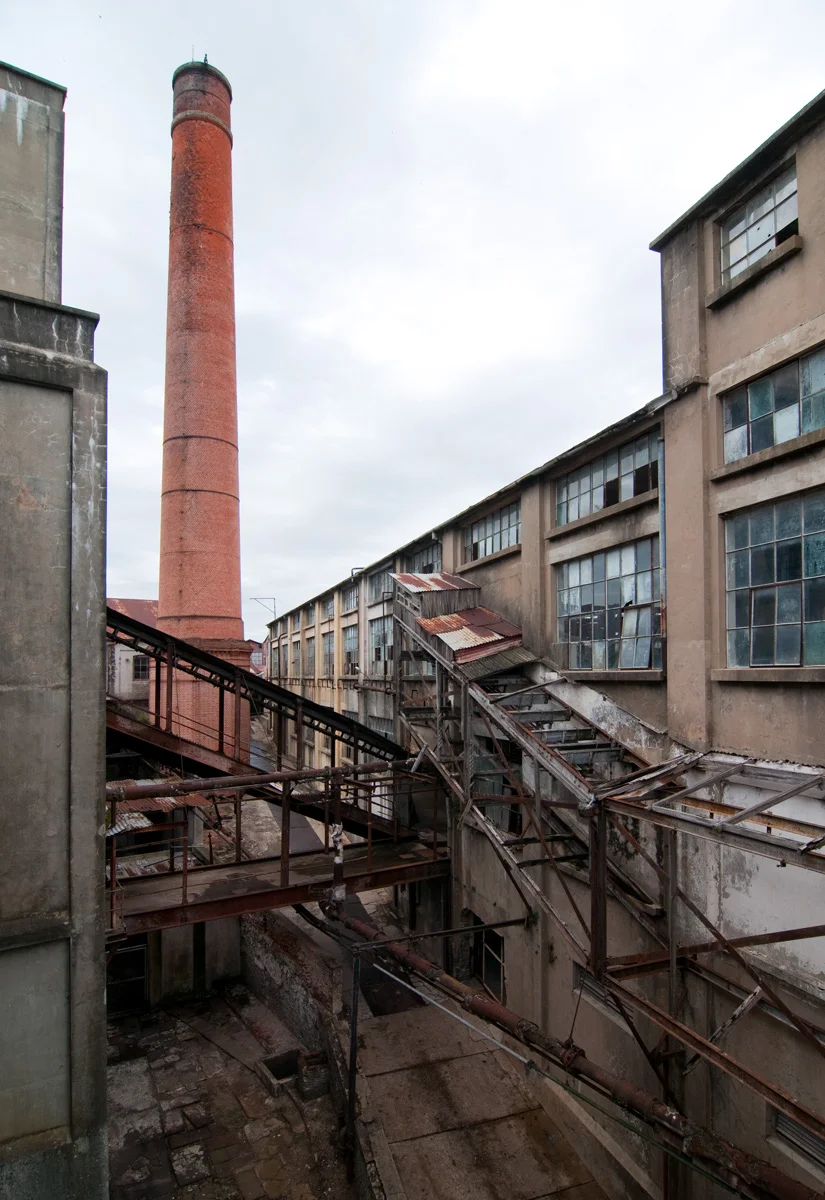

Frigorífico Anglo del Uruguay
Five thousand people once worked here, and on a busy day they processed four hundred cattle every hour. The Frigorífico Anglo del Uruguay rose on the bank of the Uruguay River at Fray Bentos, a sprawl of cooling halls, canning lines, and chimneys that turned the cattle of the South American grasslands into food for distant cities. The numbers from its peak are almost hard to believe: in 1943, with much of the world at war, the plant shipped over sixteen million cans of corned beef to Europe. For a generation of soldiers, this factory was dinner.
From Liebig to the Vestey Empire
El Anglo did not begin under that name. The works had been built decades earlier by the Liebig Extract of Meat Company, which boiled beef into a concentrated extract and sold tinned corned beef under the Fray Bentos label. In 1924 the British Vestey Group, a meat-trading dynasty with cattle and cold stores spread across several continents, bought the aging Liebig facilities and reopened them as the Frigorífico Anglo del Uruguay. The products kept the Fray Bentos name in European shops, but the scale changed. Refrigeration let the plant export not just extract and tinned meat but frozen and chilled beef, and the Vesteys had the ships and the markets to move it. The factory became one of the great industrial engines of the River Plate.
A City Within a City
A plant this large needed a workforce, and the workforce needed somewhere to live. Along the river's edge rose Barrio Anglo, a neighborhood of small brick houses with walls thick enough to hold off the summer heat. It was a self-contained world. There was a hospital and a school, a social club where people gathered after their shifts, and a football team that became a point of local pride. The people who filled these streets came from far away: English and Belgian managers and clerks, Russians, Spaniards, Italians, and Uruguayans who had traded rural poverty for the certainty of a factory wage. Tradition holds they came from around sixty countries in all. They were not statistics on a production sheet. They raised families in those brick houses, buried their dead in local ground, and built a community whose rhythms were set by the factory whistle.
The Work Itself
Inside, the labor was relentless and exact. The slaughtering, cooling, cooking, and canning ran as a single continuous system, and the boast was that nothing went to waste: every part of the animal found a use, from meat to tallow to hides. It was demanding, often grueling work, performed in cold, in noise, in the constant pressure of the line. Yet for the families of Barrio Anglo it was also dignity and stability, a place in the modern industrial world. The factory gave them identity as much as income. To have worked at El Anglo meant something, and the descendants of those workers still speak of it that way.
When the Whistle Stopped
Nothing about the boom was permanent. After the Second World War, Europe and the United States cut back their purchases of South American meat, and the orders that had sustained Fray Bentos thinned. The plant limped on, but the economics never recovered. In 1979 the Frigorífico Anglo del Uruguay closed for good, and the company town lost the reason it existed. The brick houses remained, the social club remained, but the line fell silent. Today the works are preserved as part of the Fray Bentos Industrial Landscape, recognized by UNESCO in 2015, where visitors walk through the old halls that once fed millions and try to imagine the heat, the noise, and the five thousand lives that filled them.
From the Air
The Frigorífico Anglo complex stands at roughly 33.13°S, 58.30°W on the eastern bank of the Uruguay River at Fray Bentos, Uruguay, directly opposite the Argentine shore. From altitude the site reads as a dense cluster of long industrial buildings and the grid of Barrio Anglo's workers' housing hugging the waterfront, with the Libertador General San Martín Bridge spanning the river just to the north toward Gualeguaychú. There is no commercial airport in Fray Bentos itself; the nearest options are Tydeo Larre Borges (SUPU) at Paysandú, about 90 km upriver to the north, and Gualeguaychú Airport (SAAG) across the river in Argentina. The flat river-plain terrain gives excellent long-range visibility; clear, dry conditions in the southern autumn and winter offer the best views of the riverbank works.
Nearby Stories
- Esteros de Farrapos 17 km away
- Cry of Asencio 42 km away
- Atucha Nuclear Power Plant 78 km away
- Nueva Helvecia 106 km away
- Battle of Vuelta de Obligado 114 km away
- Battle of Sarandí 138 km away
- Abadía del Niño Dios 140 km away
- Tacuarembó 204 km away