
Basilica of Our Lady of Luján
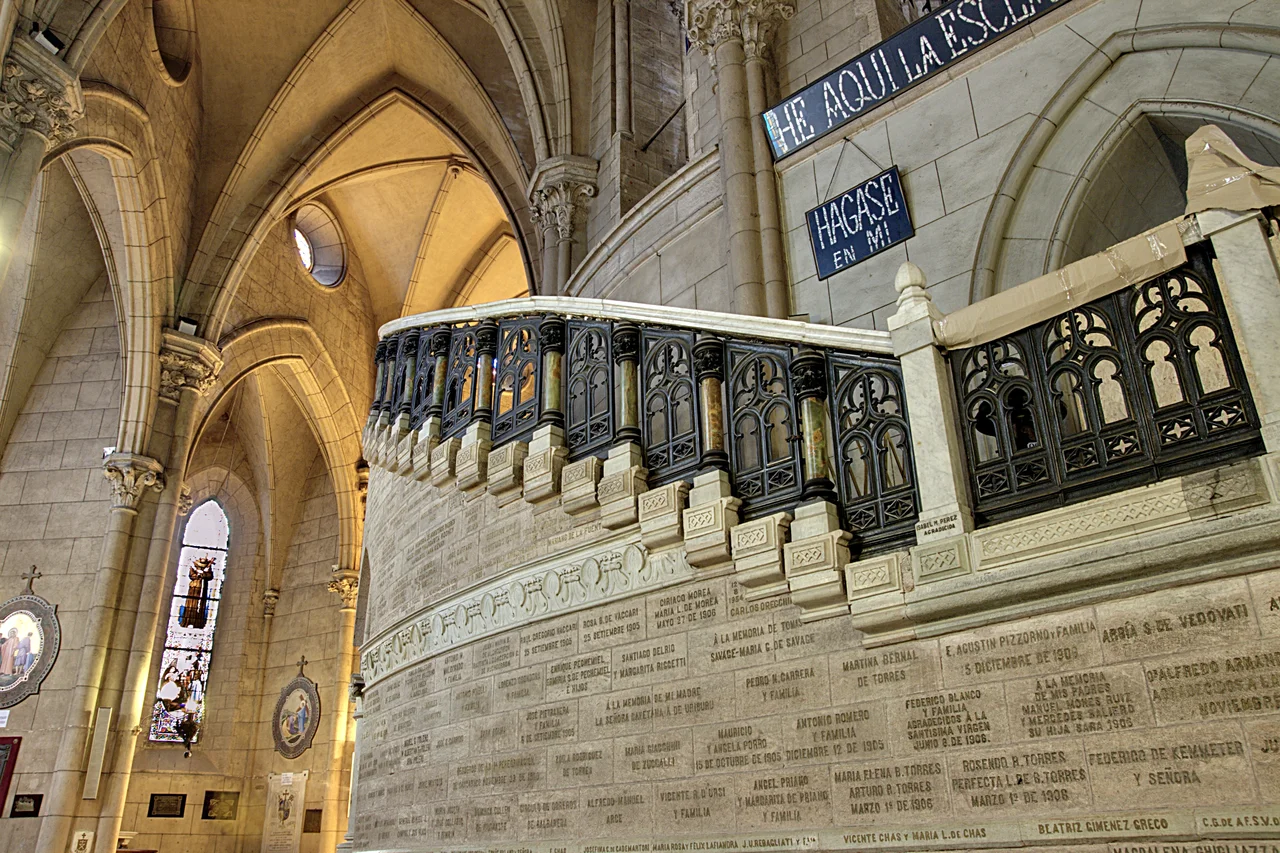
Twin towers of grey stone climb 106 meters above an absolutely flat plain, visible from far across the pampas long before you reach the town. The Basilica of Our Lady of Luján is one of the largest neogothic churches in the Americas, its copper roof and bronze doors built to overwhelm. And yet the entire colossus exists to house a single object the size of a forearm: a terracotta statue of the Virgin Mary, roughly thirty-eight centimeters tall, dressed in blue and white. The scale tells the whole story. Here, the small thing is the holy thing, and everything around it was raised to give that small thing a worthy home.
The Oxen That Would Not Move
The legend begins in 1630. A settler in distant Santiago del Estero had ordered a terracotta image of the Immaculate Conception, made in Brazil, to anchor a new shrine. The crate carrying it traveled by oxcart up from the port of Buenos Aires. At a riverside estate near present-day Luján, the caravan stopped for the night - and the next morning the oxen refused to move. The drivers unloaded the cargo piece by piece, and only when they removed the box holding the little Virgin did the animals walk on. The faithful read the message plainly: the image wished to remain. A simple hermitage rose on the spot, and the great basilica is its distant, towering descendant.
The Man Who Kept the Image
The most faithful guardian of the early shrine was a young enslaved African named Manuel - El Negro Manuel, as history records him - who had traveled with the caravan. The word 'enslaved' must not be softened: he was a man held in bondage, who possessed his own dignity and his own faith regardless of the chains the era placed on him. By tradition he was entrusted with the care of the image, tending its hermitage and its garments and guiding the prayers of the pilgrims who came, until his death in 1686. For more than half a century, the holiest object in what would become Argentina was kept by a man the colonial world refused to count as free. The shrine remembers him; the country that grew around it owes him a debt it rarely names.
A Cathedral Raised by Hand
The basilica that stands today was begun in 1889 and not completed until the 1930s - more than four decades of labor on the open plain. The French architect Ulderico Courtois designed it in soaring Gothic Revival style, all pointed arches and vaulting stone, a piece of medieval Europe transplanted to the South American grassland. In 1930 Pope Pius XI formally proclaimed Our Lady of Luján the patron saint of Argentina, Paraguay, and Uruguay, binding three nations to this one spot. The structure is deliberately, almost defiantly grand - a statement that the humble image at its heart deserved nothing less than the most ambitious building the young republic could raise.
Where a Nation Comes to Walk
More than six million pilgrims come to Luján every year, and the basilica is the largest stage on which Argentina performs its faith. The most extraordinary moment arrives on the first Sunday of October, when roughly a million young people walk the entire sixty-eight kilometers from Buenos Aires, filling the highways through the night to arrive at the towers by dawn. They come for many reasons - devotion, gratitude, grief, a promise made in hard times - and not all of them believe. But they walk, together, toward the same small figure in blue and white that, the story says, once chose this place and refused to leave. Few buildings anywhere hold a country's longing so completely as this one on the flat Luján plain.
From the Air
The basilica stands in the city of Luján at 34.56°S, 59.12°W, about 68 km west-northwest of central Buenos Aires. Its twin neogothic spires rise 106 meters and dominate the otherwise flat pampas skyline - by far the most conspicuous landmark for many kilometers, easily picked out from altitude. The Río Luján winds nearby. The nearest major airports are Buenos Aires Ezeiza (SAEZ) to the southeast and Aeroparque Jorge Newbery (SABE) on the city waterfront. The terrain is uniformly flat farmland, giving the towers exceptional visibility in clear weather; on the first Sunday of October, the highways from Buenos Aires toward Luján are visibly thronged with the annual youth pilgrimage on foot.
Nearby Stories
- Battle of Caseros 11 km away
- Ezeiza Massacre 16 km away
- San Antonio de Areco 21 km away
- Martín García Island 44 km away
- Lobos 44 km away
- Battle of Vuelta de Obligado 76 km away
- Los Toldos 118 km away
- Ramallo Massacre 119 km away