
Ezeiza Massacre
They came to celebrate, not to die. On 20 June 1973, by the police count, some three and a half million people streamed toward the highway near Ezeiza airport to greet Juan Perón, returning at last from eighteen years of exile in Spain. Families brought children. The young carried banners. Many had waited their whole adult lives for this moment. And then, from the speaker's platform itself, gunfire raked the crowd. The people who fell that day at the intersection called Puente 12 were not soldiers. They were celebrants, and the men who shot them belonged, nominally, to the same movement they had come to honor.
A Movement at War With Itself
To understand the killing, you have to understand the strange coalition Perón had built. From exile he had blessed both wings of his movement at once: young left-wing Peronists, including the Montoneros and the Peronist Youth, whose icons were closer to Che Guevara than to any general, and a hardened right wing of union bosses, nationalists, and figures like José López Rega, his secretary, who would later found the murderous Triple A death squad. For years Perón had let each side believe he was theirs. As his plane crossed the Atlantic that day, the question both factions had buried for a decade rose to the surface: when the old man finally chose, who would he choose?
Puente 12
The right wing did not wait to find out. The reviewing stand near Puente 12, where the airport access road meets the Camino de Cintura, had been organized by Lieutenant-Colonel Jorge Osinde and other figures of Peronism's hard right. From positions around that platform, armed men opened fire on the columns of left-wing youth gathered below, trapping them in the open. At least thirteen people were identified among the dead, and 365 were wounded; the newspaper Clarín and many witnesses believed the true toll was far higher, but no official investigation ever counted them. Perón's plane was diverted and never landed at Ezeiza. The homecoming he had dreamed of became a name for slaughter.
The People in the Crowd
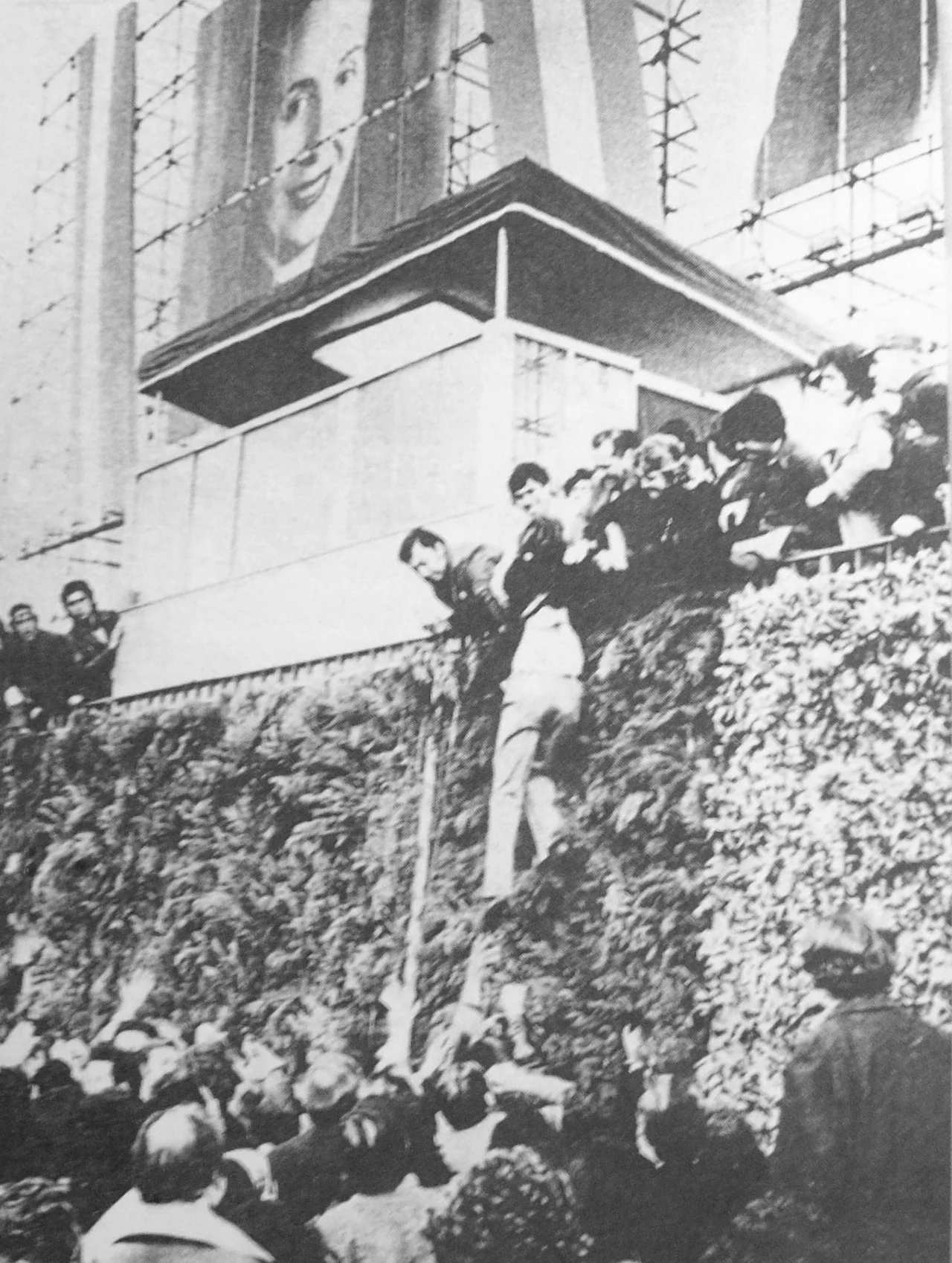
It is easy, fifty years on, to reduce that day to its factions, its acronyms, its conspiracies, and there were conspiracies enough; even the Italian neo-fascist Stefano Delle Chiaie was reportedly present, threads later pulled by investigators including the Spanish judge Baltasar Garzón. But the dead were not abstractions. They were Argentines who had ridden buses for hours and slept by the roadside, who believed that a better country was arriving on an airplane. Most were young. Some were carried away by strangers as they bled. A photograph survives of one fallen victim being lifted from the ground, and in it the whole euphoria of the morning collapses into a single human weight in other people's arms.
What the Day Began
Historians treat the Ezeiza massacre as a hinge in Argentine history. If the great Peronist rally of October 1945 marked the movement's birth, one historian wrote, then 20 June 1973 marked the arrival of its violent right wing as a force that would shape everything after. Within months the left was driven out of the government, López Rega's Triple A was hunting opponents, and the country was sliding toward the 1976 coup and the years of state terror that followed. The killing at Ezeiza was not the Dirty War, but it was a rehearsal for its logic: that fellow citizens could be marked as enemies and cut down, and that no one would be made to answer.
From the Air
The Ezeiza massacre took place at Puente 12, near the intersection of the General Ricchieri freeway and the Camino de Cintura, about 10 km from Ezeiza / Ministro Pistarini International Airport, southwest of Buenos Aires, at approximately 34.82°S, 58.54°W. Recommended viewing altitude is 2,000 to 4,000 feet AGL to take in the freeway interchanges and the sprawl of greater Buenos Aires fanning out toward the city center to the northeast. Visual landmarks: the runways and terminals of Ezeiza airport itself just to the southwest, and the dense grid of the capital beyond. Nearest airports are Ezeiza / Ministro Pistarini International (ICAO: SAEZ) immediately adjacent, and Buenos Aires Aeroparque Jorge Newbery (ICAO: SABE) about 30 km to the northeast on the riverfront. Visibility over the metro area is often reduced by urban haze; mornings after rain are clearest.
Nearby Stories
- Lobos 4.5 km away
- Cathedral of La Plata 5.8 km away
- Luján, Buenos Aires 7.6 km away
- Battle of Caseros 7.6 km away
- Colonia del Sacramento 23 km away
- Basilica of Our Lady of Luján 37 km away
- Chascomús 67 km away
- Tronador (rocket) 85 km away