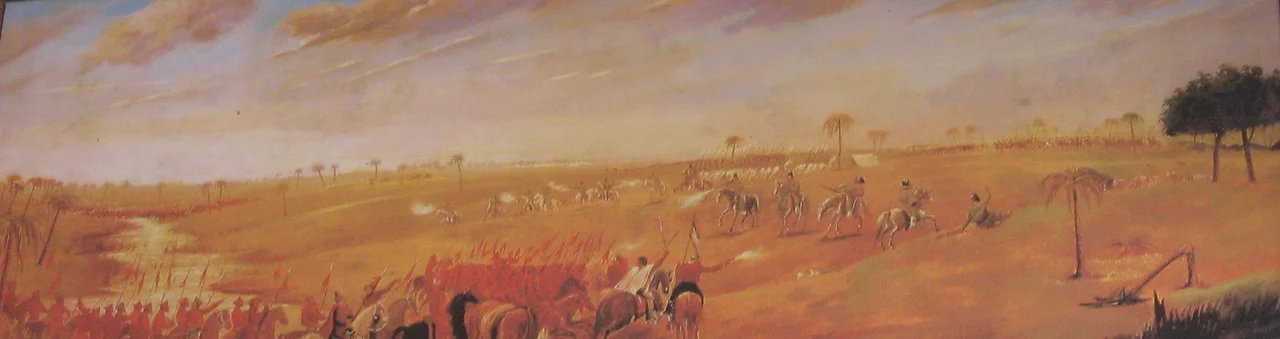

Battle of Caseros
For more than twenty years, Juan Manuel de Rosas had governed the Argentine Confederation as its most powerful man. On the morning of 3 February 1852, on flat farmland near a circular brick dovecote called El Palomar, that long dominance ended in roughly six hours. An aging administrator far more comfortable behind a desk than on a battlefield, Rosas had insisted on taking personal command of his army. He chose no clever ground, scouted no terrain, and simply waited for the enemy to come to him. They came in overwhelming numbers — and by midday the man who had ruled a generation was fleeing toward a British warship.
A Republic at War With Itself
From 1814 onward, the young Argentine nation had torn at itself over a single unresolved question: what shape its government should take. The civil wars that followed pitted province against province and caudillo against caudillo for decades. Rosas had mastered that chaos, ruling from Buenos Aires and pressing his ally Manuel Oribe to besiege Montevideo across the river. But when Rosas moved to choke off the city's trade, he angered the men who depended on it — chief among them Justo José de Urquiza, governor of Entre Ríos, who suspected that Rosas's endless talk of war was merely a way to delay writing a constitution the country badly needed.
The Pronouncement
Urquiza chose his moment carefully. From Concepción del Uruguay he issued a public statement — his Pronunciamiento — demanding that Rosas step down, and began gathering horsemen by the thousand. He struck a treaty with the Empire of Brazil, which feared Rosas's grip on the river, and with the Montevideo government. First the alliance drove Oribe out of Uruguay, where the old commander chose negotiation over bloodshed and withdrew without a fight. Then the allies turned their full attention to Rosas himself. Urquiza crossed Morón creek and positioned his Grand Army — the Ejército Grande — on the plains west of the capital, near the lands of a ranching family named Caseros.
Two Armies on the Plain
Rosas fielded some 10,000 infantry, 12,000 cavalry, and 60 guns, but morale was failing and desertion had already thinned his ranks before a shot was fired. His most capable general, Ángel Pacheco, had resigned in frustration at Rosas's meddling. Against them stood Urquiza's force of 24,000 — among them 3,500 Brazilians and 1,500 Uruguayans, and in its ranks two men who would one day be presidents of Argentina, Bartolomé Mitre and Domingo Faustino Sarmiento. Many of Urquiza's soldiers were gauchos rather than trained troops, hard horsemen of the open country. The two sides met near the Caseros ranch, on ground now occupied by the National Military College.
Six Hours and a Surrender
The fighting lasted about six hours. When Rosas's defenders finally ran low on ammunition, the Brazilian lines pushed forward and took the high ground, and the battle was decided. Roughly 2,000 men fell that day, some 1,500 of them from Rosas's army, with another 7,000 captured. By the grim arithmetic of nineteenth-century war it was, remarkably, not a slaughter — only about four percent of those who fought were killed or wounded. But the dead were real men, gauchos and conscripts and officers alike, left on a quiet stretch of farmland. Wounded in the hand, Rosas wrote a brief note of resignation, then boarded the British ship Centaur, protected by the British consul, and sailed into exile in England.
The Reckoning and the Constitution
Victory did not come gently to Buenos Aires. Word of the defeat reached the city by late morning, and as authority collapsed, looters moved through the streets for more than a day. The aftermath turned vengeful: members of Rosas's feared enforcement squad, the Mazorca, were tried and executed, and the surviving soldiers of one mutinous regiment were shot without trial. Yet from this hard turn came something lasting. Urquiza, now preeminent, gathered the fractured provinces under the San Nicolás Agreement, which called for the assembly that produced the Argentine Constitution of 1853 — the foundation of the country's law to this day. The civil wars would not fully end until 1880, but Caseros had set the nation on a new course.
From the Air
The battlefield lies on the western edge of Greater Buenos Aires near El Palomar, at roughly 34.60°S, 58.61°W — today the grounds of the Colegio Militar de la Nación (National Military College), between the Caseros and Palomar railway stations. From the air the site reads as institutional green and parade ground amid dense suburban sprawl; the historic circular dovecote that gave El Palomar its name still stands. El Palomar Airport (ICAO: SADP) is immediately adjacent, less than 2 km away. Aeroparque Jorge Newbery (ICAO: SABE) sits about 17 km east toward the river, and Ministro Pistarini International (Ezeiza, ICAO: SAEZ) roughly 20 km south. Low haze is common over the flat plains; a clear morning offers the best view of how little high ground the terrain ever offered either army.
Nearby Stories
- Ezeiza Massacre 1.9 km away
- Luján, Buenos Aires 5.1 km away
- Curutchet House 13 km away
- Colonia del Sacramento 17 km away
- Martín García Island 28 km away
- Atucha Nuclear Power Plant 37 km away
- Lobos 43 km away
- Cry of Asencio 87 km away