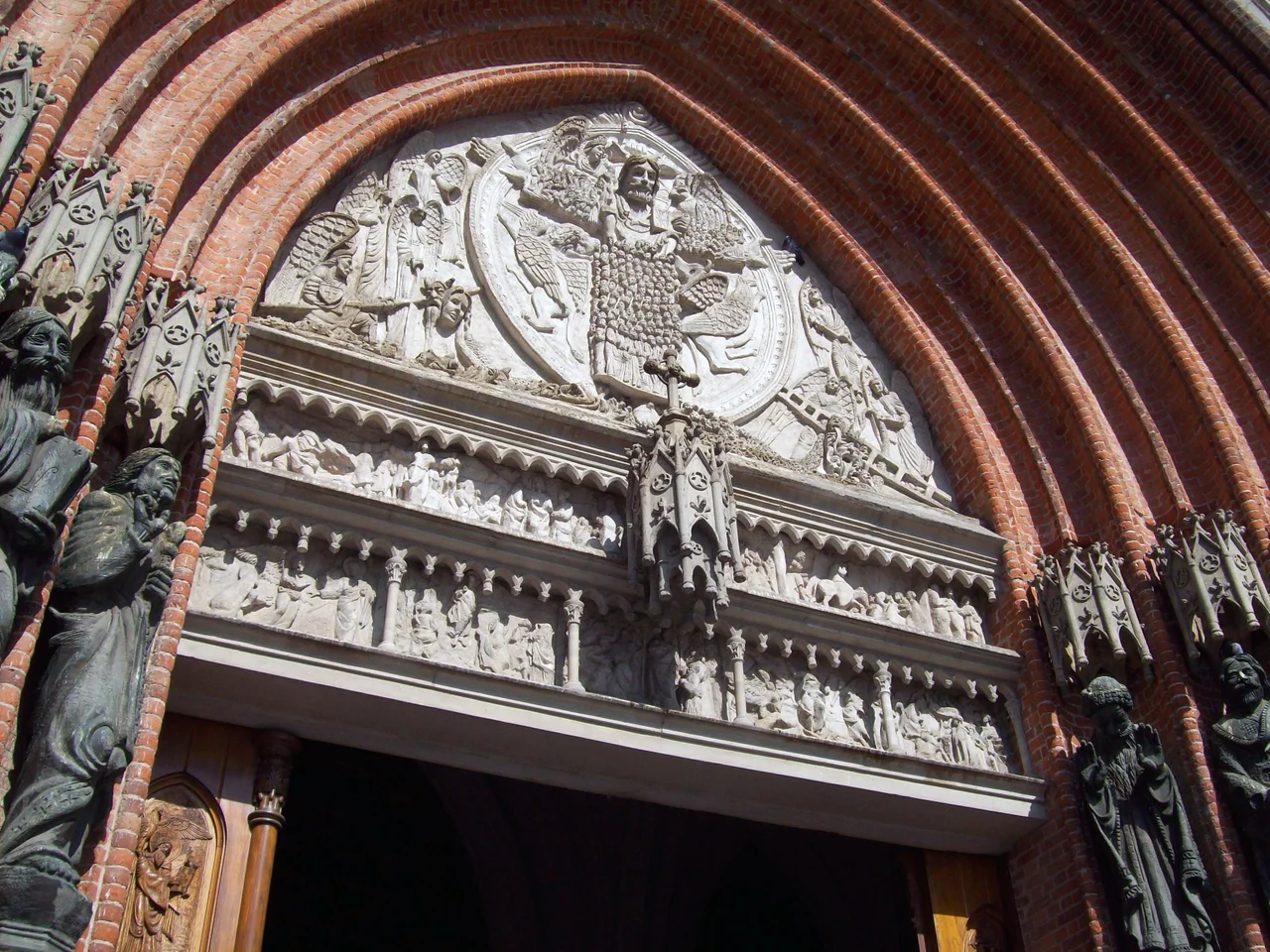

Cathedral of La Plata
For most of the twentieth century, this enormous church stood unfinished, its twin towers stopping abruptly in mid-air, its raw brick exterior never given the stone dressing the architects intended. The builders had lost their nerve. They feared the foundation could never bear the colossal weight the design demanded, and so in the 1930s they simply stopped. It would take until the year 2000, more than a century after the first stone was laid, for the Cathedral of La Plata to finally rise to its full height: two towers reaching 112 meters, among the tallest of any church in the Americas, crowning the geographic heart of one of the world's great planned cities.
A Cathedral for a City Drawn from Scratch
La Plata is not an ordinary city. It was conceived in the 1880s as the capital of Buenos Aires Province, laid out on a perfect grid with diagonal avenues slashing across it and its grandest monuments placed by deliberate design. The cathedral was meant to anchor it. It rises at the city's exact geographic center, facing the central Plaza Moreno and, across the square, the City Hall, the two powers of church and state staring at each other over an expanse of open ground. The cornerstone went down in 1884, the same era the city itself was being measured out, so that the cathedral and La Plata were, in a sense, born together.
Amiens and Cologne, Rebuilt in the Pampas
The men who designed it looked to Europe's medieval masterpieces. The plans, drawn by architect Ernesto Meyer under the direction of the city's planner, the engineer Pedro Benoit, with the architect Emilio Coutaret collaborating, took their inspiration from the Gothic cathedrals of Amiens in France and Cologne in Germany. The result is pure Gothic Revival, soaring and pointed and intricate, a thirteenth-century European silhouette transplanted to the flat Argentine plain. It was consecrated as a parish church in 1902 under the name Nuestra Señora de los Dolores, and elevated to the rank of cathedral in 1932, even as the work above it remained stubbornly incomplete. The scale is hard to overstate. The building runs some 120 meters long and 76 meters wide, with room inside for thousands of worshippers, making it one of the largest churches anywhere in Latin America.
The Foundation That Almost Defeated It
The fear that halted construction was not unreasonable. A church this immense is a staggering load to place on the earth, and the builders doubted the ground beneath could hold it. For decades the cathedral waited, towers truncated, brickwork bare. Then, in the mid-1990s, an ambitious campaign finally tackled the problem head-on. Engineers strengthened the foundation, repaired the damaged brick and joints, and completed what had been abandoned: two full spires, six turrets, two hundred pinnacles, and eight hundred slender needles, all topped off with a carillon of twenty-five bells. The two great towers finally reached their full height and gained their names, the Tower of Jesus and the Tower of Mary, standing guard over the plaza below. In 2000, the finished cathedral was at last opened to the public, a century-long project brought to its conclusion.
The Beauty of Bare Brick
When the restoration was done, a choice remained: dress the exterior in stone as originally planned, or leave the brick exposed. They left it bare, and it transformed the building's character. Most Gothic Revival churches hide their structure behind carved stone, but here the warm red brick stands frankly visible, giving La Plata's cathedral the look of the brick Gothic churches of northern Europe rather than the limestone cathedrals of France. It now resembles distant cousins like Uppsala Cathedral in Sweden, Roskilde in Denmark, and Helsinki's St. John's Church. With its towers rising some 367 feet, it remains among the six tallest churches in the Americas, a Northern European spirit raised, improbably and magnificently, beneath the South American sky.
From the Air
The Cathedral of La Plata stands at 34.923°S, 57.956°W, at the precise geographic center of La Plata, capital of Buenos Aires Province, about 55 km southeast of the city of Buenos Aires. Its twin towers reach roughly 112 meters (367 ft), making it the dominant vertical landmark on an otherwise flat coastal plain and easily visible against La Plata's distinctive grid-and-diagonal street pattern; it faces the green rectangle of Plaza Moreno. Best viewed at lower to medium altitudes in clear weather. The nearest airport is La Plata Airport (SADL), roughly 5 km to the northwest; Ezeiza International (SAEZ) lies about 40 km to the northwest.
Nearby Stories
- Lezama Park 1 km away
- Colonia del Sacramento 18 km away
- Ezeiza Massacre 18 km away
- Nueva Helvecia 38 km away
- Tronador (rocket) 42 km away
- Chascomús 49 km away
- Lobos 67 km away
- German cruiser Admiral Graf Spee 92 km away