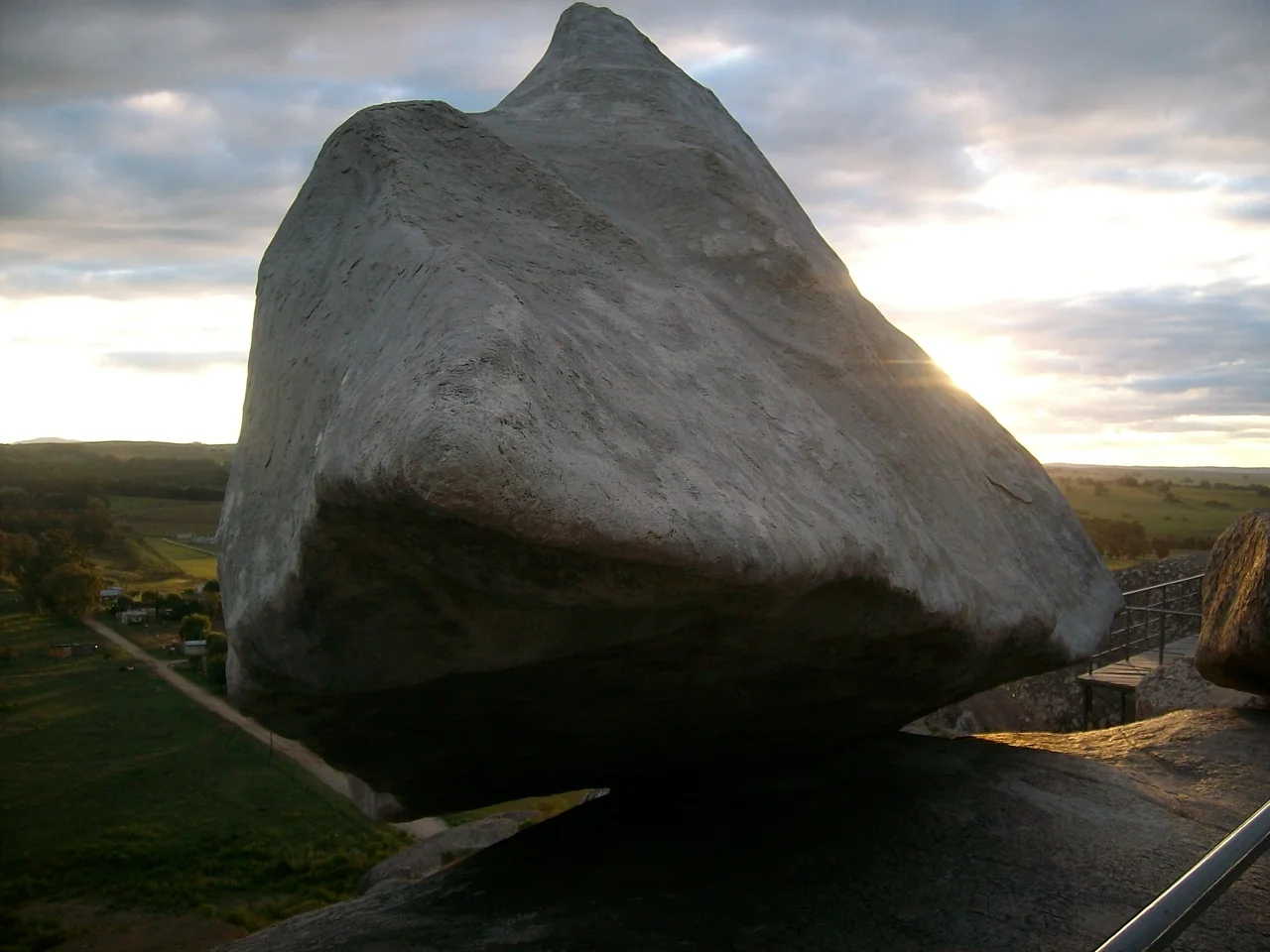

Piedra Movediza
Visitors used to wedge an empty bottle under the base of the rock and walk away. Hours later they would come back to find it in shards. Nothing they could see had moved. The 300-ton boulder above Tandil still sat exactly where it had sat for centuries, balanced on a contact point no wider than a fist, and yet the glass beneath it lay crushed - proof that the stone breathed in some slow rhythm too patient for the human eye. They called it La Piedra Movediza, the Moving Stone, and for a generation it was the strangest tourist attraction in Argentina.
A Stone That Should Have Fallen
The granite of the Tandilia hills is among the oldest rock on the planet, a crystalline basement laid down when the region's ridges first cooled roughly 2.3 billion years ago. As that ancient stone weathered, it shed enormous rounded blocks - and one of them came to rest near the crest of La Movediza hill in a configuration that defied common sense. A rounded vertex met a small point of contact, and there the boulder stayed, leaning out over the slope as though caught mid-tumble. It rocked imperceptibly through the day, settling and shifting with temperature, wind, and the faint flexing of the earth. To stand beneath it was to feel the pleasant terror of something enormous held in suspension, a 300-ton weight that the laws of physics seemed to have simply forgotten to bring down.
The Afternoon It Let Go
On 29 February 1912, sometime between five and six in the evening, the Moving Stone finally moved for the last time. It toppled from its perch and shattered into pieces at the foot of the hill. No one ever issued an official cause. One theory blamed quarrymen, irritated by the tourists the rock kept drawing to their worksite. Another pointed to the blasting in the nearby quarries, whose vibrations may have nudged the boulder past its tipping point. The manager's wife claimed she had seen a group of people rocking the stone that very afternoon. A lightning strike back in 1848 had already flaked away part of its mass, leaving it that much more fragile. Whatever the trigger, a town woke the next morning to find that its quiet miracle was gone.
Naming a City After a Rock
The loss cut deep because the stone was more than a curiosity - it was the city's namesake. Tandil is widely thought to come from the Mapuche words tan, falling, and lil, rock: the falling rock, named for the very boulder that would one day fulfill the prophecy in its own name. For years the broken segments lay where they had landed while proposals to re-cement them came and went, and none was ever agreed upon. The townspeople kept the empty silhouette in their memory the way you remember a missing tooth, an absence with a shape.
The Replica on the Hill
In May 2007 the silhouette returned. Engineering students built a faithful copy of the Moving Stone and set it back on the original spot, founding a site now called Parque Litico La Movediza. The replica is honest about what it is: cemented firmly into the supporting rock, it does not teeter, does not breathe, will smash no bottles. It is a monument to a thing that could not last, standing in the exact place the real one stood, and it has become the single greatest symbol of the city of Tandil. From the hill the view spreads across the humid pampas toward Tandil's rooftops, and the nearby spire of El Centinela - a separate 7-meter granite finger weighing some 72 tons - still leans against the sky, a reminder that this landscape has always specialized in stone caught in the act of almost falling.
From the Air
La Piedra Movediza sits at 37.31 S, 59.17 W on La Movediza hill, on the northwestern edge of Tandil in the Tandilia hills of Buenos Aires Province. From the air the city reads as an urban grid set against low, rounded granite ridges that rise abruptly from the otherwise flat humid pampas - a rare relief feature in an ocean of farmland, and the easiest way to fix Tandil visually. Tandil Airport (ICAO: SAZT) lies just south of the city. A relaxed viewing altitude of 2,500-4,000 feet AGL keeps both the hills and the urban grid in frame; the Pampas are prone to fog and low frosts in autumn and winter, so clear, dry days give the best look at the ridgelines. Mar del Plata (SAZM) is about 160 km to the southeast, and Buenos Aires Ezeiza (SAEZ) roughly 360 km to the north-northeast.
Nearby Stories
- Yellow Fever in Buenos Aires 23 km away
- Museo Juan Manuel Fangio 48 km away
- Azul 64 km away
- Tres Arroyos 94 km away
- Aerolíneas Argentinas Flight 644 99 km away
- Austral Líneas Aéreas Flight 205 120 km away
- Casa del Puente 153 km away
- Chascomús 180 km away