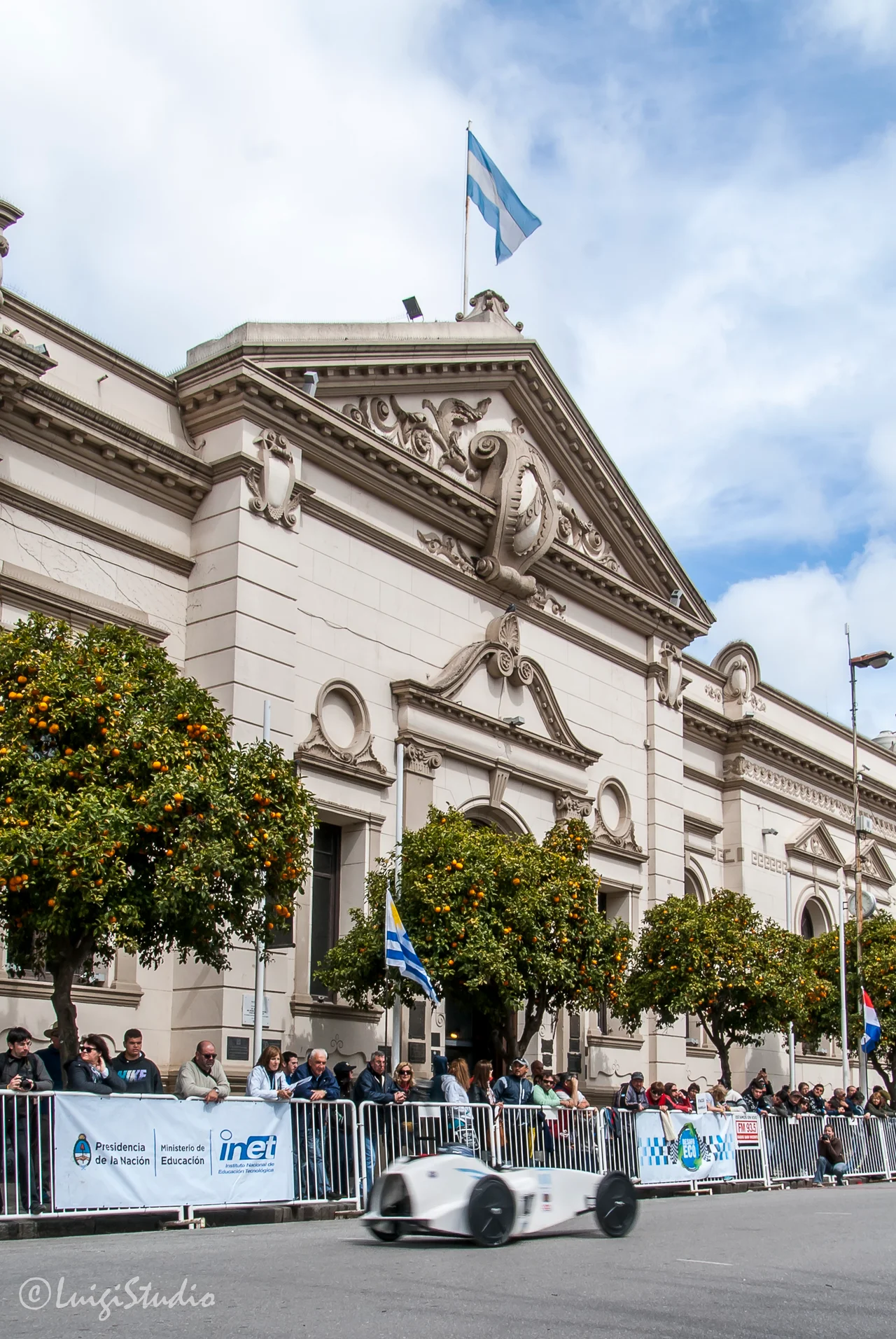

Museo Juan Manuel Fangio
The boys called him el Chueco, the bandy-legged one, for the way he bent his left leg around a football to score. Decades later, the whole world would learn a different name for him: el Maestro. Juan Manuel Fangio was born in 1911 in Balcarce, a quiet farming town in the rolling green country south of Buenos Aires, and it was here, just a few blocks from the modest house where he grew up, that Argentina built a temple to its most beloved son. The museum that bears his name opened in 1986, and Fangio himself walked through the doors on opening day to see it.
The Mechanic Who Became a Maestro
Fangio learned engines before he learned to win. As a boy he swept floors and turned wrenches in a Balcarce garage, and the feel for machinery he developed there never left him. He came late to the world stage, already in his late thirties when Formula One held its first championship in 1950. Then he simply dominated it. Between 1951 and 1957 he won the drivers' title five times, and he did it driving for four different teams: Alfa Romeo, Maserati, Mercedes-Benz, and Ferrari. No driver before or since has matched that spread. His record of five championships would stand for forty-six years, until Michael Schumacher finally surpassed it in 2003. Of the fifty-two Grands Prix Fangio entered, he won twenty-four. He started from pole nearly as often. The numbers still look impossible.
A Cathedral of Curves and Chrome
The museum occupies the old town hall, repurposed across six levels and some 4,600 square meters, and it holds more than fifty cars. Walk the ramps and the history of motor racing unspools beside you. There is the silver Mercedes-Benz W196, the open-wheel weapon Fangio drove to two of his titles, its bodywork smooth as a bullet. Nearby sits the dark-red Maserati 250F, the car many call the most beautiful Grand Prix machine ever made and the one he wrestled to victory at his legendary 1957 German Grand Prix. Lancia-Ferraris, a Sauber-Mercedes sports prototype, a McLaren, an Alfa Romeo 308: each level is a different chapter, the trophies and faded photographs filling the spaces between.
The Pilgrims Who Came to Pay Respects
What sets this place apart is who has stood in its rooms. The guest book reads like a roll call of the sport's aristocracy. Stirling Moss, Fangio's teammate and rival, who famously refused to overtake him at one race out of sheer respect. Sir Jackie Stewart and Phil Hill, both world champions in their own right. Carroll Shelby, the Texan who would go on to build the Cobra and humble Ferrari at Le Mans. Italy's Luigi Villoresi and Clay Regazzoni, and Argentina's own José Froilán González and Carlos Reutemann. They came not to a corporate showroom but to a farming town, because this is where the Maestro belonged.
The Greatest Drive, and a Long Goodbye
If one race explains the reverence, it is the German Grand Prix at the Nürburgring in 1957. A botched pit stop dropped Fangio far behind the two leading Ferraris, and he was already forty-six years old, the season's elder by a generation. He did not settle for the podium. Lap after lap he hauled the Maserati back, shattering the circuit's lap record again and again, and caught both Ferraris in the closing miles to win. Many call it the finest drive in the history of the sport. He retired the next year having won his five titles, then served as honorary president of Mercedes-Benz Argentina from 1987 until his death in 1995. The pilgrimage to Balcarce has not stopped since.
Balcarce Beneath the Sierras
Strip away the racing legend and Balcarce is still worth the drive. The town sits on the inland flank of the Sierra de los Padres, low blue hills that rise from the Pampas like an afterthought, and the surrounding fields make it one of Argentina's great potato regions. The light here is wide and clean, the horizon nearly unbroken. It is easy to understand how a boy raised among these horizons might grow up unhurried, patient, attuned to the long game. Fangio raced the way Balcarce farms: with care, with timing, and with an almost stubborn refusal to throw away what could be won by waiting.
From the Air
The Museo Juan Manuel Fangio sits in central Balcarce at approximately 37.85°S, 58.25°W, on the inland side of the Sierra de los Padres roughly 60 km northwest of the Atlantic coast. From the air the town is a tidy grid of streets set against the low blue ridgeline, with the green-and-tan patchwork of potato fields spreading out across the Pampas in every direction. The nearest major field is Mar del Plata's Astor Piazzolla International Airport (ICAO: SAZM), about 65 km southeast on the coast; the small Villa Gesell Airport (ICAO: SAZV) lies to the northeast. Recommended viewing altitude is 3,000 to 5,000 feet AGL for a clear read of the town against the sierras. Visibility is typically excellent over the open Pampas, though coastal fog can drift inland on humid summer mornings.
Nearby Stories
- Austral Líneas Aéreas Flight 205 9.8 km away
- Tandil 50 km away
- Murder of Fernando Báez Sosa 72 km away
- Piedra Movediza 75 km away
- Villa Gesell 115 km away
- Tres Arroyos 138 km away
- Monte Hermoso 286 km away
- HMS Sheffield (D80) 1660 km away