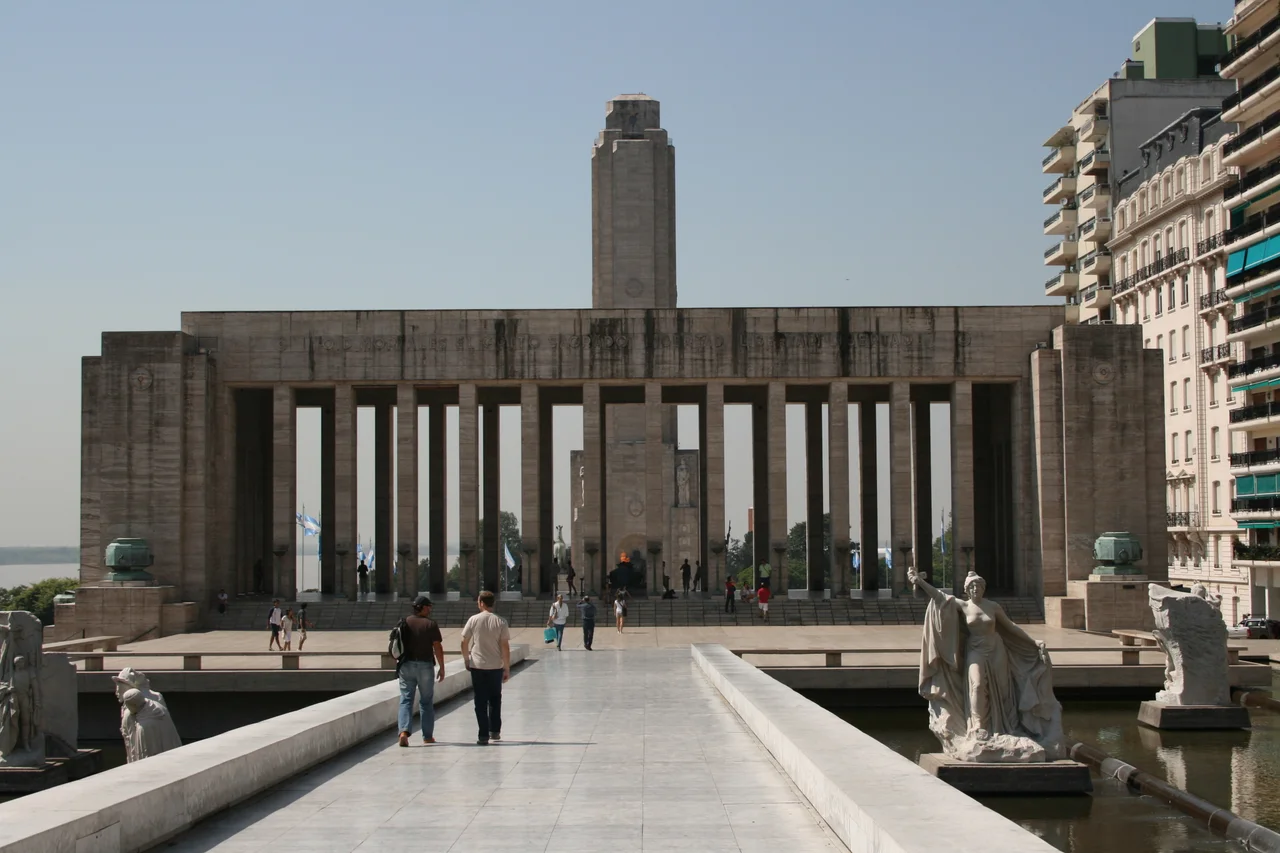

National Flag Memorial
On February 27, 1812, on the bank of the Paraná River, an Argentine general named Manuel Belgrano ran a flag of light blue and white up a pole for the very first time. The country it would one day represent did not yet exist; independence was still four years away, and the colors were his own invention, taken from the national cockade. Today a vast monument of pale Andean stone rises from that riverside in Rosario, a 70-meter tower climbing over the Paraná like the prow of a ship. It is the National Flag Memorial, and it marks not only where a flag was born, but where the man who made it finally came home.
A Ship of Stone
The memorial is built like a vessel setting out onto the river, and it is enormous, covering roughly ten thousand square meters, raised largely from stone hauled across the country from the Andes. Construction began in 1943 and stretched on for years; the complex was finally inaugurated on June 20, 1957. It has three movements, like a piece of music. The Tower, seventy meters tall, honors the May Revolution of 1810 that set independence in motion. The Civic Courtyard, a great open space used for mass gatherings, stands for the hard work of building a state. And the Triumphal Propylaeum represents the nation as it was finally organized under the Constitution of 1853. Beneath it, a hall of honor displays the flags of every nation of the Americas.
The Oath Passage
You can reach the monument by way of a pedestrian walk with a resonant name: the Pasaje Juramento, the Oath Passage. It begins downtown, between the city hall and the cathedral, on the Plaza 25 de Mayo, and runs toward the river and the propylaeum. Lining it are statues by Lola Mora, the pioneering Argentine sculptor from Tucumán who broke into a male-dominated art world at the turn of the twentieth century, her allegorical figures of Liberty, Victory, and the Mother giving the passage the weight of ceremony. To walk it is to retrace, symbolically, the path from an ordinary city square to the sacred ground where a country first declared itself in cloth and color.
The Crypt in the Tower
There is a grave at the base of the tower, and whose it is gives the whole monument its ache. Manuel Belgrano died on June 20, 1820, at the age of fifty, of dropsy, ignored and impoverished. He had given his fortune to the war of independence and received almost nothing back; the government owed him years of unpaid salary and never answered his pleas. Too poor to pay his doctor in cash, he settled the bill with his watch. His funeral was small and silent, and his death passed almost unnoticed in the press of the day. The country he helped invent barely paused to mourn him. The memorial was inaugurated on the anniversary of that lonely death, and his crypt rests in the tower's base. The nation that forgot him in 1820 now keeps eternal watch over him.
An Empty Pole
Among the flagpoles at the memorial, one is usually left bare on purpose. It is reserved for the national days of other countries, especially those whose immigrants helped build Argentina, so that on the right date the Italian, Japanese, or Irish colors fly here beside the river. It is a quietly generous gesture from a nation largely made by newcomers, an acknowledgment that the flag Belgrano raised came to shelter people from everywhere. Each June 20, Flag Day, the memorial and its surrounding park fill with crowds. They gather where the colors first flew, above the bones of the man who dreamed them up, on the bank of the great river that carries his story to the sea.
From the Air
The National Flag Memorial stands on the Paraná River waterfront in central Rosario, Santa Fe Province, at roughly 32.95°S, 60.63°W. Its 70-meter tower is the dominant landmark of the riverfront and one of the most recognizable structures in the city from the air, a tall pale spire at the eastern edge of downtown where the streets slope down to the water. The broad, island-studded Paraná spreads to the east. The nearest airport is Rosario – Islas Malvinas International Airport (ICAO: SAAR, IATA: ROS), about 13 km west-northwest; Buenos Aires lies roughly 300 km downriver to the southeast. Best viewed at lower altitude in clear conditions, when the tower casts a long shadow across the riverside park.
Nearby Stories
- Battle of Cepeda (1859) 19 km away
- Battle of the Tonelero Pass 24 km away
- Abadía del Niño Dios 45 km away
- Ramallo Massacre 60 km away
- Sa Pereira Rail Disaster 126 km away
- San José Palace 152 km away
- Battle of Quebracho Herrado 185 km away
- The Pampas 212 km away