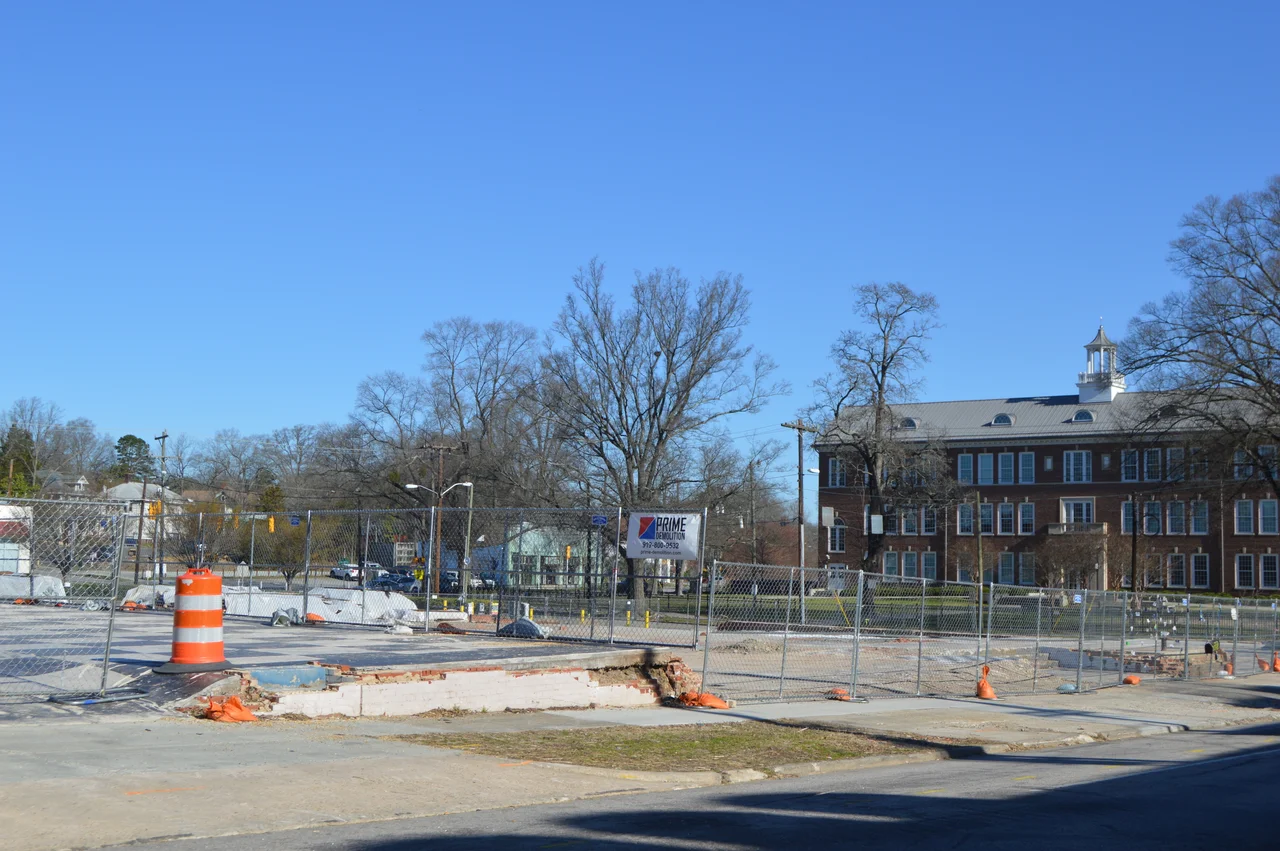

2019 Durham Gas Explosion
Kaffeinate stood at 115 North Duke Street in the Brightleaf District of downtown Durham, North Carolina - a small coffee shop run by Kong Lee and his family, named for the caffeine that gives coffee its lift. At 9:38 a.m. on Wednesday, April 10, 2019, someone called 911 to report the smell of natural gas near the storefront. Firefighters were on the scene within minutes. Kong Lee had already walked outside that morning, complaining to a contractor crew about the smell - a security camera caught him waving his hand in front of his nose as he spoke to them. The crew had valid permits to be there. Underneath the sidewalk, the gas was still flowing. The explosion came at 10:06 a.m.
Kong Lee and Jay Rambeaut
Kong Lee owned Kaffeinate. He was in the shop that morning helping evacuate his customers and staff - city officials confirmed that eight to ten people had been led out of the building in the minutes before the blast. Lee was preparing to leave too, still moving through the shop, when the gas ignited. He was killed instantly in the collapse of the building over him. Jay Rambeaut was a Dominion Energy first responder dispatched to the scene to help contain the leak. He was caught in the explosion and critically injured. He was taken to UNC Medical Center in Chapel Hill, where he died of his injuries on April 25, two weeks after the blast. Their names anchor the casualty list. Twenty-five other people were injured. Nine of them were Durham firefighters. Five were in critical condition immediately after the explosion. Ten Duke University employees were among the injured.
Sixty Minutes of Gas
The investigation report from the Durham Fire Department later traced the sequence with grim precision. A three-person crew from a contractor called Optic Cable Technology was using a horizontal-drilling machine to install underground fiber-optic cable along North Duke Street. Their drill bit struck and breached an underlying gas line in front of Kaffeinate. The leak began somewhere around 9:00 a.m. By 9:38 someone smelled it strongly enough to call. By the time of the explosion at 10:06, an estimated 46,000 cubic feet of natural gas had vented into the open air, into the building's basement, into the wall cavities and the air conditioning ducts of the shop. The fire department's report could not say what specifically ignited it. Investigators also noted that there was no evidence that Lee, the contractor crew, or anyone else in the immediate vicinity had called 911 to report the leak before the first emergency call - which the investigators saw as a critical failure of training and protocol for utility-locate strikes in a downtown setting.
The Blast Wave
The explosion was felt several miles away. The smoke plume showed up on local weather radar. Fifteen buildings in and around the Brightleaf District suffered damage. The coffee shop was reduced to rubble. An adjacent building housing a private Porsche collection was destroyed - the cars crushed inside their bay. An office building directly across from Kaffeinate had its interior and exterior shredded by the blast pressure. Two blocks away, windows still shattered. The Durham School of the Arts, a magnet school within the impact radius, had interior damage; mercifully no students were injured. Passersby and people from nearby buildings ran toward the rubble to pull the trapped and the bleeding clear. Some of them helped motorists trapped in cars whose airbags had blown from the pressure wave. Firefighters fought the resulting fire through the morning; the search-and-rescue effort continued into the next evening.
Lawsuits, Rebuilds, and a Memorial Block
Vincent Price, the president of Duke University, confirmed in the days after the blast that ten Duke employees had been hurt. Durham mayor Steve Schewel ordered a city review of utility-locate procedures and contractor coordination. On June 22, 2020, four separate lawsuits were filed naming the contractor and other corporate parties. They represented victims of the blast, including one of the two who had been killed. The Brightleaf District rebuilt slowly. Kong Lee's family, the Kaffeinate community, and the broader Durham coffee scene held memorials in the months that followed and worked to keep his name attached to the place where his shop had been. The investigation report stands as a procedural document for how such failures begin and how they end: a drill bit in the wrong place, a smell that should have triggered a 911 call thirty minutes earlier than it did, sixty minutes of unstopped gas, and two people who would not come home that night.
Flight Context
The site is at 36.0000N, 78.9081W, in downtown Durham just west of Five Points and the Carolina Theatre, in the Brightleaf Square/Bright Leaf Historic District. From cruise the city center reads as the concentration of mid-rise buildings around the Bull City core, with Duke University's West Campus visible to the west and downtown Durham's railroad spine running north-south. Raleigh-Durham International (KRDU) lies about 13 nm SE; Horace Williams (KIGX) at Chapel Hill about 10 nm WSW.
From the Air
Coordinates 36.0000N, 78.9081W; recommended viewing altitude 3,000-5,000 feet AGL. Visual landmarks include downtown Durham's mid-rise core, Duke University's West Campus and the Duke Chapel tower about 1.5 nm WSW, and the rectangular American Tobacco Campus to the south. Nearest airports: Raleigh-Durham International (KRDU) ~13 nm SE; Horace Williams (KIGX) at Chapel Hill ~10 nm WSW; Person County (KTDF) ~22 nm N. The blast site at 115 N. Duke Street has been rebuilt - this is a flyover of a place where two people died, treated with the respect that asks for.
Nearby Stories
- Orange County Speedway 3.7 km away
- Tobacco Road 8.7 km away
- Haw River 15 km away
- Johnston County, North Carolina 18 km away
- Soul City, North Carolina 25 km away
- Chinqua Penn Plantation 29 km away
- North Carolina Aviation Museum 40 km away
- Cherry Hill Plantation 45 km away