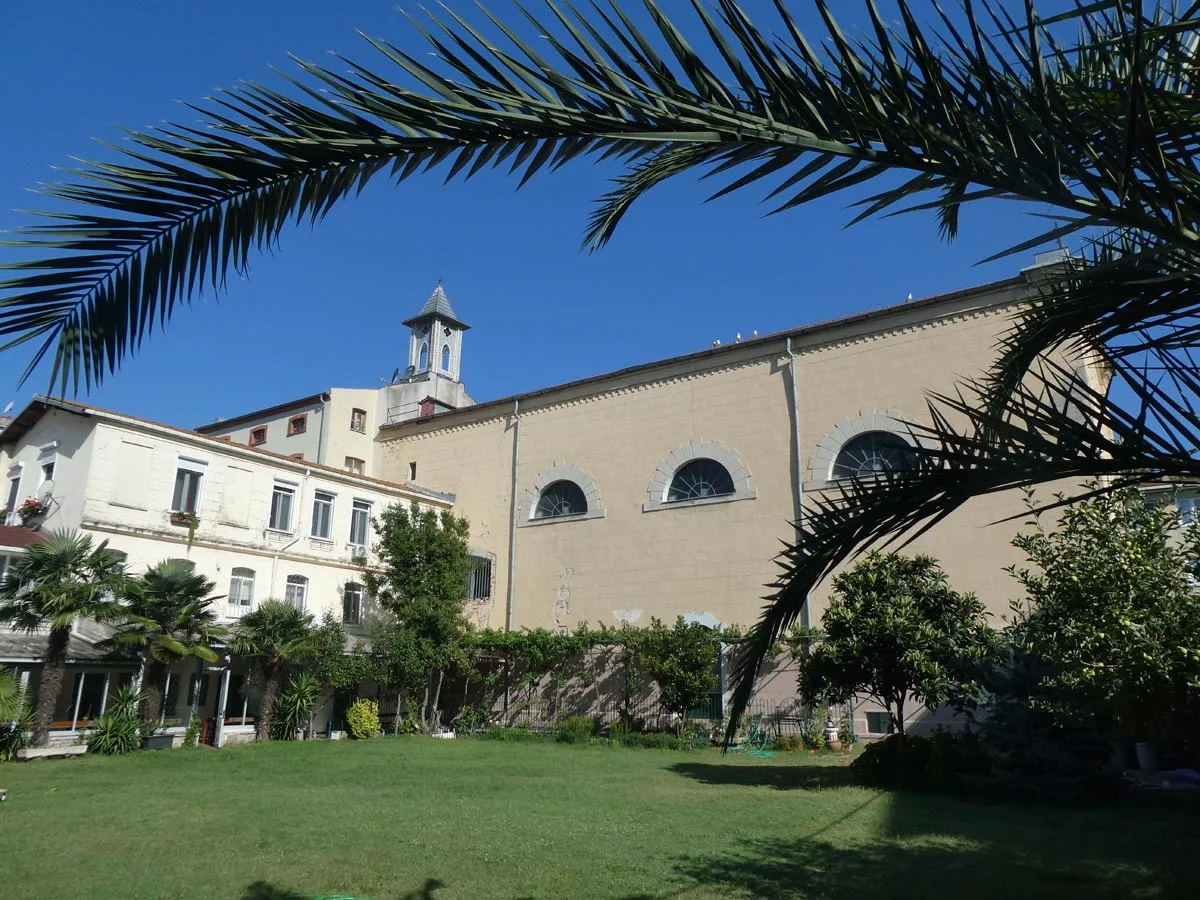

2024 Istanbul Church Shooting
Tuncer Cihan had come to the Church of Santa Maria for Sunday Mass. It was the morning of 28 January 2024, around 11:40. The church in Sarıyer, on the European shore of the Bosphorus, belongs to a Franciscan order from Italy and has served Istanbul's small Catholic community for centuries. Two masked men entered during the service. They shot and killed Tuncer Cihan. A second person was wounded. The Polish consul-general and his family, who were also attending that morning, were unharmed. By evening, flowers and candles had been placed at the church door, and a Turkish flag hung over its facade — a city in mourning for one of its own.
A Church in the City
The Church of Santa Maria in Sarıyer — not to be confused with Santa Maria Draperis, a separate Franciscan church in Beyoğlu — is one of Istanbul's long-standing Catholic institutions, run by Franciscan friars from Italy. Sarıyer sits on the European side of the city, along the upper Bosphorus, a residential district of fishing harbors and old summer villas far from the crowded tourist districts of Sultanahmet and Beyoğlu. The congregation that gathered on that January Sunday was not large. Istanbul's Catholic community is a small one — a remnant of the city's long history as a multi-confessional metropolis. Among those present were the Polish consul-general, Witold Lesniak, and his family. That a diplomat was in attendance was coincidence, not ceremony. It was a Sunday morning. People were at church.
The Attack and Its Claim
Two assailants entered the church wearing masks and opened fire. Tuncer Cihan was killed. Investigations quickly led to the arrest of two men identified as Amirjon Kholiqov, a Tajikistani national, and David Tanduev, a Russian national, described by Turkish authorities as members of the Islamic State. On 30 January, Islamic State claimed official responsibility for the attack. Interior Minister Ali Yerlikaya announced that 47 people had been detained following raids on 30 locations connected to the investigation. Three weeks earlier, on 3 January, Turkish authorities had already arrested 25 suspected Islamic State members on suspicion of plotting attacks against churches and synagogues — a warning that had not prevented what followed. Investigators later noted that this was the group's first attack on a religious site in Turkey.
Who Tuncer Cihan Was
Reporting in the days after the attack described Tuncer Cihan as a Muslim who had been seeking to convert to Christianity, though conflicting accounts emerged within his own family. A lawyer representing the church indicated he belonged to the Alevi community. Whether he had found in this congregation a sense of spiritual home, or was simply present on that morning for reasons of his own, belongs to the private territory of his life. What is established: he was a person at worship, in a place of prayer, on a Sunday morning. He was killed there. The circumstances of his beliefs and his presence at the church were subjects of speculation in the media. His death was not.
The City's Response
Istanbul's mayor, Ekrem İmamoğlu, visited the church and addressed the city's religious minorities directly: "There are no minorities in this city or this country — we are all actual citizens." Interior Minister Yerlikaya vowed that the state would not tolerate terrorism against religious communities. Pope Francis, at his weekly Angelus prayer in Saint Peter's Square, expressed his closeness to the Santa Maria congregation. Italian Foreign Minister Antonio Tajani offered condolences and stated his confidence in Turkish authorities' ability to find those responsible. The church announced that regular masses would resume on 1 February — four days after the attack. A congregation had been violated. It gathered again.
Faith and Continuity
Istanbul has been a city of multiple faiths for most of its recorded history — Greek, Armenian, Jewish, Catholic, Syriac, Sunni, Alevi communities have coexisted within its boundaries across centuries, sometimes violently, sometimes with remarkable ease. The attack on Santa Maria was a shock partly because such violence against a place of worship is rare in the city's modern history and partly because the church represents something delicate: a small community maintaining a long tradition against diminishing numbers. Mass resumed the following week. The candles placed outside were replaced by fresh ones. The Franciscan friars from Italy continued their ministry. That continuity, unspectacular and quiet, is its own kind of answer to what happened there.
From the Air
The Church of Santa Maria sits in Sarıyer on the European shore of the Bosphorus at approximately 41.16°N, 29.04°E. The nearest major airport is Istanbul Airport (LTFM), roughly 20 km to the west-northwest. Flying south along the Bosphorus from the Black Sea, the upper European shore neighborhood of Sarıyer is visible below, characterized by residential buildings along the water and forested hillsides rising steeply behind. The church itself is not readily visible from altitude but sits within the dense urban fabric of Sarıyer's shoreside district. Recommended viewing altitude for the broader Bosphorus corridor is 3,000–5,000 feet.
Nearby Stories
- Kınalıada 6.2 km away
- Şile Castle 7.8 km away
- Second Battle of Çatalca 8.9 km away
- Hereke 20 km away
- 2025 Istanbul Earthquake 25 km away
- Battle of Constantinople (922) 61 km away
- Januarius MacGahan 87 km away
- Edirne 160 km away