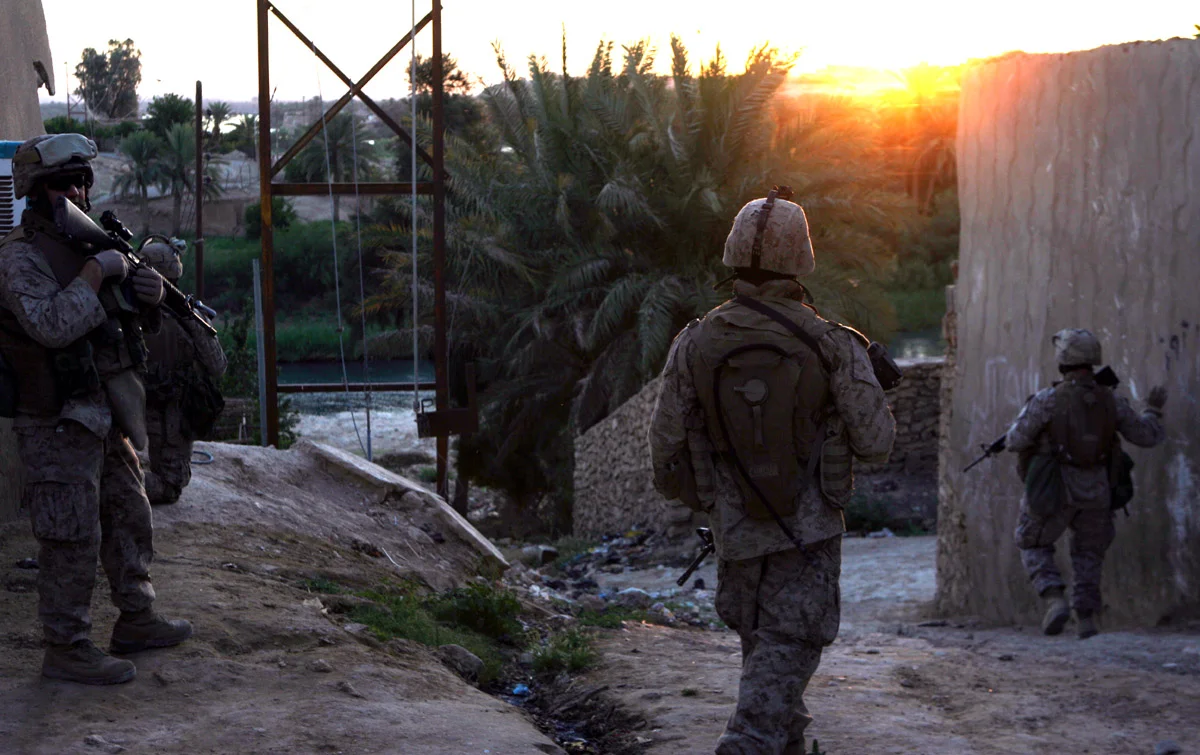

3rd Battalion, 3rd Marines
On 14 December 1945, three months after Japan formally surrendered, Private First Class W.C. Patrick Bates of Kilo Company was shot dead by a Japanese sniper during a mopping-up patrol on Guam. He was the last American killed in World War II, and he wore the patch of 3rd Battalion, 3rd Marines. That this battalion, born on a North Carolina tobacco field in 1942, would also bury the war's final casualty says something about how thoroughly its history would intertwine with the violent century to come.
Born at New River
The battalion was activated on 1 June 1942 at what is now Marine Corps Base Camp Lejeune, initially designated the 5th Training Battalion. Its first Marines were a strange mix: officers and enlisted men left behind when the 1st Marine Division shipped out to the South Pacific, padded with raw recruits straight from Parris Island. For two months they did little but try to organize themselves. Then on 24 August they boarded a train for San Diego, and a week after that the SS Lurline carried them across the Pacific to Samoa. They lived in small wooden huts the locals called fales, fought constant rain, and watched mosquitoes carry filariasis into the swelling arms and legs of their fellow Marines. By the time the 3rd Marine Division finally formed up around them in New Zealand, the battalion had been training for eight months. They were ready for what came next.
America's Battalion
What came next was the Pacific. Bougainville in November 1943: 36 dead at Piva Forks, including Corporal John Logan Jr. and Captain Robert Turnbull, both posthumously awarded the Navy Cross. Guam in July 1944: 97 killed and 300 wounded taking Chonito Cliff and Adelup Point under flamethrower and tank support, the Japanese rolling grenades down the slope at advancing Marines. Then Iwo Jima, where they sat offshore in transports for a month as floating reserve, never landed, watching the smoke rise. Decades later, during a 1980s tour as commander, Charles Krulak gave them the nickname that stuck: America's Battalion. Krulak went on to become the 31st Commandant of the Marine Corps. The name remained behind.
Vietnam: 1,600 Days
No Marine battalion spent more time in Vietnam than 3/3. Sixteen hundred days. Forty-eight combat operations. Six hundred and fifty-three Marines killed, nearly 2,800 wounded. Operation Starlite in August 1965 was the first major Marine engagement of the war, and it was Corporal Robert Emmett O'Malley of India Company who jumped into a Viet Cong trench near An Cuong 2 and killed eight enemy soldiers, refusing evacuation despite being wounded three times. He became the first Marine in Vietnam to receive the Medal of Honor. Two years later, on 2 March 1967, Captain John Ripley's Lima Company stumbled into a PAVN regiment trying to cross the DMZ; twelve Marines died and twenty-eight were severely wounded. The roll call from those years includes Oliver North, posthumous Medal of Honor recipient Lance Corporal William R. Prom, and PFC Robert Quick, who was awarded a posthumous Navy Cross for smothering a grenade near Gio Linh.
From the Heart of the Pacific
In 1975 the battalion was reformed for the third time at Marine Corps Base Hawaii, in Kaneohe Bay. From then on the unit billed itself as Marines from the heart of the Pacific, deploying constantly across the Indian and Pacific Oceans. They sat off Lebanon in 1983, two weeks before the Beirut barracks bombing killed 241 Americans from the 24th MAU. They held Cement Ridge in Saudi Arabia during Desert Shield, then crossed into Kuwait in 1991. They went to Afghanistan three times and Iraq three times in the years after September 11. India Company in Helmand Province in 2010 fought 92 firefights in seven months, reporting 174 enemy killed. By the time the deployment ended, Nawa District was described as a model of counterinsurgency, the most stable district in southern Afghanistan. The battalion was deactivated in January 2023, its colors cased after eighty years of service.
Flight Context
Located at 34.76 degrees north, 77.41 degrees west, within the Camp Lejeune training complex in Onslow County, North Carolina. View from 1,500 to 3,000 feet AGL to take in the New River basin where the battalion was born. Nearest airports: Albert J. Ellis Airport (KOAJ) to the west and MCAS New River (KNCA) on base. Visibility is best in clear winter air after frontal passages.
From the Air
Located at 34.76 degrees north, 77.41 degrees west, within the Camp Lejeune training complex in Onslow County, North Carolina. View from 1,500 to 3,000 feet AGL. Nearest airports: KOAJ (Albert J. Ellis) and KNCA (MCAS New River). Use caution for restricted airspace over the base.
Nearby Stories
- Emerald Isle 5.7 km away
- Topsail Beach, North Carolina 13 km away
- Jones County, North Carolina 14 km away
- Arapahoe, North Carolina 16 km away
- Sampson County, North Carolina 30 km away
- HMT Bedfordshire 43 km away
- National Airlines Flight 2511 43 km away
- Lake Waccamaw, North Carolina 62 km away