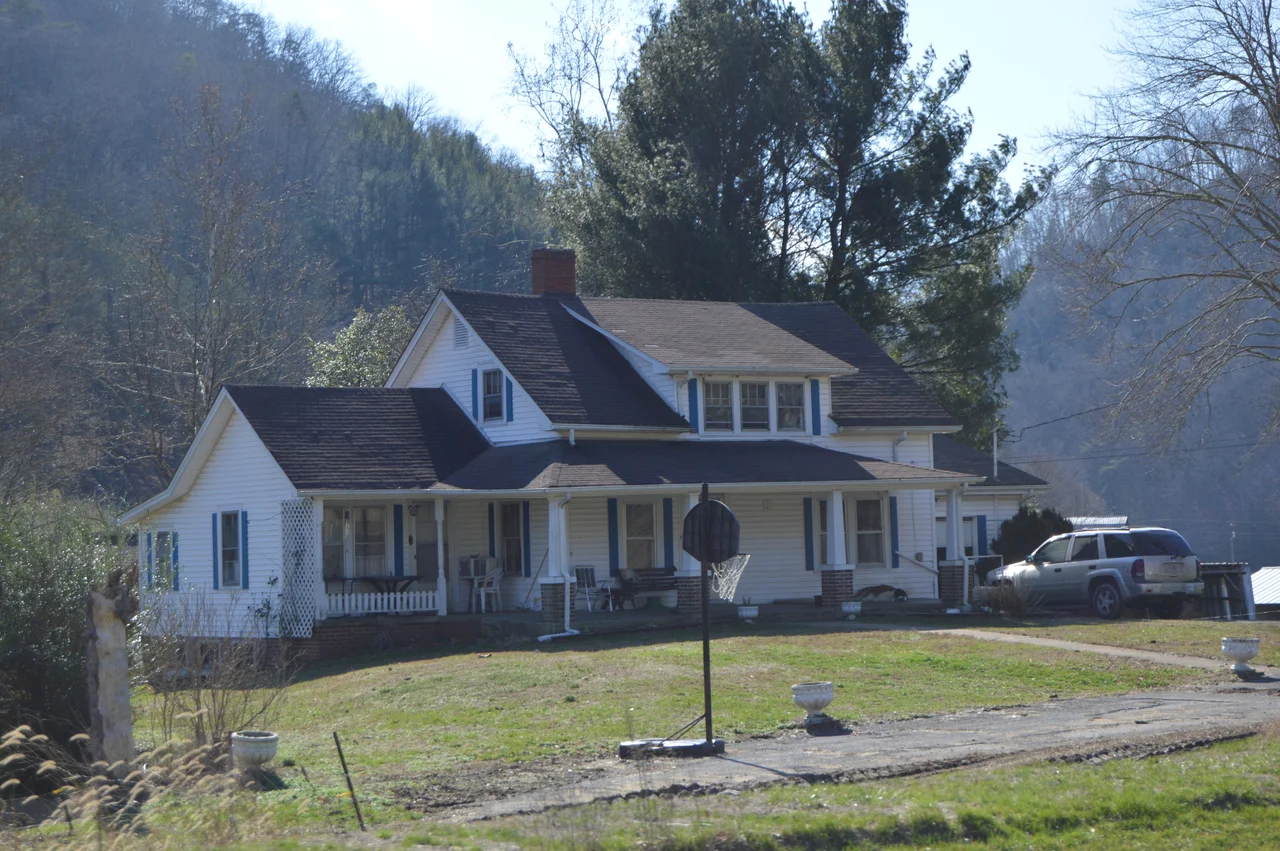

A. P. and Sara Carter House
Sara Dougherty Carter learned to play autoharp in this house. A.P. Carter, her husband, came home to it between trips through the surrounding hollows, collecting old ballads he would later teach the group that became known as the Carter Family. The house is not grand. It is a one-story frame dwelling in Maces Spring, Virginia, that the Carters enlarged with a half-story upstairs sometime in the 1920s or 1930s to make room for more bedrooms. The remodel turned a plain mountain house into something close to the bungalow style that was sweeping the country. Plain or not, music was made here. The first Carter Family recordings were laid down at the 1927 Bristol Sessions, and the songs A.P. carried home to Maces Spring became the bedrock of American country and folk music.
Two People Under One Roof
Alvin Pleasant Delaney Carter, born in 1891, was a tall, restless man who walked the back roads of Poor Valley with a notebook, listening for songs other people had forgotten. Sara Dougherty Carter, born in 1898, had a deep, plain voice that sounded like she meant every word. They married in 1915 and lived in this house through the years that changed everything for them - 1927 when Ralph Peer recorded them in Bristol; the late 1920s and 1930s when their records sold by the millions; the long, slow drift apart that ended their marriage and ended the original Carter Family group. They recorded their last sides as a trio in 1941. Sara had remarried by then and moved to California; A.P. stayed in Maces Spring. He lived in this house, in different forms over the years, for most of his life.
What the House Holds
Bungalow style was an Arts and Crafts ideal that arrived in rural Appalachia as something more practical than fashionable - a way to make a tight house bigger without tearing it down. The Carters added a half-story for sleeping space. Their daughters Gladys, Janette, and Joe grew up here. Janette would later found the Carter Family Fold next door, the venue that still hosts old-time and bluegrass music every Saturday night. The house was placed on the National Register of Historic Places in 1985, six years after Sara's death and twenty-five years after A.P.'s. It survives now as a witness to a marriage that did not last but produced music that has.
Why Houses Matter
A song about leaving home means something different when you can stand in the yard where it was learned. The Carter Family songbook - Wildwood Flower, Will the Circle Be Unbroken, Keep on the Sunny Side - became the inheritance of Johnny Cash, Bob Dylan, Emmylou Harris, and countless others. A.P. died in 1960. Sara died in 1979. Their house remained, the way the songs remained: weathered but still standing in Poor Valley at the foot of Clinch Mountain, near the bend of road that leads to the Fold.
From the Air
Located at 36.67°N, 82.41°W in Maces Spring (now part of Hiltons), Scott County, Virginia, at the foot of Clinch Mountain in the Poor Valley. From the air the home appears as a small frame house in a narrow valley between forested ridges. Nearby airports: KTRI (Tri-Cities, TN-VA) lies about 17 nm south-southwest; KVJI (Virginia Highlands, Abingdon) is about 25 nm east-northeast. Recommended viewing altitude 1,500-3,000 ft AGL. The house is part of a cluster of Carter Family sites - the Fold venue, the Carter Store museum, and A.P.'s birthplace cabin all stand within walking distance.
Nearby Stories
- Gray Fossil Site 5.1 km away
- Emory and Henry University 16 km away
- Wise County, Virginia 17 km away
- Valle Crucis Episcopal Mission 24 km away
- Tazewell County, Virginia 40 km away
- Cumberland Gap 63 km away
- The Titanic Museum: The Ship That Docked in Tennessee 84 km away
- The Kentucky Meat Shower: When Flesh Fell From a Clear Sky 151 km away