
Valle Crucis Episcopal Mission
In 1847, three Episcopal monks knelt for private confession in a mountain valley in western North Carolina. By the standards of the antebellum Episcopal Church, this was nearly heresy. The Order of the Holy Cross at Valle Crucis lasted only a few years before being dissolved as too Catholic for American Protestantism - but in that brief window, it operated a monastery, a divinity school, a working farm, and a school that prepared at least one enslaved man's son for ordained ministry.
Vale of the Cross
The name Valle Crucis - Latin for Vale of the Cross - was given to the valley by Episcopal Bishop Levi Silliman Ives, who saw the convergence of three streams as a natural cross laid into the landscape. Ives established the mission in 1842, importing the Rev. William Glenny French as the first Superior of a new Order of the Holy Cross. Father William set a punishing schedule: religious services three times a day, two hours of manual labor for every man and boy in the community, mission work to the surrounding mountain settlements - both free and enslaved. The Order survived just four years. Private confession and absolution were too Catholic for an Episcopal Church still defining itself against Rome, and the society was abolished in 1849.
The Classical and Agricultural School
What did endure was the school. The Classical and Agricultural School at Valle Crucis was the first in North Carolina to teach practical agriculture alongside Latin and theology. One section prepared young men for the ministry - and in 1850, William Alston, identified in mission records as a Black student, finished his coursework here. He went on to become an ordained minister serving congregations in Philadelphia and New York. In the South of the 1850s, before emancipation, before Reconstruction, this was an outcome the surrounding mountain communities could barely have imagined. William West Skiles, a deacon and brother in the original order, had helped Father William keep the community running through its hardest years.
The Church of the Holy Cross
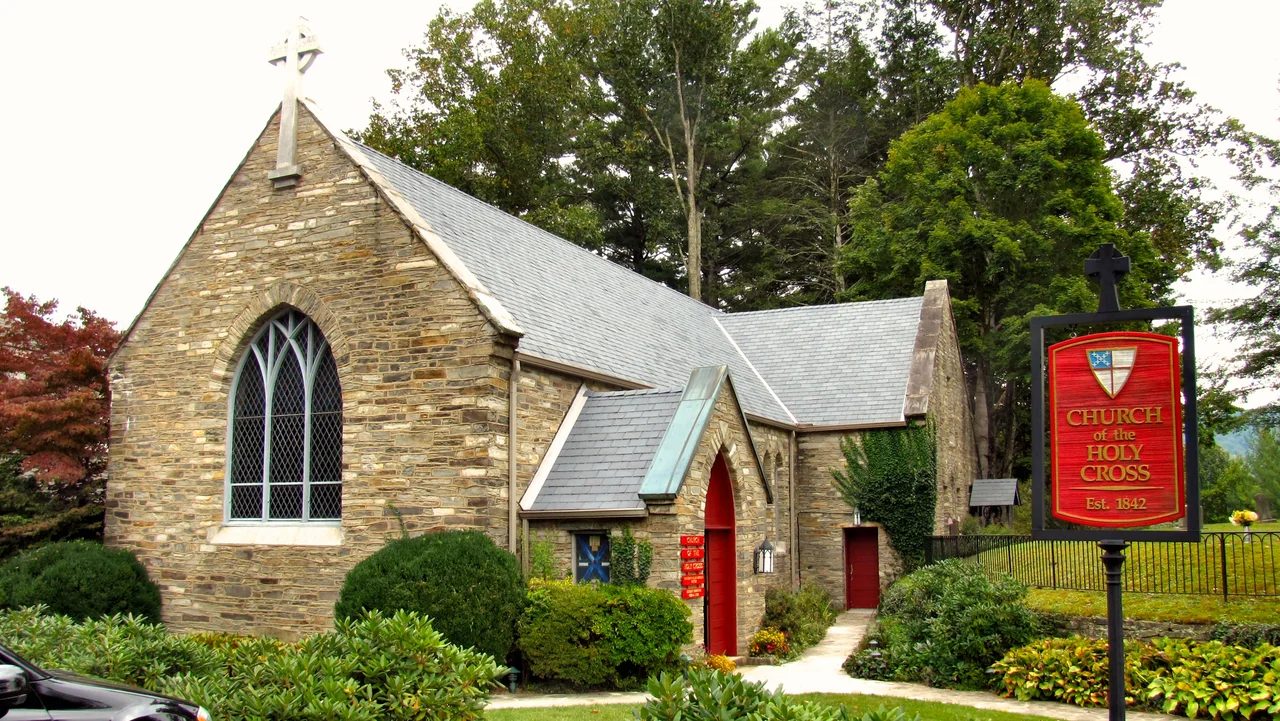
The Gothic Revival stone church visitors see today was built in 1924, its cornerstone laid by Episcopal masons who shaped the chancel walls from local stone. The parquet floor is unique in the valley - made from the cutoff end-pieces of 2x4s, each three inches thick, dovetailed and locked into a subfloor by hand. The Skiles Altar, given by the modern Order of the Holy Cross in the mid-twentieth century, is a converted Dutch cupboard, hand-carved with inscriptions honoring the deacon who held the original mission together. The oldest grave in the church cemetery dates to 1808 - decades before the mission existed.
Hermitages and the Turnpike
Beyond the main complex sit four small cabin hermitages and the Chapel of St. Anthony, opened to artists, writers, educators, and visitors of any faith who want a few days of contemplation. The chapel has a hickory floor, a hand-hewn altar, and local artwork on the walls. Outside the property runs the Valle Crucis, Shawneehaw and Elk Park Turnpike, built as a private toll road in 1891-1892 by hand labor alone, without machinery. A four-mile section between the Valle Crucis Elementary School and Banner Elk is famous for its winding curves. The original roadbed is now part of NC Highway 194. The whole complex was added to the National Register of Historic Places in 1993.
From the Air
Valle Crucis sits at 36.20N, 81.80W in the Watauga River valley of Watauga County, NC, at roughly 2,800 ft MSL. Recommended viewing altitude 6,500-8,000 ft - terrain rises to Grandfather Mountain (5,946 ft) ten nautical miles southeast. Nearest GA airport is Watauga County Memorial (KGEV) at Boone, eight miles east. Alternates include Elk River private (NC06) and Avery County (K7A8). The valley is narrow and tucked between ridges; expect rapid weather changes and limited visual approach options. The 1924 Gothic Revival church stone tower is visible as a small landmark in the green valley floor.
Nearby Stories
- Moravian Falls, North Carolina 3.7 km away
- Joara 3.9 km away
- Blue Ridge Mountains 11 km away
- Sullivan County, Tennessee 14 km away
- Yancey County, North Carolina 25 km away
- 2025 North Carolina Cessna Citation II Crash 27 km away
- Holston Mountain 36 km away
- Galax, Virginia 40 km away