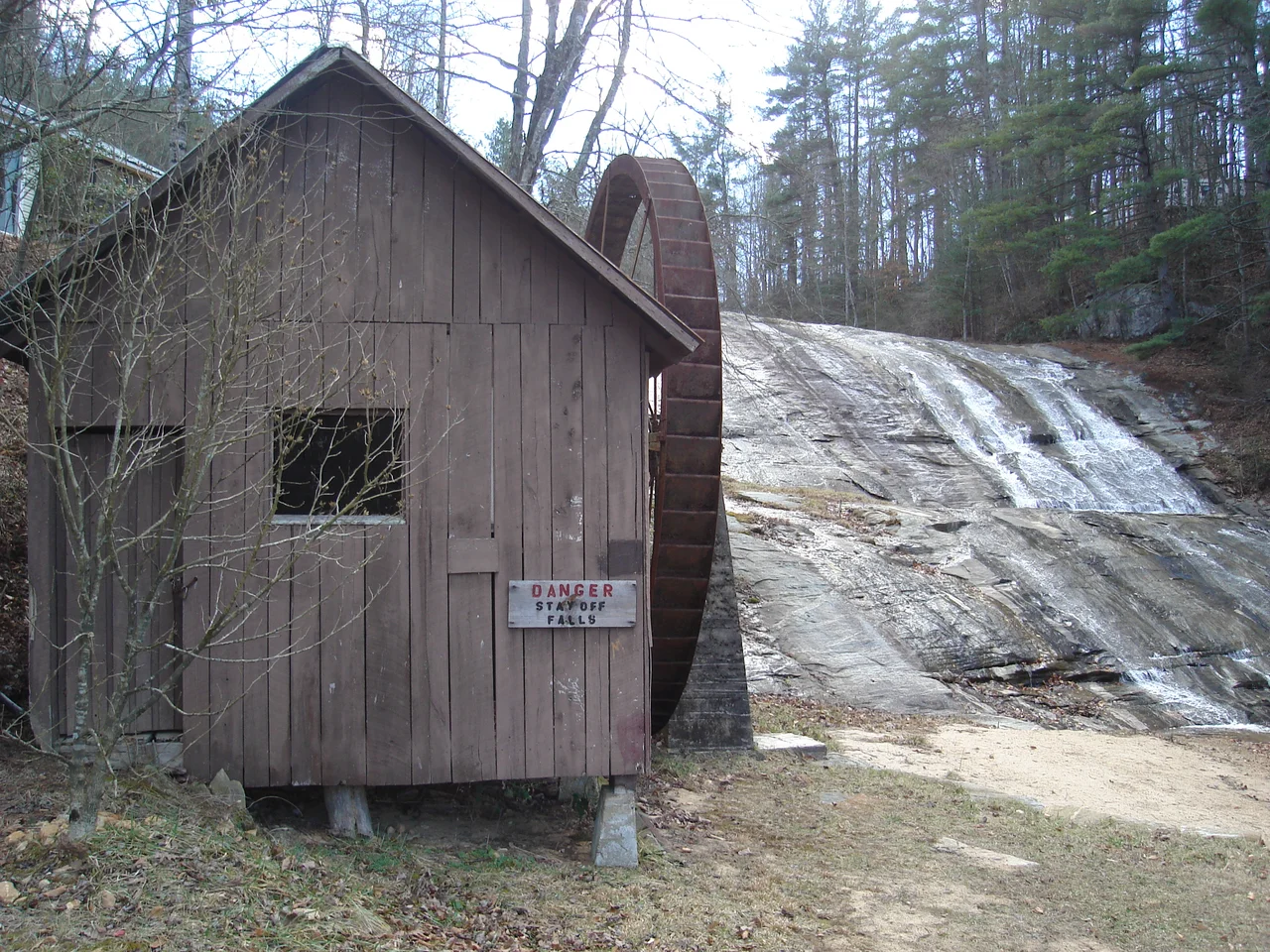

Moravian Falls, North Carolina
At its peak around the turn of the twentieth century, the Yellow Jacket newspaper claimed a circulation of one million copies. Its rivals estimated the real number at around 250,000 - which was still more than twice the Sunday circulation of any other newspaper in the South. The Yellow Jacket was published in Moravian Falls, North Carolina, a town of fewer than two thousand people tucked into the foothills of the Brushy Mountains in Wilkes County. More than a dozen newspapers were printed in this tiny community, distributed nationally and read by hundreds of thousands of Americans who probably could not have located Moravian Falls on a map. How a place with no railroad station and a population that hovered in the hundreds became a publishing powerhouse remains one of the stranger stories in American media history.
Petersburg and the Forks of the Road
Moravian Falls did not begin with the name it now carries. The settlement had two earlier names - Petersburg, and Forks of the Road - that suggest a frontier crossroads more than a destination. The Owen family settled the area around 1750. Four years later, in 1754, the Moravian Church purchased approximately nine thousand acres of nearby land - the tract that now lies submerged beneath the W. Kerr Scott Dam and Reservoir. There is no record that the Moravians ever actually built a settlement there during the eighteenth century. The community took its name from a local waterfall in the Brushy Mountains foothills, and the Moravian connection became more legend than history. The waterfall itself remains a small tourist attraction in a town that draws most of its visitors today for the surrounding mountain scenery rather than its religious origins.
The Yellow Jacket and the Fool-Killer
Starting in the late 1800s, Moravian Falls became, improbably, a publishing center. The Yellow Jacket led the pack. Its name signaled its editorial style - aggressive, populist, willing to sting. The Fool-Killer carried a similar attitude. The Lash announced its purpose in its title. These were rural papers, written in the voice of the white Southern small farmer, anti-elite, anti-corporate, often anti-Black, sometimes anti-Catholic, always opinionated. They circulated by mail across the rural South, in farmhouses and country stores, reaching audiences that the metropolitan dailies in Atlanta and Charlotte never touched. The Yellow Jacket's million-copy claim was almost certainly inflated, but even the rival estimate of 250,000 represented an enormous readership for a town this size. More than a dozen other newspapers printed in Moravian Falls have left thinner historical traces, but their existence points to a publishing ecosystem improbably anchored in a foothills hamlet.
Brushy Mountains, Pores Knob
The Brushy Mountains rise sharply south of Moravian Falls, a small range that runs east-west between the Blue Ridge and the Piedmont. Pores Knob is the highest point in the range, and it sits within the boundaries of Moravian Falls itself. The mountains are old by any geological reckoning - part of the worn-down southern Appalachians, lower in elevation than the Blue Ridge to the west but steeper and more abrupt where they meet the surrounding lowlands. Moravian Falls has a humid subtropical climate with mild winters, warm humid summers, and about fifty inches of rain a year. Snow averages about six inches annually. The community sits in USDA hardiness zone 7b, which means most of the South's flora grows comfortably here. The Brushy slopes hold mixed hardwood forest and the kind of stream-cut hollows that the early settlers found suitable for small farms and water-powered mills.
The October 2017 Tornado
Severe weather is uncommon in Moravian Falls. The community sits far enough inland and at enough elevation that tornadoes rarely touch down. On October 23, 2017, that pattern broke. A rare EF1 tornado touched down in Moravian Falls and then tracked northeast through Wilkesboro and North Wilkesboro and into the Mulberry, Fairplains, and Hays communities. The storm caused significant damage - downed trees, damaged buildings, power outages - in a region whose infrastructure was not built with regular tornado activity in mind. EF1 is the second-weakest tornado category, with winds between 86 and 110 miles per hour, but in tightly clustered foothills communities the effects can still be substantial. The October 2017 storm became a marker on the local weather timeline, the rare event that broke the usual pattern of summer thunderstorms and winter freezing rain.
The Schools and the Hubbard House
Wilkes Central High School and Central Wilkes Middle School both sit in Moravian Falls today, drawing students from across the central portion of Wilkes County. They are the largest and most ethnically diverse public schools in the Wilkes County system. The Benjamin Hubbard House was added to the National Register of Historic Places in 2009 - one of the surviving structures from the community's nineteenth-century period. The population, 1,712 as of the 2020 census, makes Moravian Falls a census-designated place rather than an incorporated town. The waterfall that gave the community its name still drops through the Brushy foothills. The Yellow Jacket and the Fool-Killer and the Lash are long gone, but the surprising fact that they ever existed here, and that they reached so many readers, is one of those local details that elevates an otherwise quiet community into something worth remembering.
From the Air
Moravian Falls sits at 36.11 N, 81.18 W in the foothills of the Brushy Mountains in Wilkes County, NC. From the air, look for Pores Knob just south of the community as the highest point in the local range. The W. Kerr Scott Dam and Reservoir lies nearby. North Wilkesboro Airport (KUKF) is about 5 miles north. Hickory Regional (KHKY) lies about 25 miles south. Recommended viewing altitude 3,000 to 5,000 feet AGL to take in the surrounding foothill terrain.
Nearby Stories
- Blue Ridge Parkway 7.7 km away
- Blowing Rock 10 km away
- 2025 North Carolina Cessna Citation II Crash 14 km away
- Joara 16 km away
- Wil-Cox Bridge 19 km away
- Hanging Rock State Park 22 km away
- Galax, Virginia 33 km away
- Emory and Henry University 49 km away