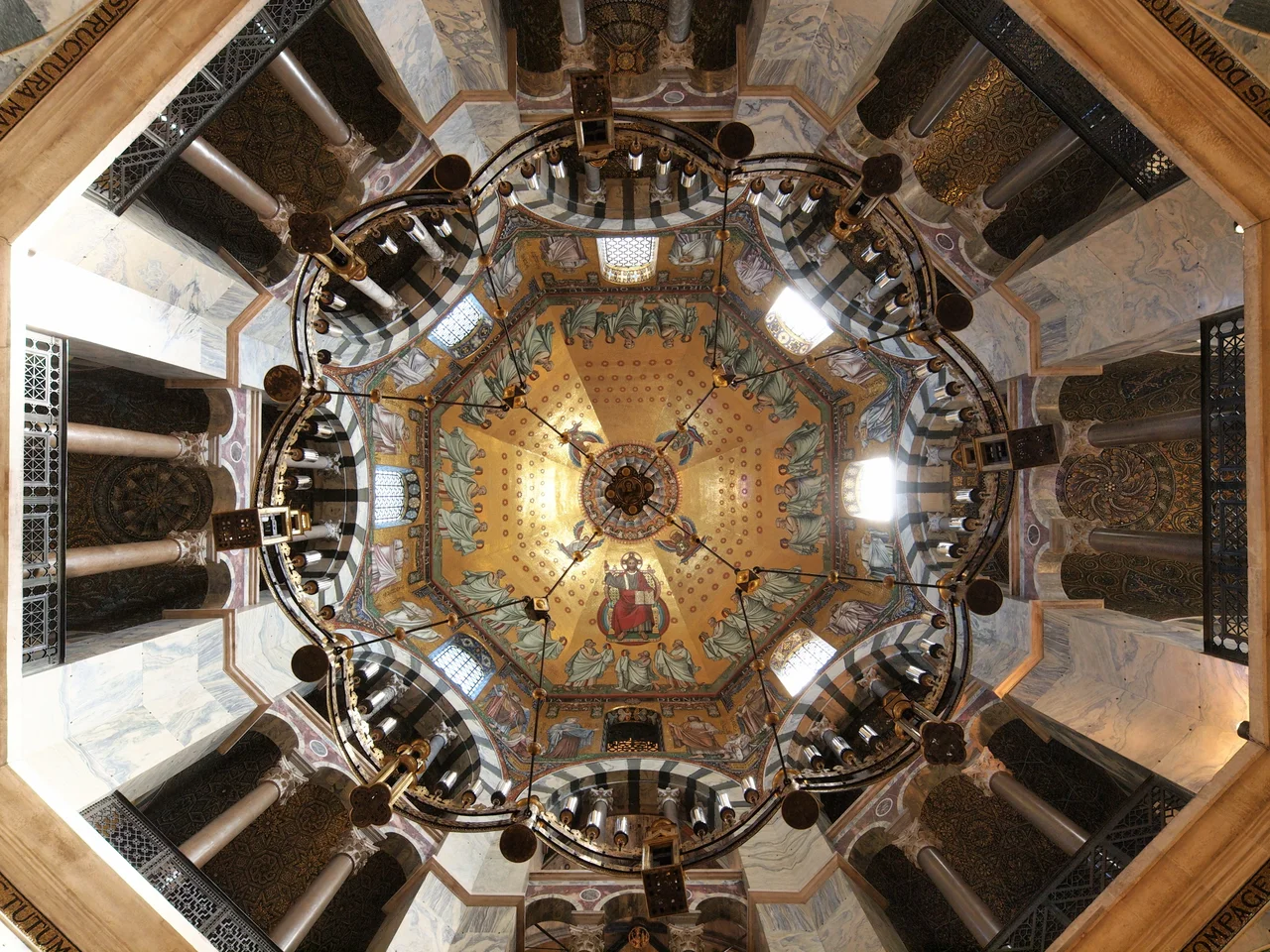

Aachen Cathedral
In the year 1000, Emperor Otto III ordered the floor of his great-great-grandfather's chapel pulled up. He had Charlemagne's vault opened. According to a courtier named Otto of Lomello, who was there, they found the dead emperor seated upright on a throne, crowned, scepter in hand, looking very much as he had on the day they buried him in January 814. The story is almost certainly embellished. The chapel where it happened is not. Aachen Cathedral still stands above that vault, an octagon of marble columns and gold mosaic that for nearly six centuries was the place where thirty-one kings of the Germans came to be made.
An Emperor Builds a Heaven on Earth
Charlemagne began construction sometime between 793 and 796 - a date confirmed by dendrochronology on the original timbers in 2009. His architect, Odo of Metz, modeled the building on the Basilica of San Vitale in Ravenna, the great Byzantine church of the Western Roman remnant. Columns and marble were stripped from ancient buildings in Rome, Ravenna, Trier, and Cologne and hauled north to Aachen, where Charlemagne was assembling a New Rome on the site of a Roman bath. A foundry was set up nearby to cast bronze doors, railings, statues of horses and bears. When Alcuin wrote to the king in 798 he reported the chapel nearly finished. Pope Leo III consecrated it in 805. The architectural historian Ulrike Heckner has argued that every measurement in the building traces back to a unit she calls the Aachener Königsfuß - the Aachen royal foot, 322.4 millimeters - a standard apparently invented for this one structure.
The Throne and the Coronations
Inside the western gallery sits a low marble throne whose plates, recent analysis suggests, were taken as spolia from the Church of the Holy Sepulchre in Jerusalem. Between the coronation of Otto I in 936 and the last Aachen coronation in 1531, thirty-one German kings climbed those steps. Even rulers crowned elsewhere came to sit on this throne, because to be king of the Germans was, in the imagination of the Middle Ages, to inherit something directly from Charlemagne. The ceremony took place at the high altar; the enthronement followed. The Marienschrein, the gilded shrine completed in 1239, holds the four great Aachen relics - cloth said to be St. Mary's cloak, Christ's swaddling clothes, John the Baptist's beheading cloth, and Christ's loincloth. Since 1349, by a custom now nearly seven centuries old, the relics are taken out and shown to pilgrims once every seven years. The last pilgrimage was in 2023. The motto was Discover Me.
Glass House for a Saint
By the 14th century the octagon felt too small for the cult that had grown around the canonized Charlemagne. Between 1355 and 1414 the mayor Gerhard Chorus and the Marienstift built a Gothic choir to the east - twenty-five meters long, thirteen wide, thirty-two high. They called it the Glashaus, the glass house, because more than a thousand square meters of stained glass made up its walls. Iron tension rods were built into the vault from the start, holding the slender stone piers against the lateral thrust so the windows could be as enormous as physics allowed. The model was Sainte-Chapelle in Paris. The purpose was the same: a transparent reliquary, a building that became light around the bones of saints. Charlemagne's gold-and-silver Karlsschrein has rested in this choir since 1215, where Frederick II laid it on the day of his own coronation.
Numerology in Bronze
The numbers in the building mean something. Eight, the shape of the central plan, was the medieval symbol for the eighth day - Sunday, resurrection, eternal life. Ten was the number of perfection: the diameter of the octagon, including its outer aisle, measures one hundred Carolingian feet, the same as the dome's height. The Wolfstür, the cast bronze door at the western entrance, divides each leaf into eight rectangles framed by eggs, symbols of life since antiquity, and the lion-head door rings are wreathed by twenty-four acanthus scrolls - two times twelve, three times eight, whichever numerology you prefer. Above the door, in the entrance hall, sits a bronze pine cone with 129 perforated scales and an inscription in dactylic hexameter referring to the Tigris and Euphrates of Mesopotamia. Nobody is sure how old it is. Estimates range from the third century to the tenth.
What the Bombs Spared
When American troops fought their way into Aachen in October 1944 - the first major German city to fall to the Allies - the cathedral was already badly damaged from years of bombing and artillery. Much of the choir's medieval glass was gone. The cloister was wrecked. The Holiness Chapel was destroyed beyond reconstruction. But the core had been protected: the most precious objects had been removed to secure storage, and the octagon's basic structure held. Reconstruction stretched over thirty years and cost an estimated forty million euros. In 1978 Aachen Cathedral became the first German site inscribed on the UNESCO World Heritage list. Today a seismometer monitors the Lower Rhine fault from a chamber in the building's foundations - a twelve-hundred-year-old chapel doing scientific work, still listening to the earth beneath the city Charlemagne chose.
From the Air
Coordinates: 50.7747°N, 6.0839°E. The octagonal dome and Gothic choir form a tight, distinctive footprint in central Aachen's Altstadt, immediately south of the Rathaus. Best viewed at 2,000-4,000 ft AGL from the east in clear light - the Gothic glass house dominates the silhouette. Nearest major airports: Maastricht Aachen (EHBK) 35 km northwest, Düsseldorf (EDDL) 80 km northeast, Cologne-Bonn (EDDK) 75 km east. Aachen lies in the Lower Rhine basin; expect haze in summer and frequent low ceilings in autumn.
Nearby Stories
- Heinsberg-Lindern Railway 7.8 km away
- Baptismal font at St Bartholomew's Church, Liège 7.8 km away
- Federal Office for the Protection of the Constitution 16 km away
- Limburg (Belgium) 17 km away
- F.L.Y. 17 km away
- Marcinelle Mining Disaster 84 km away
- Fort Jeanne d'Arc 148 km away
- Marmoutier Abbey 202 km away