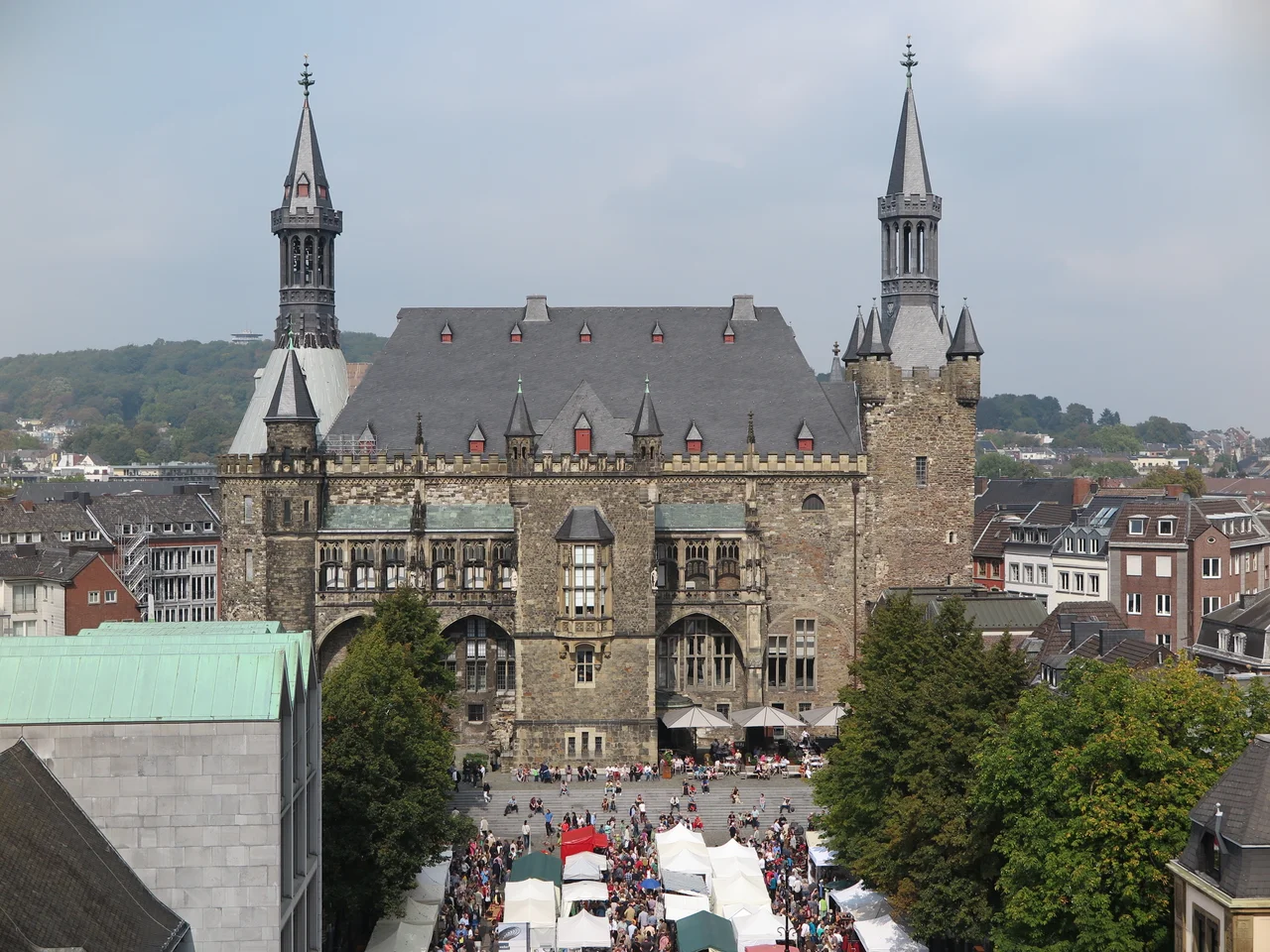

Aachen Town Hall
On the night of 14 July 1943, the towers of Aachen Town Hall caught fire from Allied bombing, and by morning the steel skeletons inside the tower caps had twisted from the heat. The north wall of the Coronation Hall had shifted as much as thirty centimeters from vertical. Engineers braced the building with emergency beams to keep it from collapsing on what remained of the medieval frescoes inside. The Rathaus, like the city it served, would spend decades reassembling itself. But it had done this kind of work before. The Aachen Town Hall is essentially a 14th-century Gothic building that ate a Carolingian palace, survived a Great Fire, was remade in Baroque, then Neo-Gothic, then ruined, then rebuilt - and is still where the mayor of Aachen reports to work.
Built on Charlemagne's Foundations
When construction began in 1330, the masons did not start with empty ground. They started with the rubble of Charlemagne's palace - specifically the Aula Regia, the great hall of the Palatine residence that had stood there since the eighth century. The Granus Tower, which had risen from the palace complex in the 790s, was raised higher and incorporated into the south side of the new building. Stones laid for an emperor became the foundation of a city government. The man in charge of all this was Gerhard Chorus, a mayor of Aachen who lived from 1285 to 1367 and who, in the same decades, also helped commission the Gothic choir of the cathedral next door. The Rathaus was finished in 1349. Inside, the new Coronation Hall hosted the great banquet that followed every imperial coronation across the square at the cathedral - a tradition that ran until 1531, when the last German king was crowned in Aachen.
The Fire and Its Many Sequels
Aachen burned in 1656. The Great Fire took the Rathaus roof and towers and forced the city to rebuild in the new Baroque manner. Between 1727 and 1732 the chief architect Johann Joseph Couven stripped out the Gothic muntins, replaced the gothic figures, and remade the front facade in stucco and curling stone. The interior followed - the White Hall and the sitting room still carry his fingerprints, with wood paneling in the Aachen-Liege Baroque style of Jacques de Reux. Then in 1883 it burned again. A fire started in a chemist's warehouse on Antoniusstrasse, cinder landed on the Granus Tower, and within four hours both towers and the entire roof of the Rathaus were ablaze. The Coronation Hall and its frescoes survived. The towers were rebuilt by the Aachen architect Georg Frentzen, restoration dragged on for eighteen years, and Kaiser Wilhelm II finally inaugurated the rebuilt Rathaus on 19 June 1902.
Rethel's Charlemagne
When the 19th-century rebuilders restored the Coronation Hall, they hired the Romantic painter Alfred Rethel to fill its walls with frescoes from the life of Charlemagne. He began in 1847; his student finished the cycle in 1861. The work survived the 1883 fire by sheer luck - the flames stopped at the floor above. After the Neues Museum frescoes in Berlin were destroyed in the Second World War, Rethel's Aachen cycle became one of the most important surviving examples of German late Romantic history painting. Five of the eight panels were physically cut out of the walls during the war by the restorer Franz Stiewi and hidden in the Suermondt-Ludwig-Museum. They came back when the building was patched together. Reconstruction of the Coronation Hall was substantially complete by 1953. The tower caps - their design debated for decades by architects, RWTH students, and a working group of preservation experts - were not finally rebuilt until 1978, following a plan by Leo Hugot that insisted on the historical silhouette over any modern alternative.
Replicas of an Empire
Walk through the Rathaus today and you find replicas of the Imperial Regalia of the Holy Roman Empire - the Imperial Crown of Otto I, the Sabre of Charlemagne, the Imperial Orb, the Vienna Coronation Gospels. The originals are in Vienna, locked in the Imperial Treasury. These copies were commissioned by Kaiser Wilhelm II around 1915 to mark the thirty-one coronations held in Aachen between 813 and 1531. Nearby hang portraits of Napoleon, painted in 1807, and his wife Josephine, painted in 1805 - gifts presented by Napoleon to his "good city of Aachen" in 1807, recalling the imperial couple's visits to the city. Elsewhere in the building hang portraits of the envoys from the 1748 peace congress that ended the War of the Austrian Succession, when the Rathaus's Peace Hall was prepared but never used because the diplomats could not agree on seating arrangements. The city kept the envoy portraits as a consolation prize.
The Charlemagne Prize
Every spring since 1950, the Aachen city council has gathered in the Coronation Hall to award the Karlspreis - the Charlemagne Prize - to a person or institution judged to have served the cause of European unity. Winston Churchill received it. Konrad Adenauer received it. Pope Francis. Emmanuel Macron. The list reads like a directory of postwar European political thought. The ceremony takes place in the same room where, six centuries earlier, newly crowned German kings sat down to their coronation feast. Outside, in the market square, statues of fifty medieval rulers still face the cathedral spire across the way. Inside, the modern city government works in offices remade and remade and remade again. The Rathaus is the building Aachen refuses to lose.
From the Air
Coordinates: 50.7761°N, 6.0838°E. The Rathaus sits about 150 m north of Aachen Cathedral, the two buildings defining the medieval core of the Altstadt. Two prominent towers - the larger Granus Tower on the south, the Marktturm on the north - make the building easy to identify from above. Recommended viewing altitude: 2,000-3,500 ft AGL. Best framed with the cathedral octagon in the same shot from the southwest. Nearest airports: Maastricht Aachen (EHBK) 35 km NW; Cologne-Bonn (EDDK) 75 km E; Düsseldorf (EDDL) 80 km NE.
Nearby Stories
- Heinsberg-Lindern Railway 7.8 km away
- Baptismal font at St Bartholomew's Church, Liège 7.8 km away
- Federal Office for the Protection of the Constitution 16 km away
- Limburg (Belgium) 17 km away
- F.L.Y. 17 km away
- Marcinelle Mining Disaster 84 km away
- Fort Jeanne d'Arc 148 km away
- Marmoutier Abbey 202 km away