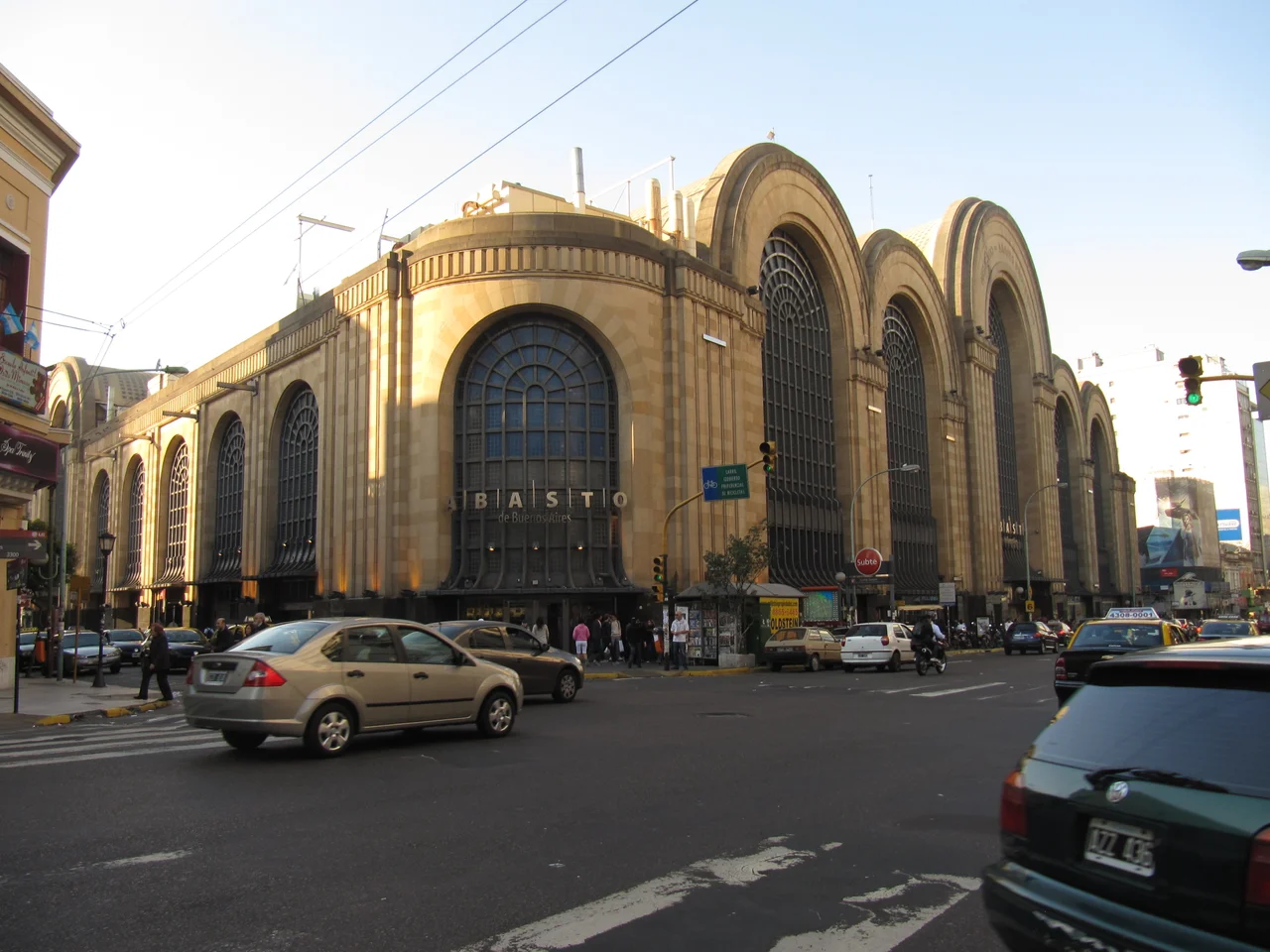

Abasto de Buenos Aires
Before dawn, the corner of Corrientes and Anchorena belonged to the crates. Horse carts and then trucks rolled in from the orchards of La Boca and Olivos, and inside a vast hall of arching concrete the wholesalers of Buenos Aires haggled over tomatoes and oranges by the ton. This was the Mercado de Abasto, the central market that fed a city for nearly a century - and the neighborhood that grew up around its noise and smell gave the world a voice that would come to mean tango itself. A boy raised in these streets, selling and singing among the market stalls, became Carlos Gardel, the man Argentines still call El Morocho del Abasto - the dark-haired boy of the Abasto. The building where the crates once stacked to the ceiling now glows with shop windows and cinema marquees, but the name has never left: this is, and always will be, the Abasto.
A Cathedral for Cabbages
The market began modestly. In 1888 the Devoto brothers proposed a supply market on land they had bought in the Balvanera neighbourhood, conveniently set beside the Sarmiento railway and midway between the produce-growing zones at either end of the city. The first covered section opened in 1893 - a mere 1,300 square meters. But Buenos Aires was swelling with European immigrants by the hundreds of thousands, and the market grew with the hunger of the city, adding refrigerated storage, an ice factory, stables, and retail annexes. By the early 1930s the old halls could no longer cope. The answer was the building that still stands: a soaring Art Deco market completed in 1934, its great vaulted bays of reinforced concrete among the boldest engineering in Argentina at the time. The architects - José Luis Delpini, Viktor Sulčič, and Raúl Bes - were the same team that designed La Bombonera, the legendary home stadium of Boca Juniors. They built for the masses, whether the crowd came for cabbages or for football.
The Songbird of the Abasto
No story of this neighborhood survives contact with Carlos Gardel for long, because his presence is everywhere in it. He grew up around the market, absorbed its working-class swagger, and rose to become the defining performer of tango-canción - the tango as song - his recordings and films carrying the genre across the world before his death in a 1935 plane crash. Argentines crowned him with nicknames: El Morocho del Abasto and El Zorzal Criollo, the Creole Songbird. In 1927 he bought a house nearby on Jean Jaurès street for his mother, Berta Gardés, and lived there until 1933; today that house is a museum devoted to his life. On the Zelaya passage close by, the facades of houses are painted with his lyrics and his portrait, and the underground station that serves the area carries his name. To walk the Abasto is to walk through a permanent, open-air homage to a single voice.
Decades of Silence
Markets, like songs, can end. On 14 October 1984 the city moved its central produce trade to a new Mercado Central beyond the city limits, and the great hall fell quiet. For more than a decade the building stood abandoned - a monumental Art Deco shell in the middle of a living neighborhood, too grand to demolish and too costly to use. It was a strange, suspended period: the engine that had organized the rhythms of an entire district, from the pre-dawn deliveries to the cafés that served the market workers, simply switched off. The neighborhood around it carried on, still called Abasto by everyone, still haunted by Gardel, but its namesake heart sat empty behind locked doors.
A Second Life Behind the Old Facade
Rescue came in 1996, when the real estate company IRSA, led by Eduardo Elsztain, bought the derelict landmark. Rather than tear it down, the developers preserved its historic Art Deco facade and rebuilt the interior as a modern shopping center, which opened in 1998. Today escalators climb through the soaring concrete vaults the architects raised for produce wholesalers, past cinemas and Argentine brands. Some travelers find the transformation bittersweet - a temple of commerce reborn as a temple of commerce of a very different kind. But the building endures, and so does the neighborhood's identity. Step out of the mall and the Abasto is still Gardel's barrio: his house museum a few blocks away, his lyrics on the walls, his name on the station below. The crates are long gone. The song never left.
From the Air
The Abasto building stands on Avenida Corrientes in the Balvanera district of Buenos Aires at roughly 34.604°S, 58.411°W, just west of the city center and a few blocks north of Once Station. From the air, the long pale roof of the Art Deco hall is a distinctive block within the dense grid, with the broad arrow of Avenida Corrientes running northwest toward the suburbs. A viewing altitude of 4,000-6,000 ft over central Buenos Aires keeps the avenue grid and the market roofline in clear view. Aeroparque Jorge Newbery (SABE) lies about 5 km northeast on the Río de la Plata shore; Ministro Pistarini International (SAEZ, Ezeiza) is roughly 20 km southwest. Visibility over the city is best on dry, clear autumn and winter days (April-August).
Nearby Stories
- Ezeiza Massacre 1.9 km away
- Luján, Buenos Aires 5.1 km away
- Curutchet House 13 km away
- Colonia del Sacramento 17 km away
- Martín García Island 28 km away
- Atucha Nuclear Power Plant 37 km away
- Lobos 43 km away
- Cry of Asencio 87 km away