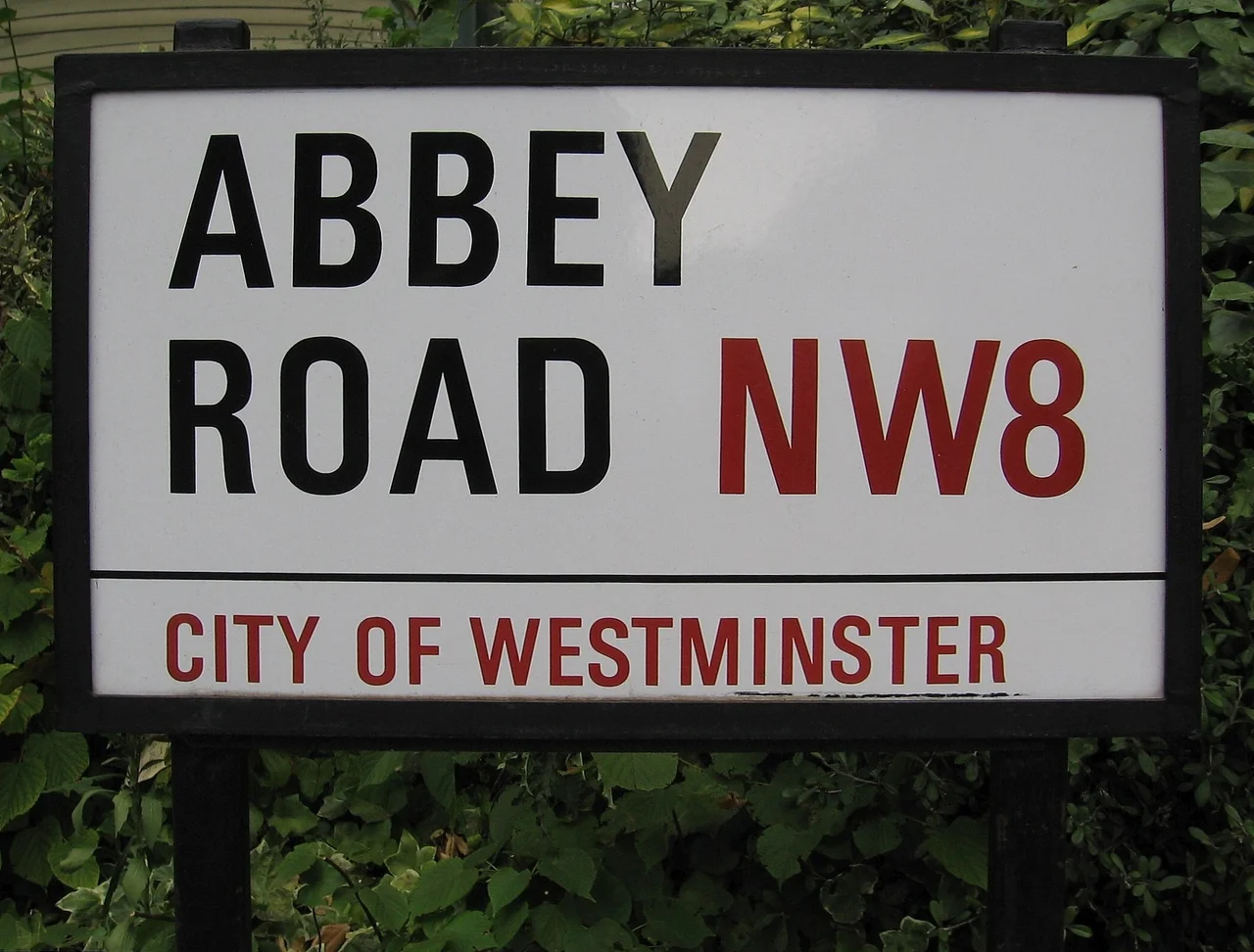

Abbey Road
Westminster City Council repaints the wall every three months. They have to. Fans write messages on it - in pen, in pencil, in lipstick, in marker - and the council comes back, paints over them in cream, and the cycle starts again. The street sign is mounted high on the side of a building because so many people kept stealing the one at eye level. The zebra crossing itself was granted Grade II listed status by English Heritage in December 2010 - the only pedestrian crossing in Britain to be officially protected as a building. Cars still drive through it. Tourists still step into the road to imitate the cover photograph of the Beatles' 1969 album. Every few minutes someone holds up traffic on Abbey Road. The drivers have learned to be patient.
An Ordinary Road That Became Famous
Abbey Road begins in Kilburn at the junction with Quex Road and West End Lane, and runs roughly a mile southeast through St John's Wood, ending at the junction of Grove End Road and Garden Road. The name comes from Kilburn Priory, the medieval abbey that once stood here, with Abbey Farm leading down the track that became this street. The road was developed in the early nineteenth century. It crosses the boundary between Camden and the City of Westminster at Boundary Road - a perfectly accurate name. Most of it is residential, blocks of flats and Victorian terraces. The Abbey National Building Society, now Santander UK, was founded in 1874 in a Baptist Church on Abbey Road, taking its name from the same source. It would have remained a quiet north London thoroughfare except for what was happening at number 3, the southeastern end.
Number 3 Abbey Road
Abbey Road Studios sits at 3 Abbey Road, just before the road ends. EMI's recording complex - founded in 1931 - had been the workplace of generations of British musicians long before the Beatles arrived in 1962. Elgar conducted the London Symphony Orchestra at its opening. Glenn Miller recorded there during the war. Pablo Casals recorded the Bach Cello Suites there. By the mid-1960s the studio's most famous clients were the Beatles, who had recorded almost every one of their albums there. In August 1969, working on what would be their last album as a band, they decided to name it after the road outside. The plan to call it Everest, after a brand of cigarettes engineer Geoff Emerick smoked, was abandoned. Abbey Road would do.
Friday, 8 August 1969
Around 11:35 on a Friday morning, photographer Iain Macmillan was waiting on a stepladder in the middle of Abbey Road. A policeman held the traffic. The Beatles - John Lennon, Ringo Starr, Paul McCartney, and George Harrison - walked across the zebra crossing six times. Macmillan took six photographs. Three frames had the Beatles walking from left to right; three had them walking back. McCartney chose the fifth frame for the cover. The session took about ten minutes. The album was released on 26 September 1969. The cover - four men walking across a zebra crossing in everyday clothes, no album title or band name printed anywhere - became one of the most reproduced photographs in popular music. The image generated decades of conspiracy theories, particularly the "Paul is dead" rumours that latched onto McCartney being barefoot. It also generated the longest-running act of pop tourism in the world.
The Crossing That Moved
The current zebra crossing may not be exactly the one the Beatles walked across. A Westminster City Council spokesperson said in 2010 that, "by comparing photographs with the Ordnance Survey maps, we believe that the crossing might have been further north nearer 3 Abbey Road, which was the front house of the EMI Studios." Traffic management work in the 1970s probably moved it a few metres south, to its current location near the junction with Grove End Road. The detail does not matter to the tourists. The crossing is the place. A webcam mounted on the studios broadcasts the scene continuously, and any time of day you can watch strangers approach the white stripes, look both ways, hold up traffic, and pose for their friends' cameras. The whole performance now takes maybe twenty seconds before the next group is up.
The Wall That Is Always Painted Over
Outside number 3, against the white-painted brick wall of the studio's perimeter, fans leave messages. Many are tributes to John Lennon, killed in 1980; some are to George Harrison, who died in 2001. Many are simply "I was here" or song lyrics. The council paints over them every three months. The cycle of graffiti and paint has become its own ritual. The street sign at the corner of Grove End Road, frequently stolen for decades, is now mounted high on a building specifically to prevent souvenir-hunting. Behind it, the road and its zebra crossing keep functioning as a working London street. Buses, taxis, delivery vans, cars driven by frustrated locals - they all push through the same pedestrian crossing four men photographed in fifteen minutes on a summer morning in 1969. The thoroughfare and the icon are the same piece of pavement.
From the Air
Abbey Road sits at 51.5331°N, 0.1785°W in northwest central London, running through St John's Wood across the Camden/Westminster boundary. The road is roughly a mile long, with Abbey Road Studios at the southeastern end at 3 Abbey Road. Lord's Cricket Ground lies just a few hundred metres east; Regent's Park is just to the south. From altitude, the dense Edwardian and Victorian terraces of St John's Wood form a clear neighborhood pattern, with Lord's distinctive Media Centre (the futuristic pod) visible nearby. Nearest major airports: London Heathrow (EGLL) 14nm southwest, London City (EGLC) 8nm east. The famous zebra crossing is too small to see from cruising altitude, but the surrounding pattern of streets is recognizable on detailed aerial views.
Nearby Stories
- Stevenage 5.7 km away
- Malling Abbey 5.7 km away
- 1952 Farnborough Airshow Crash 7.7 km away
- Ingatestone Hall 8.2 km away
- Hellfire Caves 9.1 km away
- The Carrington Event: The Solar Storm That Could Happen Again 9.8 km away
- Bletchley Park 16 km away
- Castle Hedingham 23 km away