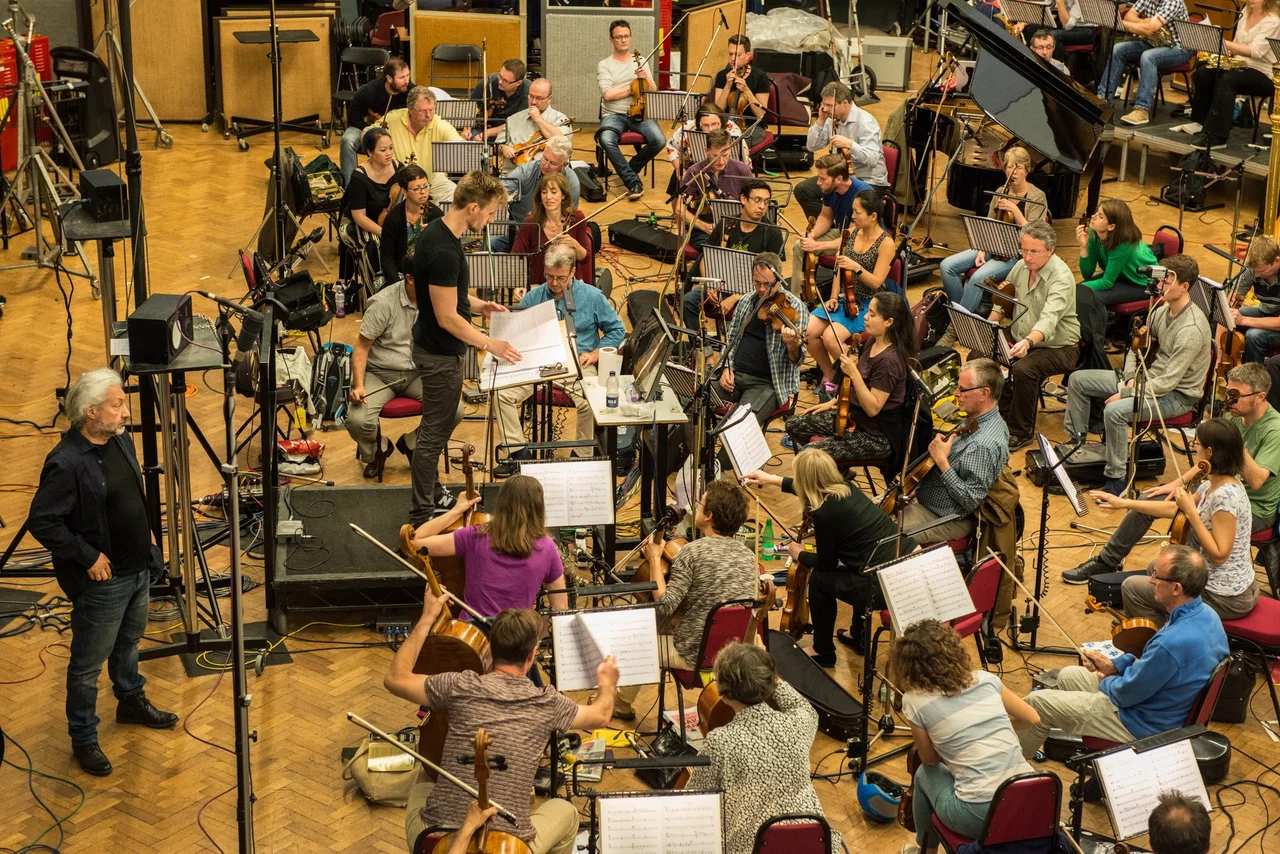

Abbey Road Studios
From the street, it looks like an ordinary Georgian townhouse. Nine bedrooms, white stucco facade, the kind of building you might walk past without thinking. Behind it, hidden by the deceptive frontage, sits one of the largest recording studios ever built. The Gramophone Company bought the property in 1929 because of what was behind the house: a large garden, big enough to accommodate the purpose-built recording facility that no one had ever made before. Three studios were constructed, and when they opened in November 1931, Pathé filmed the event. Edward Elgar conducted the London Symphony Orchestra in recordings of his own music. Stereo sound had not yet been invented. By 1934, in the same building, Alan Blumlein was inventing it.
The First Purpose-Built Studio
The original building at 3 Abbey Road was a nine-bedroom Georgian townhouse built in 1831 on the footpath leading to Kilburn Abbey. By the 1920s it had been converted into flats. Its best-known resident was Maundy Gregory, who was famous, or infamous, for selling political honours - peerages and knighthoods sold to anyone with enough money during the Lloyd George era. In 1929 the Gramophone Company acquired the building. The firm of Wallis, Gilbert and Partners was hired to convert the property. They retained the Georgian house for offices and built three large studios in what had been the back garden. The result was the world's first building designed from the start as a recording facility - an industrial concept disguised inside a residential street. Filming the opening in November 1931, Pathé caught Elgar conducting his own Pomp and Circumstance. The recordings began.
Sergeant Pepper and the Other Recordings
Before the Beatles, the studio was a centre of classical and orchestral recording. Sir Malcolm Sargent worked there extensively. Sir Thomas Beecham conducted Mozart's Jupiter Symphony in 1934 in what may have been the first commercial stereophonic recording, made by EMI engineer Alan Blumlein, who had patented stereo sound the year before. In 1936, the cellist Pablo Casals recorded the first two of Bach's Cello Suites at EMI head Fred Gaisberg's invitation - the recordings sparked a revival of interest in Bach that has not yet ended. Glenn Miller recorded there during World War II while based in the UK. "Fats" Waller played the studio's Compton organ. Then, in 1958, Cliff Richard and the Drifters - later renamed the Shadows - recorded "Move It" in Studio Two. The studio had become a centre of rock and roll.
Studio Two
Studio Two became one of the most famous rooms in recorded music. Remodeled in 1957 with its control room moved upstairs and a long wooden staircase descending into the studio floor, it was where the Beatles recorded almost all of their albums between 1962 and 1970. They used a custom-built four-track REDD mixing console designed by Peter K. Burkowitz. The technical constraints of the equipment - limited tracks, primitive automation, the requirement to bounce mixes down and lose generations of fidelity - forced the engineers and producers and the band itself to invent new techniques. The artificial double-tracking that became a Beatles signature. The tape-loop experiments on Revolver. The orchestral chaos of "A Day in the Life." The reverse guitar on "I'm Only Sleeping." Studio Two and its limitations shaped the sound.
Abbey Road, 1969
In the summer of 1969, the Beatles came to record what would be their final album as a band. They worked through July and August. The album was eventually named Abbey Road after the road outside, abandoning earlier proposals to call it Everest. Iain Macmillan photographed them on 8 August 1969 walking across the zebra crossing immediately outside the studio's gates. The image became one of the most reproduced photographs in popular music history. The album was released on 26 September 1969. Seven years later, in 1976, having become globally synonymous with the album cover, the studio formally changed its name from EMI Studios to Abbey Road Studios. The general manager Ken Townsend commissioned the artist Alan Brown to design a new logo. The Beatles had renamed the building they had recorded in.
The Threat That Created a Listing
In 2009, EMI - then under financial pressure - announced that Abbey Road might be sold to property developers. The reaction was immediate and international. A campaign to save the studios drew support from Paul McCartney and across the music industry. The British government responded by granting the building Grade II listed status in February 2010, protecting it from major alterations. In December 2010, the zebra crossing outside was also given Grade II listed status by English Heritage - the only pedestrian crossing in Britain to be officially listed as a building. In 2013, Universal Music Group took control of part of the studios, and Abbey Road is now ultimately owned by Virgin Records Limited, a UMG subsidiary. Since 2015 the building has also hosted the Abbey Road Institute, a school for music production and sound engineering. Recordings continue. The clients in any given year include almost everyone you have heard of - the Beatles' successors are still booking the same rooms.
From the Air
Abbey Road Studios sits at 51.5319°N, 0.1783°W at 3 Abbey Road in St John's Wood, northwest central London, on the boundary of Camden and the City of Westminster. The building is part of an ordinary residential block, with the famous zebra crossing immediately outside. Lord's Cricket Ground lies just a few hundred metres east, with Regent's Park further south. From altitude, the dense Victorian and Edwardian fabric of St John's Wood spreads around the studio; Regent's Park's circular footprint is the most obvious nearby landmark. Nearest major airports: London Heathrow (EGLL) 14nm southwest, London City (EGLC) 8nm east. The studio building itself is small, but the geography around it - park, cricket ground, neighborhood pattern - is readily identifiable on detailed aerial imagery.
Nearby Stories
- Stevenage 5.7 km away
- Malling Abbey 5.7 km away
- 1952 Farnborough Airshow Crash 7.7 km away
- Ingatestone Hall 8.2 km away
- Hellfire Caves 9.1 km away
- The Carrington Event: The Solar Storm That Could Happen Again 9.8 km away
- Bletchley Park 16 km away
- Castle Hedingham 23 km away