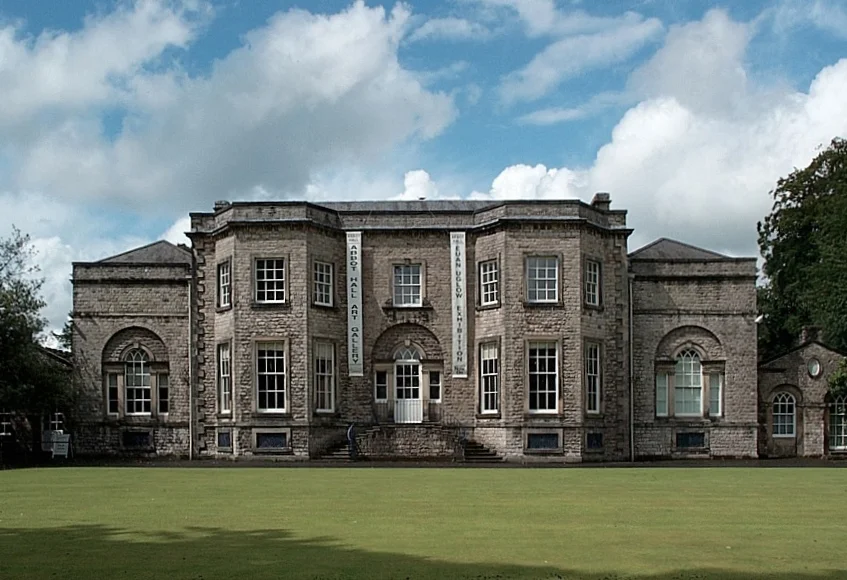

Abbot Hall Art Gallery
Before the Dissolution of the Monasteries, the abbot of St Mary's Abbey in York kept a stopping house here on the bank of the River Kent. The Abbot's Hall was where the abbot or his representative slept when visiting their Cumbrian holdings - a religious franchise outpost in the Lake District. Henry VIII closed it in 1539, the monks scattered, and the building eventually fell down. Two and a quarter centuries later, in 1759, Colonel George Wilson built a new Georgian villa on the same site and gave it the same name. That house, restored in 1957-62 from dilapidation, is the building you walk into today - and it holds one of the most significant collections of George Romney's paintings anywhere in Britain, gathered with the kind of patience that small regional galleries occasionally achieve when London is not paying attention.
The Symmetrical House
Wilson was the second son of Daniel Wilson of Dallam Tower, the substantial estate just down the road. The architect of his new townhouse is unknown - one of the small mysteries that surround a Grade I listed building. What survives is a model of mid-Georgian symmetry: seven bays across the east front, two storeys with cellars, curved steps rising to a round-headed central doorway with a delicate interlaced fanlight. Canted bay windows flank the entrance. The outermost two bays on each side step back and down, gabled with round-headed sash windows beneath an oval window set in a small pediment. The whole composition is built in stone, with quoins, a belt course and a modillioned cornice. By the early twentieth century the house had decayed badly. The art gallery conversion of 1957-62 saved it; the 2023 reopening, following a Lakeland Arts redevelopment of the building and grounds, refreshed it for another generation.
The Romney Holdings
George Romney was born just up the road in Dalton-in-Furness in 1734 and trained briefly in Kendal before going to London to become one of the three great society portraitists of his age - alongside Reynolds and Gainsborough. Abbot Hall's collection of his work is among the most important in Britain, including paintings as well as several of the sketchbooks and drawings that show him thinking on paper. The eighteenth-century holdings extend beyond Romney: a pair of views of Windermere by Philip James de Loutherbourg, and a substantial group of works by Daniel Gardner, another locally-born portrait painter. The watercolour collection covers the great period of British watercolour from the late eighteenth into the mid-nineteenth century: John Robert Cozens, David Cox, Peter De Wint, John Sell Cotman, John Varley, Edward Lear. And Turner - including his Passage of Mount St. Gotthard and his 1821 Windermere.
Ruskin, Hepworth, Hockney
John Ruskin lived in the Lake District for the last decades of his life. Abbot Hall holds one of the most comprehensive collections of his drawings and watercolours in any public institution - the working studies of the critic who taught Victorian Britain how to look at landscape. The modern collection moves into the twentieth century with sculptures by Barbara Hepworth, Jean Arp and Elisabeth Frink, and paintings by Ben Nicholson, Kurt Schwitters, Bryan Wynter, Sean Scully, David Hockney, L.S. Lowry, Graham Sutherland, Victor Pasmore, David Bomberg and Hilde Goldschmidt. It is the kind of list that announces itself: not a regional gallery that happens to own important things, but a focused collection assembled over generations to represent both the place and the broader history of British art.
The Great Picture and Arthur Ransome's Desk
In 2011, the Lakeland Arts Trust acquired and displayed The Great Picture, a remarkable triptych of Lady Anne Clifford - the Cumbrian heiress who fought a half-century legal battle to inherit her father's estates and won. The painting shows her at fifteen, in middle age, and as the heiress she eventually became. Abbot Hall is also the official address of The Arthur Ransome Society and exhibits Ransome's desk, typewriter and other memorabilia. Swallows and Amazons was set on Coniston Water just up the road, and Ransome worked at this desk to produce it. The reopening of Abbot Hall in May 2023, following the major redevelopment, was marked by an exhibition by Julie Brook - an artist whose work, like much of what hangs here, takes its bearings from the elemental materials of the northern English landscape.
From the Air
Abbot Hall Art Gallery is located at 54.32 degrees north, 2.74 degrees west, on the east bank of the River Kent at the southern edge of Kendal in Cumbria. From altitude, the Georgian villa appears as a substantial pale stone block in a riverside garden, immediately south of Kendal Parish Church. Best viewed from 2,000-2,500 feet AGL. Carlisle (EGNC) lies approximately 50 nautical miles north; Blackpool (EGNH) is about 40 nautical miles south. The Lake District National Park rises to the west and northwest; the Howgill Fells lift to the east.
Nearby Stories
- Hardknott Pass 2.1 km away
- Furness Abbey 2.3 km away
- Ireby 8 km away
- Cross Fell 10 km away
- Weardale Railway 11 km away
- Morecambe Bay Cockling Disaster 13 km away
- Bolton Castle 14 km away
- 1975 Dibbles Bridge Coach Crash 15 km away