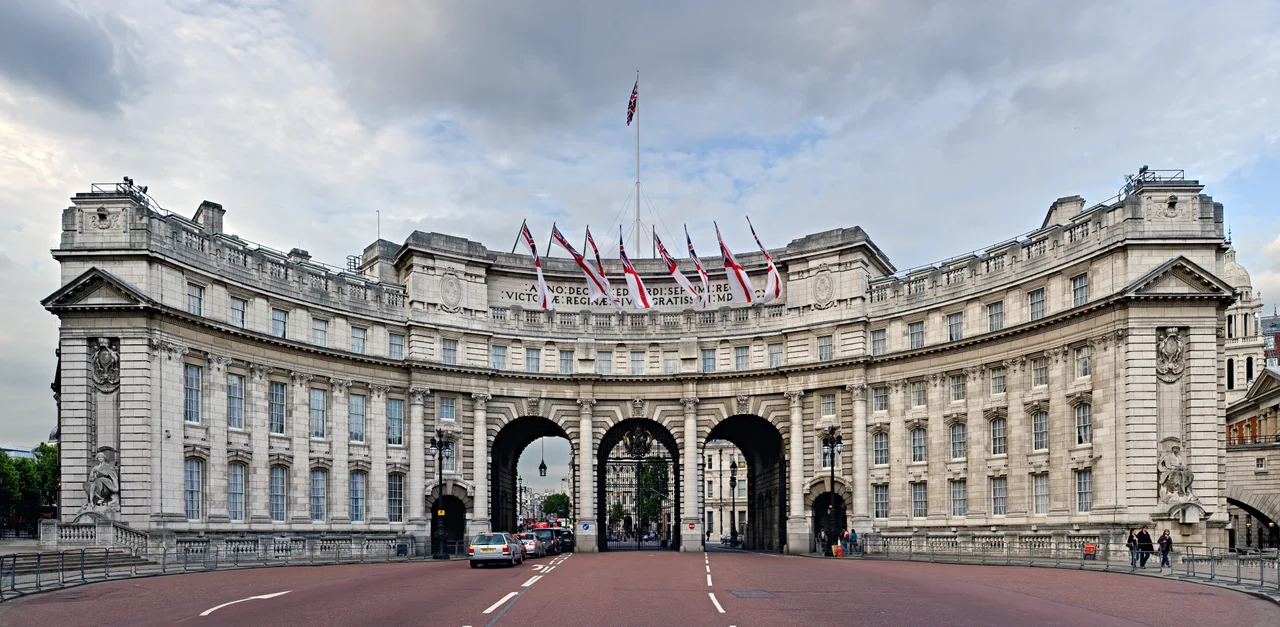

Admiralty Arch
King Edward VII commissioned Admiralty Arch as a memorial to his mother, Queen Victoria, but he never saw it completed. He died in 1910, two years before the arch opened in 1912. That melancholy gap — a son's tribute to his mother, finished only after the son himself was gone — runs quietly beneath one of London's most photographed structures. Stand at the Trafalgar Square end and look southwest toward Buckingham Palace: the arch frames The Mall like a stage set, and you realize that everything here was deliberate, designed by Aston Webb to project imperial grandeur across the full ceremonial mile.
A Son's Memorial
The arch was one piece of a larger commemorative scheme. Aston Webb designed not only Admiralty Arch but also the Victoria Memorial outside Buckingham Palace and the refaced facade of Buckingham Palace itself — a complete reimagining of the western approach to London's royal heart. The arch anchors the northeastern end of this processional axis. Construction was carried out by John Mowlem & Co and completed in 1912. Three arches span the roadway: the two outer arches carry traffic, while the central arch is reserved exclusively for royal use. For over a century, that central opening has swung wide for coronations, state funerals, and jubilee processions — and stood quietly closed for everything else. The building sits adjacent to the Old Admiralty Building, which explains its name, and housed government offices and the official residence of the First Sea Lord for nearly a century. Louis Mountbatten, 1st Earl Mountbatten of Burma, lived here during his tenure.
From Naval Headquarters to Luxury Hotel
The Admiralty's association with the building ended in 2011, when austerity-driven government cuts left it vacant. For nearly a century the rooms had hummed with naval administration, intelligence work, and the private business of Britain's most senior sailors. Then the building was put up for sale — the asking price reportedly around £75 million. A 125-year lease was sold in October 2012 to Spanish real estate developer Rafael Serrano, who planned a luxury hotel conversion. Westminster City Council granted full planning permission in August 2013 for a 100-room hotel, private residences, and a members' club. The project went through ownership changes, eventually passing to the Reuben brothers in 2022, with the Waldorf Astoria brand attached. The building is scheduled to open as a luxury hotel in 2026 — more than a century after it first opened as a memorial to a queen. Its Grade I listed status means every Edwardian arch and cornice must survive the transformation.
The Curious Nose on the Wall
Hidden within the arch, if you know where to look, is one of London's more peculiar secrets: a sculpted nose embedded in the inner wall. No official explanation has ever been provided. Local legend holds that it was placed there by a guerrilla sculptor, its purpose ranging from political satire to pure mischief. For a building designed with such formal ceremony — every detail calibrated to project dignity — the nose is an oddly human intrusion. London is full of such things: grand intentions undercut by irreverence. Admiralty Arch has seen royal processions, served as a naval command center through two world wars, housed some of Britain's most senior military officers, and will soon welcome paying guests. The nose watches it all, unimpressed.
The View Down The Mall
From the air, the geometry becomes clear: The Mall runs like a green corridor from Trafalgar Square to Buckingham Palace, with Admiralty Arch as its formal threshold and St. James's Park flanking it on either side. Walking through the arch from the busy roundabout at Trafalgar Square, the noise drops and the perspective shifts. Ahead, the Victoria Memorial anchors the far end, and on ceremonial days the entire mile is transformed into something that feels genuinely theatrical. The arch was designed precisely to produce this effect — to mark the transition from the commercial and democratic city into the world of monarchy and state. That it also housed civil servants and admirals for a century, and will soon house hotel guests, gives it a satisfying multiplicity: memorial, office, headquarters, and eventually, inn.
From the Air
Admiralty Arch sits at coordinates 51.5068°N, 0.1287°W, at the northeast end of The Mall in central London. From altitude, look for the crescent shape of the arch at the junction where The Mall meets the Trafalgar Square roundabout. Nearby is Buckingham Palace 800 meters to the southwest and Trafalgar Square directly to the northeast. London City Airport (EGLC) is approximately 11km to the east; Heathrow (EGLL) is 24km to the west. Best viewed on clear days from 2,000-3,000 feet, the ceremonial axis of The Mall is clearly visible.
Nearby Stories
- Stevenage 5.7 km away
- Malling Abbey 5.7 km away
- 1952 Farnborough Airshow Crash 7.7 km away
- Ingatestone Hall 8.2 km away
- Hellfire Caves 9.1 km away
- The Carrington Event: The Solar Storm That Could Happen Again 9.8 km away
- Bletchley Park 16 km away
- Castle Hedingham 23 km away