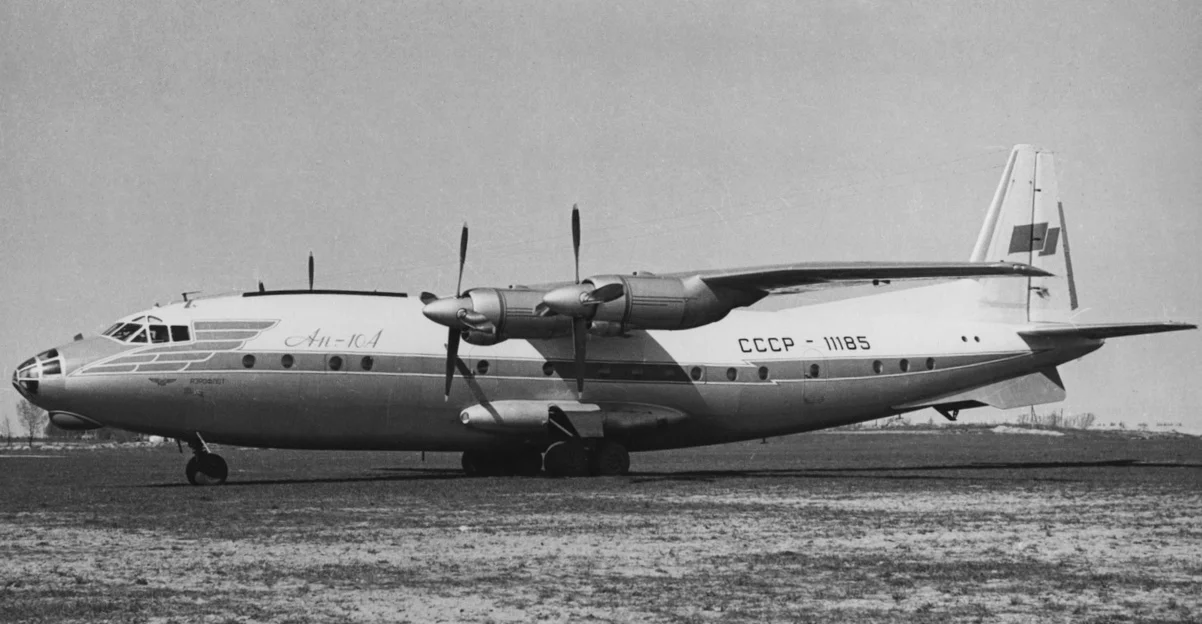

Aeroflot Flight 1491
The weather was perfect. On the morning of 18 May 1972, Aeroflot Flight 1491 left Moscow bound for Kharkiv under clear skies, the kind of untroubled conditions in which nothing is supposed to go wrong. At 11:44, air traffic control cleared the crew to descend to 1,500 meters. It was the last word anyone heard from the flight. Minutes later, passing through 1,700 meters, the Antonov An-10 came apart in mid-air, its wings folding upward as the aircraft disintegrated. All 122 people aboard were killed. There was no distress call, no warning - a plane full of ordinary travelers gone from the radar screens in the space of a few silent minutes.
The People Aboard
The flight carried 115 passengers and seven crew, and among them was a cross-section of Soviet life. There was Viktor Chistyakov, a beloved parodist and pop performer at the height of his fame. There was a journalist for the newspaper Izvestia, a Bulgarian mathematician, a senior legal scholar who had once served as a deputy prosecutor general. And there was a delegation of young East German pioneers - children, traveling far from home. The crew, led by Captain Vladimir Vasiltsov, belonged to Kharkiv's own aviation squadron, flying an aircraft that had been based in their city for over a decade. These were not abstract figures. They were performers and reporters and schoolchildren, each with a reason to be on that plane, each expecting to land in Kharkiv within the hour.
A Crack in the Wing
The investigators pieced together a chilling sequence. The emergency had begun barely a minute before the aircraft broke up, and its origin lay not in weather or pilot error but in the metal itself. Deep in the lower panel of the wing center section, fatigue cracks had been slowly growing - invisible fractures in the stringers and skin, opened by years of flight. The aircraft had accumulated more than 15,000 flying hours and over 11,000 takeoffs and landings. On this descent, a crack that had formed between two stringers spread in both directions until a critical rib failed, and with it the structure that held the wings to the fuselage. Both wings folded upward at once. The plane could not survive it. Wreckage was scattered across the Olkhovaya Balka forest, some twenty-four kilometers short of the airport.
The End of an Aircraft
Flight 1491 was not the only An-10 to fall from the sky because of its wings, and this time the response was decisive. The investigation confirmed that the type had a structural vulnerability, and the Soviet authorities grounded every An-10 and An-10A in service. Aeroflot soon wrote off its entire fleet of them; a handful with low hours were converted to cargo duty, while others were parked in cities across the Soviet Union to serve out quiet afterlives as aviation monuments, and in a few cases as children's cafes. Only one An-10 survives today, preserved at the air force museum at Monino. Notably, the crash was reported in Pravda soon after it happened - unusual in a country where domestic air disasters were typically kept out of the press.
You Are Forever Alive
The victims of Flight 1491 were laid to rest at Kharkiv's fifth city cemetery, near the airport they never reached - the crew and the unidentified together, bound now to the city that had been their destination. At the main crash site, where the fuselage had come down in the forest, a monument once stood bearing the words "You are forever alive in our hearts." Over the decades it has largely vanished; today little remains but a piece of reinforcing bar with an iron wreath hung upon it, half-swallowed by the trees. It is a modest marker for so great a loss. But the forest holds the memory, and so does the cemetery, of a spring morning when a hidden flaw in metal took a hundred and twenty-two lives from a cloudless sky.
From the Air
The crash site lies at 50.15°N, 36.35°E in the wooded Dergachevsky district north of Kharkiv, in the Olkhovaya Balka forest, roughly 24 km from Kharkiv International Airport (UKHH), the flight's intended destination. From 3,000-5,000 feet the patchwork of forest and open steppe north of the city marks the area. Note that Ukrainian airspace is closed to civil aviation.
Nearby Stories
- Hryhorii Skovoroda Literary Memorial Museum 7.2 km away
- Chuhuiv 24 km away
- Giant Ukrainian Radio Telescope 32 km away
- Central Black Earth Nature Reserve 61 km away
- Trostianets 63 km away
- Dykanka 96 km away
- Second Battle of Kharkov 107 km away
- Grace Darling 519 km away