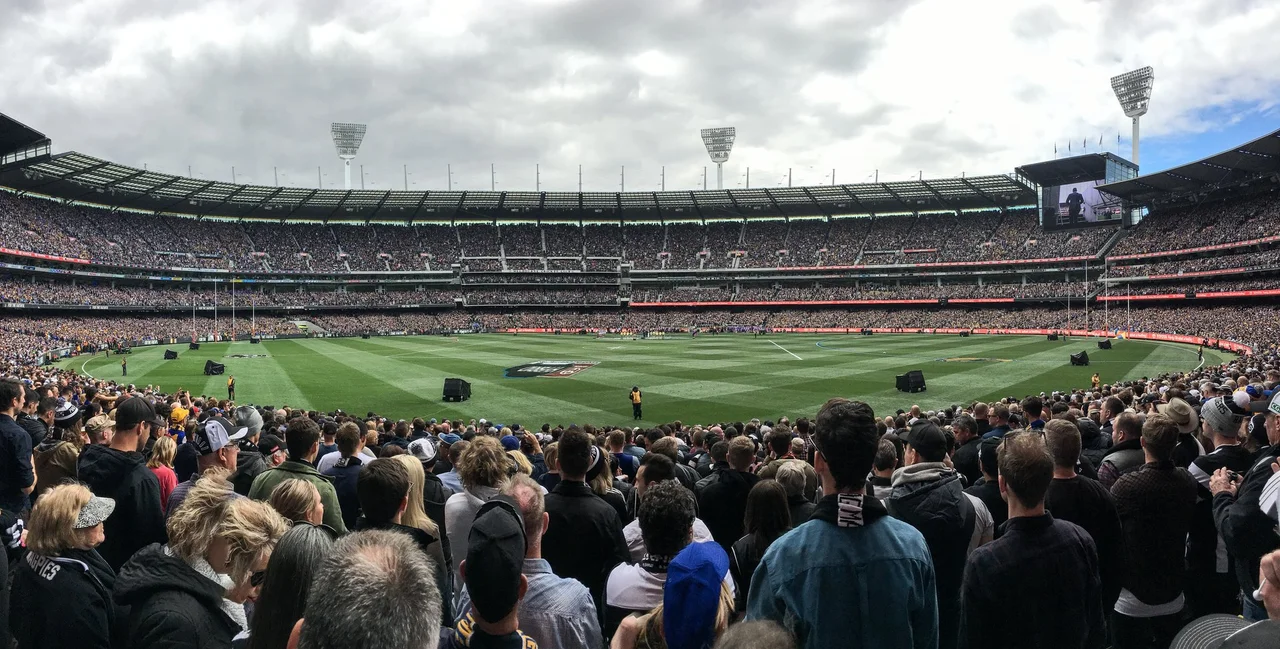

AFL Grand Final
For one Saturday afternoon at the end of September, a single patch of grass in Melbourne becomes the most important place in the country. More than a hundred thousand people pour into the Melbourne Cricket Ground, millions more watch from couches and pubs from Perth to Cairns, and an entire nation's attention narrows to the bounce of an oval ball. This is the AFL Grand Final, the match that decides the premiers of Australian rules football, and Australians do not really argue about whether it is the biggest day in their sporting calendar. They just turn up.
One Day in September
The Grand Final has its own gravity and its own folklore. It is so woven into the city's rhythm that Victoria declares a public holiday on the Friday before, and the match is so bound to its timeslot that it has been nicknamed One Day in September, the title of a famous football song. The league has resisted every temptation to move it. Rival codes chase prime-time television money by playing their championships under lights, but the Grand Final stays stubbornly in the Saturday afternoon sun, most recently bouncing down at 2:30pm. League officials have admitted that twilight would be more lucrative. Tradition has simply outvoted the money, year after year.
A Match Older Than Federation
The game now recognised as the first Grand Final was played on 24 September 1898, between Essendon and Fitzroy, before a crowd of 16,538. It nearly did not happen at all. Essendon spent the night before disputing the ground and even announced it would forfeit, then relented and played, and Fitzroy won. Since then the Grand Final has been staged almost every year, missing only 1924. The roll of honour stretches back through more than a century of Australian life: Carlton and Collingwood lead with sixteen premierships each, while Collingwood has reached the most Grand Finals of all and once won four in a row between 1927 and 1930. To win is to take the premiership cup, a flag, and a gold medallion that players wear for the rest of their lives.
The Ground That Swallowed a City
Since 1902 the match has belonged to the Melbourne Cricket Ground, and the relationship has only deepened with time. The current agreement locks the Grand Final to the venue every year until 2059. The numbers from its peak are almost unbelievable. In 1956, dressed up as a rehearsal for the Olympic opening, a record 115,802 squeezed in, with people perched on grandstand fences and even the roof of the southern stand while twenty thousand more were turned away at the gates. The all-time high came in 1970, when 121,696 watched Carlton storm back from forty-four points down to beat Collingwood, a comeback so total it remains the benchmark against which all others are measured.
Heroes Made in Seconds
What keeps the legend alive is how often the whole season turns on a single instant. In 1966, with the scores level and ninety seconds left, an eighteen-year-old named Barry Breen scrambled an ugly kick through for a behind to win St Kilda its only premiership in history. In 1989, Dermott Brereton was knocked flat at the opening bounce yet played on to kick three goals while a teammate ran most of the match with a punctured lung, in a final so brutal it is still called one of the greatest ever played. In 2018, Dom Sheed slotted a goal from the boundary line in the dying minutes to win it for West Coast. The best player on the day takes home the Norm Smith Medal, named for a man who won ten Grand Finals as player and coach and who, fittingly, once missed two chances to win one himself.
More Than a Match
By the time the ball is bounced, the day has already become a festival. A parade winds through the city or down the Yarra on boats every Grand Final Friday, drawing crowds of a hundred thousand and more. The North Melbourne breakfast, televised since the 1970s, gathers prime ministers and premiers before dawn. Big-name acts perform on the turf, sometimes gloriously and sometimes so badly that the performances become legends of their own. And when it is over, a cartoon poster of the winning club's grinning mascot, drawn in the same tradition since 1954, sells more than a hundred thousand copies through the newspaper. The football is the centre, but the day spills far beyond it, the way a national ritual always does.
From the Air
The Melbourne Cricket Ground sits at roughly 37.82 degrees south, 144.983 degrees east, in Yarra Park just east of central Melbourne and beside the Yarra River. From the air the stadium is unmistakable: a vast roofed oval ringed by parkland, with the city towers immediately to the west and the Melbourne Park tennis arenas and the Australian Open precinct right alongside to the south. Recommended viewing altitude is 2,500 to 4,500 feet AGL to take in the ground, the river and the central business district together; on Grand Final day the surrounding streets and parklands fill with crowds. Note that this is dense controlled airspace beneath Melbourne approaches. The nearest fields are Essendon (ICAO YMEN) to the northwest and Moorabbin (YMMB) to the southeast, with Melbourne Tullamarine (YMML) and Avalon (YMAV) the major airports. Expect crisp, changeable late-winter weather typical of a Melbourne September.
Nearby Stories
- Geelong 12 km away
- The Disappearance of Harold Holt: The Prime Minister Who Vanished Into the Sea 41 km away
- Eureka Rebellion 54 km away
- Yarra River 55 km away
- Sovereign Hill 65 km away
- Waterloo Plains massacre 73 km away
- Glenrowan, Victoria 142 km away
- Bass Strait 210 km away