.jpg)
Agats
Twice a day the sea rises up to 5 meters and Agats becomes, briefly, a town on water. The tide comes in from the Arafura Sea through the delta of the Asewets River and swallows the ground floor of everything without a ground floor. In Agats, the ground is not reliable. The solution, worked out over generations and formalized by the Dutch colonial post that arrived in 1938, is to build everything on stilts. Homes on stilts. Shops on stilts. Wooden boardwalks connecting them, replaced in recent years with concrete by a regency government with the budget to pour it. The town sits on the tidal flats of southwest Papua, above one of the most remarkable cultures in the Pacific and one of the most famous unsolved disappearances in mid-twentieth century anthropology.
Above the Mud
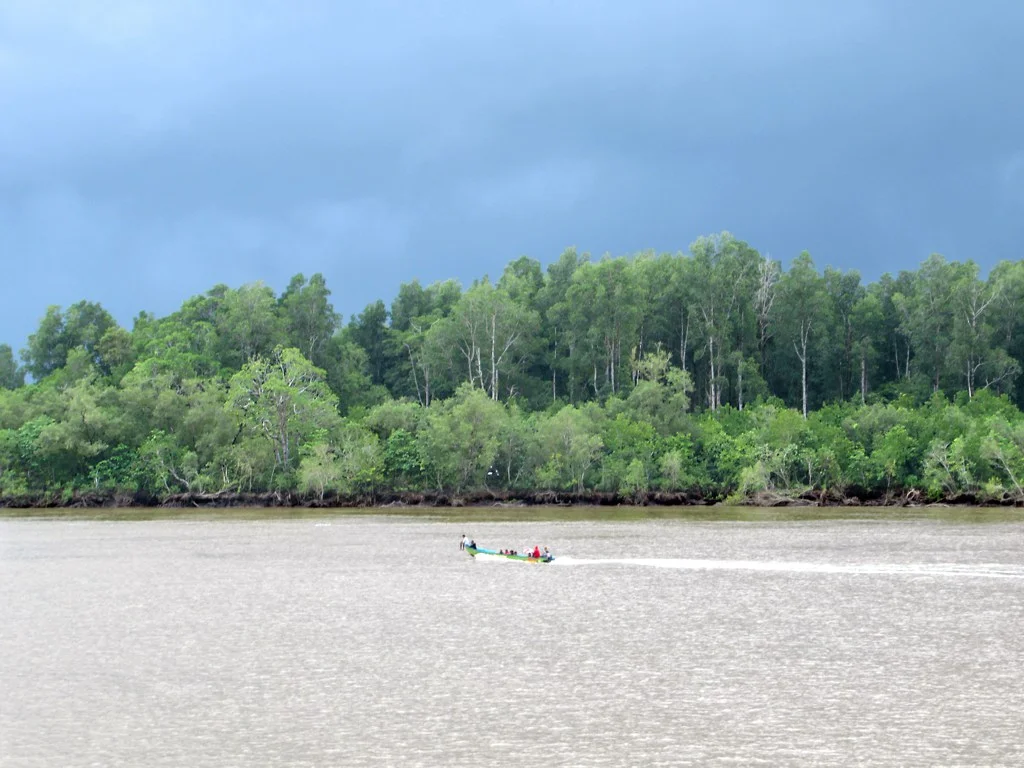
The geography of Agats requires invention. The Asewets flows past the town brackish and polluted; drinking water comes from rainwater catchment, bottled water, or a cleaner river pumped in from elsewhere. At high tide the streets would be underwater if they existed at all, so they don't exist at ground level. Instead the entire settlement floats slightly above the mud, connected by walkways that once creaked underfoot in ironwood and now increasingly clang in concrete. Electric motorcycles thread the boardwalks; charging stations run by PLN, the national utility, have appeared in the last decade. Shops. A hospital. Churches and a mosque. All elevated. It is a town that looks, from a low flight over the delta, like a page of architecture printed on a field of water.
The Asmat
Agats is the administrative heart of Asmat Regency, homeland of the Asmat people, whose woodcarving tradition is among the most celebrated in the Pacific. Long before Dutch missionaries arrived in the late 1930s, Asmat communities lived along these rivers in ceremonial longhouses, shaped by ritual cycles that outsiders did not always understand and sometimes simply outlawed. The Dutch abandoned their 1938 outpost in 1942 when Japanese forces advanced. The permanent Catholic mission that took root in 1953 was followed a year later by a permanent Dutch administrative post, which banned headhunting and opened the region to a wave of ethnographers, collectors, and museum buyers. The carving tradition, already sophisticated, found a global market. Masterworks of Asmat shields, ancestor poles, and spirit figures moved from village ceremonies into museum cases in New York, Amsterdam, and Jakarta.
The Diocese and the Museum
On 29 May 1969 the Roman Catholic Diocese of Agats was established, with American bishop Alphonse Sowada as its first leader. Sowada, a Minnesotan who became fluent in Asmat and devoted decades to the region, helped found the Asmat Museum of Culture and Progress, known in Indonesian as Museum Kebudayaan dan Kemajuan Asmat. The museum opened in 1973 and still anchors Agats visually and culturally: paper-mulberry spirit masks, carved crocodile totems, and ceremonial drums assembled as something closer to a living collection than a traditional institution. The diocese and the museum together played a peculiar double role, preserving a culture under intense pressure while being themselves agents of its transformation. That contradiction is part of the story; no one here pretends otherwise.
What Arrived After 2002
When Asmat became its own regency in November 2002, split off from Merauke, Agats became a capital. Construction accelerated. Government offices filled in. Migrants arrived, mostly Bugis from South Sulawesi and Moluccans from the Banda Sea islands, drawn by the new economy of a new regency. Annual population growth in Agats itself hit 22 percent between 2005 and 2011, compared to about 3 percent for Asmat Regency as a whole. Bis Agats, the urban kampung at the heart of the town, held 8,998 people by 2016. A famine struck the regency in 2018, and President Joko Widodo personally proposed relocating families from more remote districts into Agats; the proposal met significant resistance from communities unwilling to leave their ancestral rivers and forests.
Getting Here and Getting Out
Ewer Airport, a few kilometers from town, handles the subsidized pioneer flights from Merauke and Timika. Upgrades begun around 2019 allowed ATR turboprops to begin operating into Ewer; the river port received parallel improvements to handle the larger Tol Laut ships that connect eastern Indonesian ports. Passenger boats also run directly to Timika and Merauke. Nobody arrives in Agats by road. Nobody leaves by road. The town is, in every practical sense, an island on a tidal plain, and the rhythm of its days still follows the movement of water through the delta. Visit in the morning. Watch the tide come up under the boardwalks by afternoon. Notice how little of what happens here can be explained from anywhere else.
From the Air
Located at 5.54°S, 138.13°E on the Asewets River delta, southwest Papua. Ewer Airport (ICAO: WAKE) sits just outside town. The terrain is tidal flats and swamp at near sea level; expect convective rain and a tropical rainforest climate with heavy year-round rainfall. Approach from the Arafura Sea. No significant relief nearby; the nearest high ground is the Jayawijaya Mountains far to the northeast. Maintain visual separation from the dense river channels that braid the delta.
Nearby Stories
- Western New Guinea 30 km away
- Baliem River 41 km away
- Puncak Trikora 104 km away
- Tembagapura 132 km away
- New Guinea Mangroves 145 km away
- Puncak Jaya 165 km away
- Boven-Digoel Concentration Camp 200 km away
- Marchinbar Island 613 km away