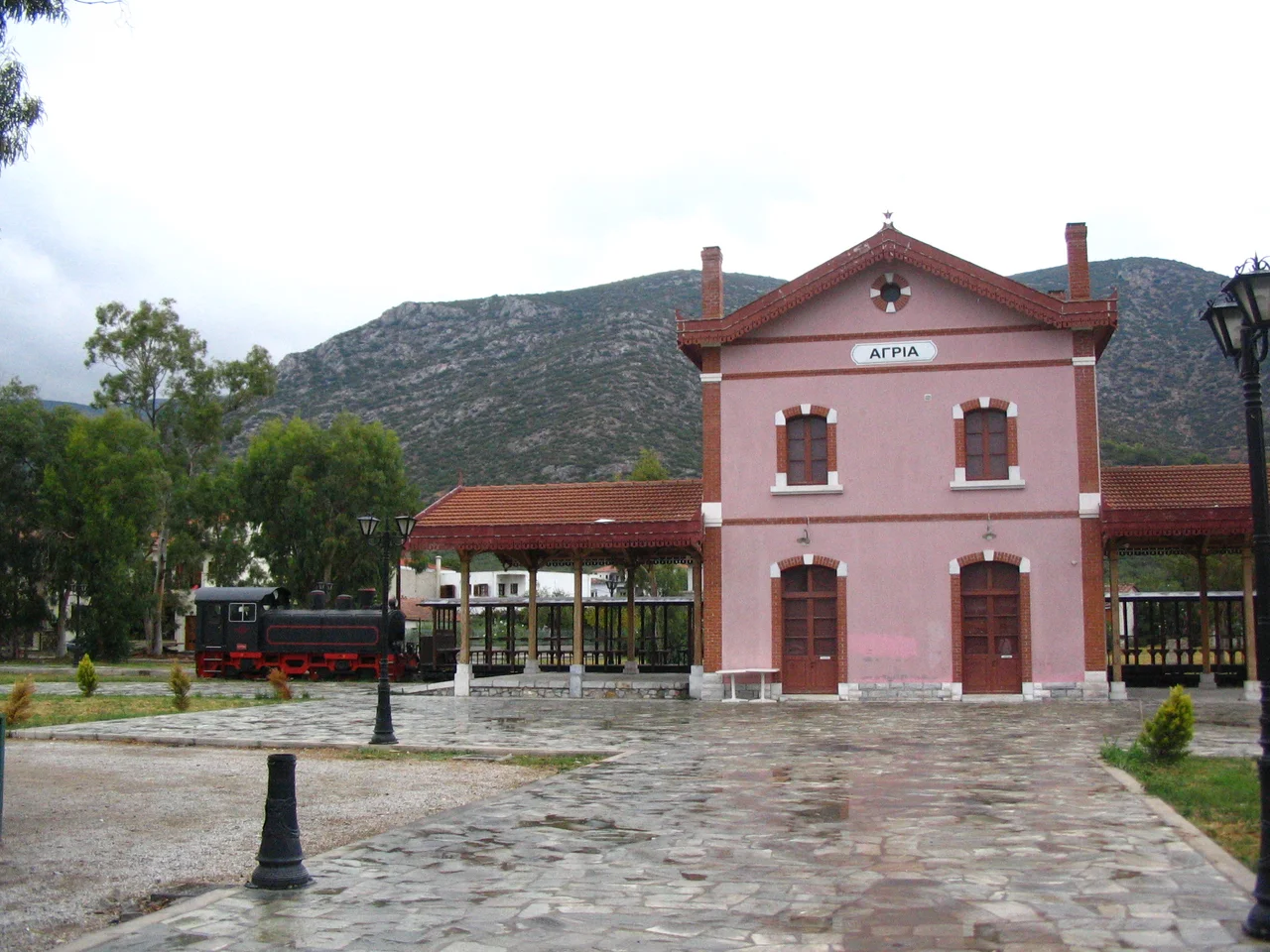

Agria
The synthesizer chords that open Chariots of Fire, the ones that play in slow motion over runners on a beach, were written by a man born here. Evangelos Odysseas Papathanassiou, known simply as Vangelis, came into the world in Agria in 1943, started composing at four, and went on to win an Academy Award. The town he was born in sits on the Pelion peninsula about seven kilometers from Volos, a strip of coast that has spent two centuries reinventing itself, from a caravan stop under Ottoman rule to an olive port that once claimed, with cheerful exaggeration, to be the busiest on Earth.
What's in the Name
Even the town's name is an argument. Some say Agria comes from the wild olive trees, the agrielies, that grew across these slopes. Others trace it to a small plant called agriada. A local scholar, Patroklos Palamidas of nearby Lechonia, offered a grander theory: that the name descends from an ancient temple dedicated to Agrea Dimitra, a rural aspect of the harvest goddess Demeter. Whichever you believe, the threads all run back to the same thing, the land and what grows on it. For most of its history Agria has been defined by olives, and the debate over its name is really a debate over which kind of fertility came first.
The Largest Port in the World
Through the long Ottoman centuries, Agria was little more than a caravan hostel and a toll station on the road. Real houses went up only in the early 1800s. The town took off after 1881, when Thessaly was annexed to Greece, and a coastal road and railway built in 1895 wired Volos to the villages of southwestern Pelion. Suddenly the bay had a way to move its sea fruit, its oil, and its black olives to the wider world. By 1920 an English trade paper called Agria the largest port in the world, measured by its exports of olives and oil. The boast was generous. The pride behind it was real, and around 200 tons of table olives still leave the town each year.
Cement, Lemonade, and Refugees
Industry arrived with the new century. In 1911 the A.G.E.T. Hercules cement plant was founded on a natural harbor, growing into one of Europe's larger producers. In 1924 the Kosmadopoulos brothers built a refrigerated fruit and ice plant and launched EPSA, a lemonade maker whose closely guarded recipe is still in use. Then, in 1922, came a wave of people who reshaped the town entirely. Refugees from Asia Minor, mostly from Eastern Thrace, arrived after being expelled from homelands their families had lived in for generations, part of the vast population exchange that uprooted millions. They took shelter in Agria and helped rebuild it, weaving their loss into the town's growth.
Occupation and the Sea
The Second World War left its marks here. From 1941 the town was a base for Italian occupation forces, and from late 1943 it housed a company of Waffen-SS field engineers; the commander's neoclassical house still stands by the church of Agios Georgios, a quiet reminder beside an ordinary street. The harder history sits alongside an easy summer pleasure. Today Agria fills with visitors who come for the boulevard and the swimming at nearby Soutrali beach, and for the rock-cut chapels of Timios Stavros and Panaghia Tripa. Each midsummer, on a night of the new moon, the town honors its fishermen with a feast of kakavia, the traditional fish soup, ladled out by the water that built the place.
From the Air
Agria sits at 39.340 degrees N, 23.013 degrees E, on the Pagasetic Gulf coast about 7 km southeast of Volos, at the foot of the Pelion peninsula. From the air it reads as a coastal town backed by the rising Pelion slopes, with the prominent cement works on its natural harbor serving as an unmistakable landmark. The nearest airport is Nea Anchialos National (LGBL), across the gulf to the west-southwest. Follow the curving northern shore of the Pagasetic Gulf southeast from Volos to find it. Clear daytime conditions give the best view of the town against the green mountainside.
Nearby Stories
- Farsala 10 km away
- Oreus 10 km away
- Glossa 13 km away
- Archaeological Museum of Lamia 14 km away
- Tempi Train Crash 55 km away
- Mount Olympus 61 km away
- Siege of Euripos 62 km away
- Byzantine Empire under the Palaiologos Dynasty 112 km away