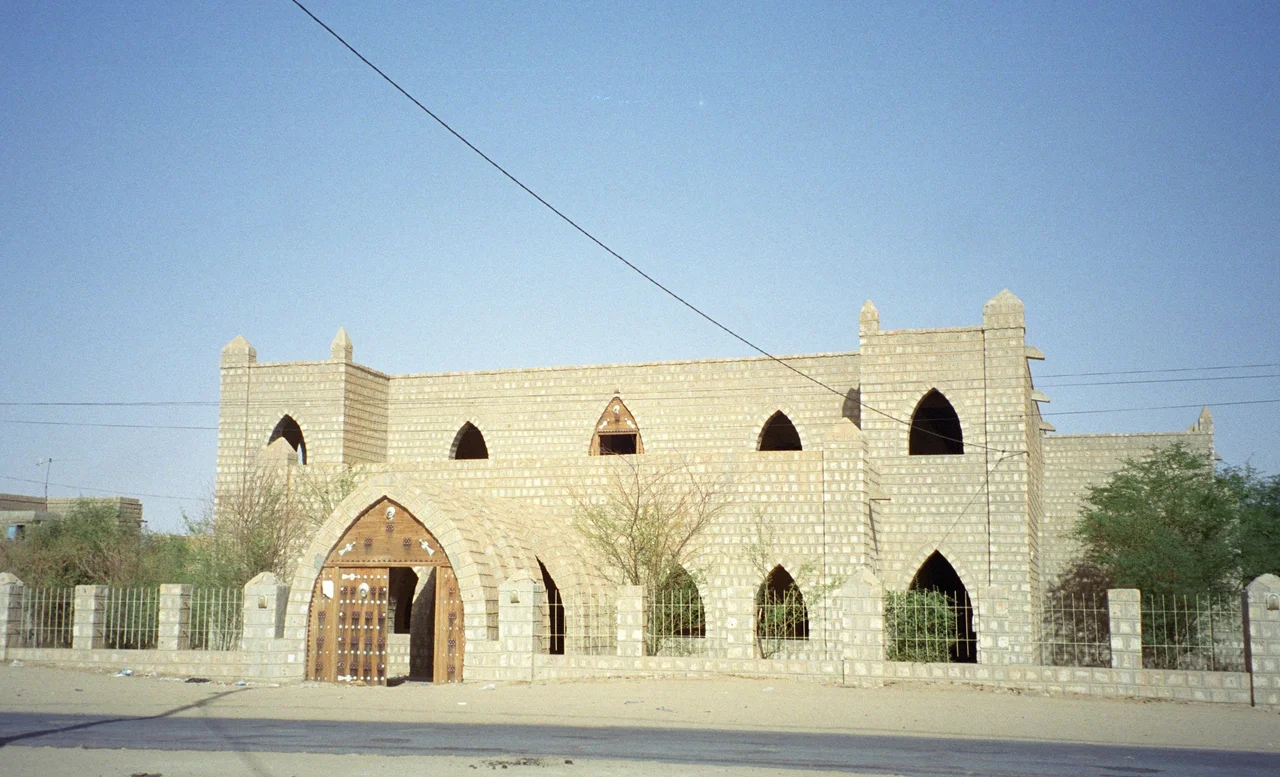

Ahmed Baba Institute
The fire was meant to be the last word. On January 28, 2013, as French and Malian troops closed on Timbuktu, the retreating occupiers who had used the Ahmed Baba Institute as a barracks set it alight. Early reports said the whole library and its treasures were gone. They were wrong. The flames consumed some four thousand manuscripts, but tens of thousands more had already vanished, not in smoke but in secret, spirited out of the city by the people of Timbuktu in one of the great cultural rescues of our time.
Named for a Scholar in Exile
The institute carries the name of Ahmad Baba al-Massufi, the brilliant seventeenth-century scholar of Sankoré who was exiled to Morocco when invaders conquered his city in 1591, losing his vast personal library in the process. Four centuries later, the institution bearing his name was founded in 1973, financed largely by Kuwait, with a single purpose: to gather, protect, and study the written legacy of Timbuktu. For generations, families across the city had kept manuscripts in trunks and back rooms, inherited heirlooms of a literate civilization that flourished while much of the world assumed Africa had no written history. The institute set out to prove otherwise, manuscript by manuscript.
A Civilization in Ink
What the institute preserves is staggering in range. The manuscripts are not only Qur'ans, though there are many of those. They are works of astronomy and mathematics, medicine and law, poetry and history, correspondence and commerce, some dating back centuries, written in elegant Arabic script and sometimes illuminated in gold. They are evidence, in their own hand, that Timbuktu was a city of readers and thinkers, of judges issuing rulings and astronomers charting the heavens. By 2013 a program to digitize them was underway, run by Norway and Luxembourg under UNESCO's eye, though only a fraction had been scanned when the war arrived.
The Quiet Evacuation
When the city fell in 2012, the danger to the manuscripts was immediate. The custodian Abdel Kader Haidara and a network of librarians and ordinary families began a covert operation that would last months. Night after night, they packed ancient works into metal footlockers and carried them out of Timbuktu, hidden in mule carts, vegetable wagons, and canoes, downriver and overland to safe houses and finally to Bamako, hundreds of miles south. In all, some 350,000 manuscripts were moved to safety. It was dangerous, exhausting work. During the French intervention, a helicopter nearly fired on a boat of manuscripts, mistaking the cargo for smuggled weapons.
What the Fire Could Not Take
Against that backdrop, the arson of January 2013 was a blow but not the catastrophe it first appeared. The roughly four thousand manuscripts lost to the flames had all been copied in digital form, and another ten thousand stored underground survived untouched. The institute's building could be repaired; the knowledge inside it had been carried out of harm's way by the courage of a community. The episode became, against every expectation, a story of preservation rather than loss, of librarians who treated old paper as something worth risking their lives for. In Timbuktu, the written word has outlasted empires, droughts, and armies. It outlasted this, too.
From the Air
The Ahmed Baba Institute (IHERIAB) lies at 16.78°N, 3.01°W in Timbuktu, Mali, on the southern fringe of the Sahara. The nearest airport is Timbuktu (ICAO: GATB), roughly 7 km north of the old city; the 2013 fire occurred as ground forces moved on the adjacent airfield. From the air the institute blends into the tan urban grid near Timbuktu's historic mosques. The dry season offers the clearest views; harmattan dust frequently degrades visibility over the region from late autumn into spring.
Nearby Stories
- Essakane 13 km away
- Liptako 18 km away
- Tondidarou 86 km away
- Hand of Fatima (rock formation) 159 km away
- Lake Débo 184 km away
- Hombori 187 km away
- Festival au Désert 332 km away
- Oualata 374 km away