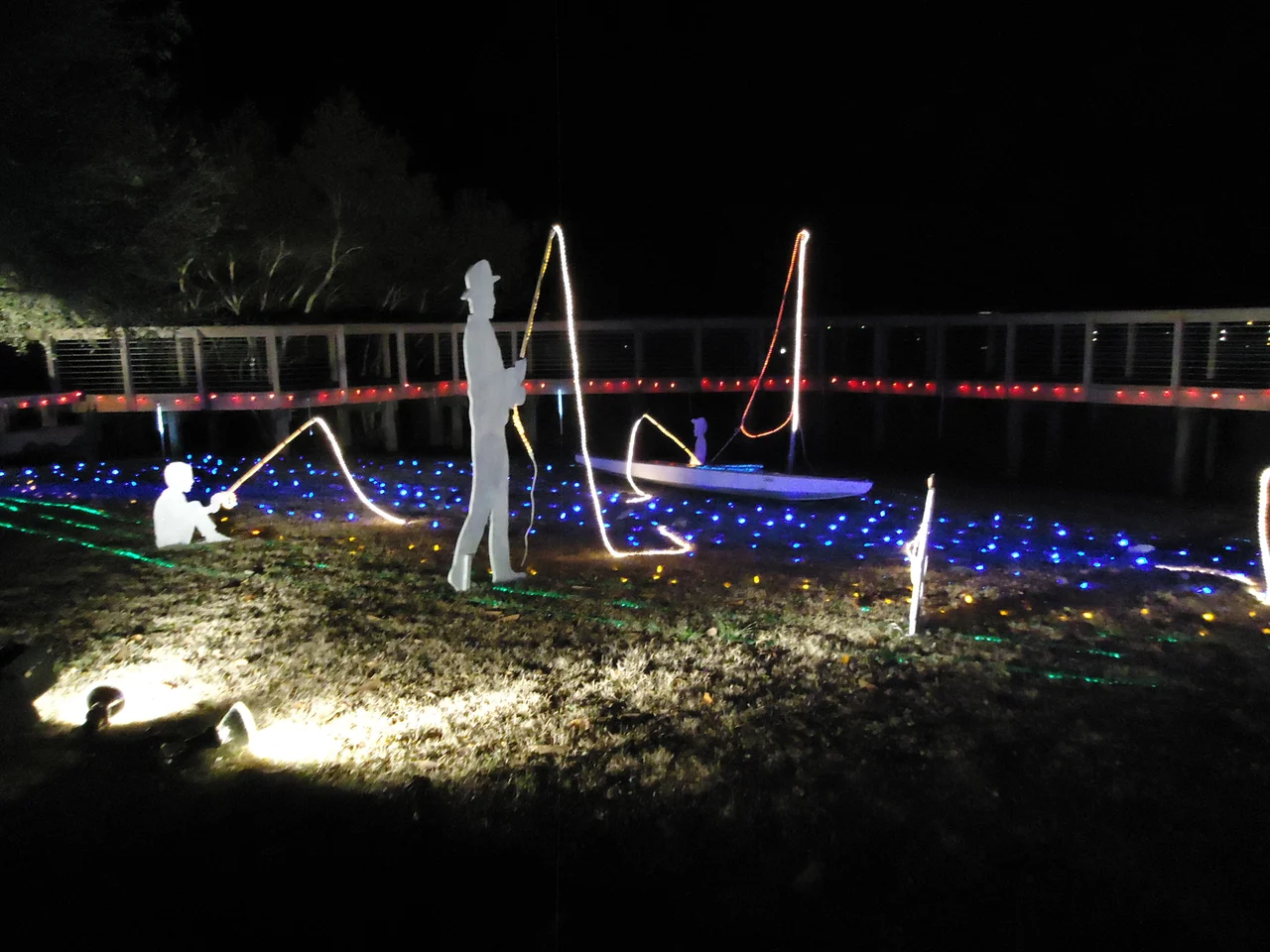

Airlie Gardens
Minnie Evans worked the front gate of Airlie Gardens for years, taking admission tickets from white visitors who had no idea that the woman in the booth was painting some of the most original work in 20th-century American art on the back of those tickets, on scraps of paper, on anything she could find. She had visions. She drew them in colored pencil and crayon, then ink and oil, faces inside faces, plants made of eyes, gardens that bloomed inward. Her painting Airlie Oak now hangs in the Smithsonian American Art Museum. The oak it was named for is still here, 500 years old, its crown spread wider than most houses.
Minnie Evans, Gatekeeper and Visionary
Minnie Evans worked the Airlie admission booth from 1948 until 1974, the gatekeeper who became one of the most important self-taught artists of the 20th century. She had begun drawing in 1935, at age 43, after a voice she described as inner instruction told her to. Born in 1892 to a family with roots in Trinidad and rural Pender County, she lived most of her life in Wilmington and saw, around her, a community that the Wilmington massacre of 1898 and decades of Jim Crow had repeatedly tried to erase. Her work refused that erasure. She painted faces emerging from foliage, suns with eyes, Edenic landscapes where Black presence was central rather than marginal. The Whitney included her work in 1975. The Smithsonian acquired Airlie Oak. The garden where she sat at the gate now centers her: the Minnie Evans Sculpture Garden inside Airlie's grounds includes the Bottle Chapel, a small structure built from thousands of colored glass bottles, lit from inside, designed by artist Virginia Wright-Frierson as a tribute to Evans's spirit. Step inside in late afternoon and the light moves across you in dappled blues, greens, ambers.
How a Family Built a Garden
Airlie was created in 1886 as a private garden for the Pembroke Jones family, designed initially by Sarah Green Jones and later transformed by German landscape architect Rudolf Topel. The name came from the Jones family's ancestral home in Scotland. The Joneses were New York-Wilmington wealth, the kind of Gilded Age fortune that could afford to plant thousands of azaleas just because they would look spectacular in April. Topel laid out a flowing, naturalistic Southern garden with sweeping vistas, hidden corners, and a planting palette built around what would bloom: azaleas, camellias, magnolias, palms, wisteria. The estate passed through several hands over the next century. New Hanover County bought it in 1999 and opened it to the public, which is how the gates Minnie Evans had once kept became the gates everyone now walks through.
The Oak
Airlie Oak is a southern live oak, Quercus virginiana, somewhere around 500 years old. In 1967 it was registered as member 238 of the Live Oak Society. When North Carolina Forest Service workers measured it in 2007, the tree stood 128 feet tall, its trunk circumference exceeded 21 feet, and its crown spread 104 feet. At that measurement it was the largest live oak in North Carolina. Standing under it is the experience the garden is built around. The branches reach down and then back up, draped in Spanish moss, low enough to touch in places. The light comes through filtered and slow. The oak was already an old tree when the first European colonists reached the Cape Fear River. It will likely be here when most of what we are building now is gone.
Mount Lebanon and the Storm
Tucked into the grounds is Mount Lebanon Chapel, built around 1835 by Thomas H. Wright. It is the oldest surviving church structure in New Hanover County, part of the parish of St. James Church in Wilmington. The little Gothic Revival chapel was used by summering Wilmington families who couldn't make it back into town for Sunday services. The graveyard beside it holds Wright family stones and others, the names worn smooth where they have weathered. In September 2018, Hurricane Florence sat over the Carolinas for days and dumped historic rainfall. At Airlie, more than 300 trees came down. The garden closed for cleanup, reopened in November, and the staff is still planting replacements. The 500-year oak survived. Some things have been doing this longer than the storms.
From the Air
Airlie Gardens sits at 34.215 N, 77.828 W on the east side of Wilmington, just inland from Wrightsville Beach. From 2,000-4,000 feet AGL the gardens read as a dense pocket of forest, ponds, and clearings tucked between the Intracoastal Waterway to the east and Wilmington's suburban grid to the west. Look for the small dark mirror of Airlie Lake and the brighter green of the formal garden beds. Wilmington International (KILM) lies about 6 miles northwest.
Nearby Stories
- Ocean Isle Beach house fire 4.7 km away
- Pender County, North Carolina 6.6 km away
- Bald Head Island 13 km away
- Marine Corps Base Camp Lejeune 16 km away
- Lake Waccamaw, North Carolina 17 km away
- The Robesonian Takeover 59 km away
- Swansboro 59 km away
- Mercury-Redstone 4 726 km away