.jpg)
Al-Balad, Jeddah
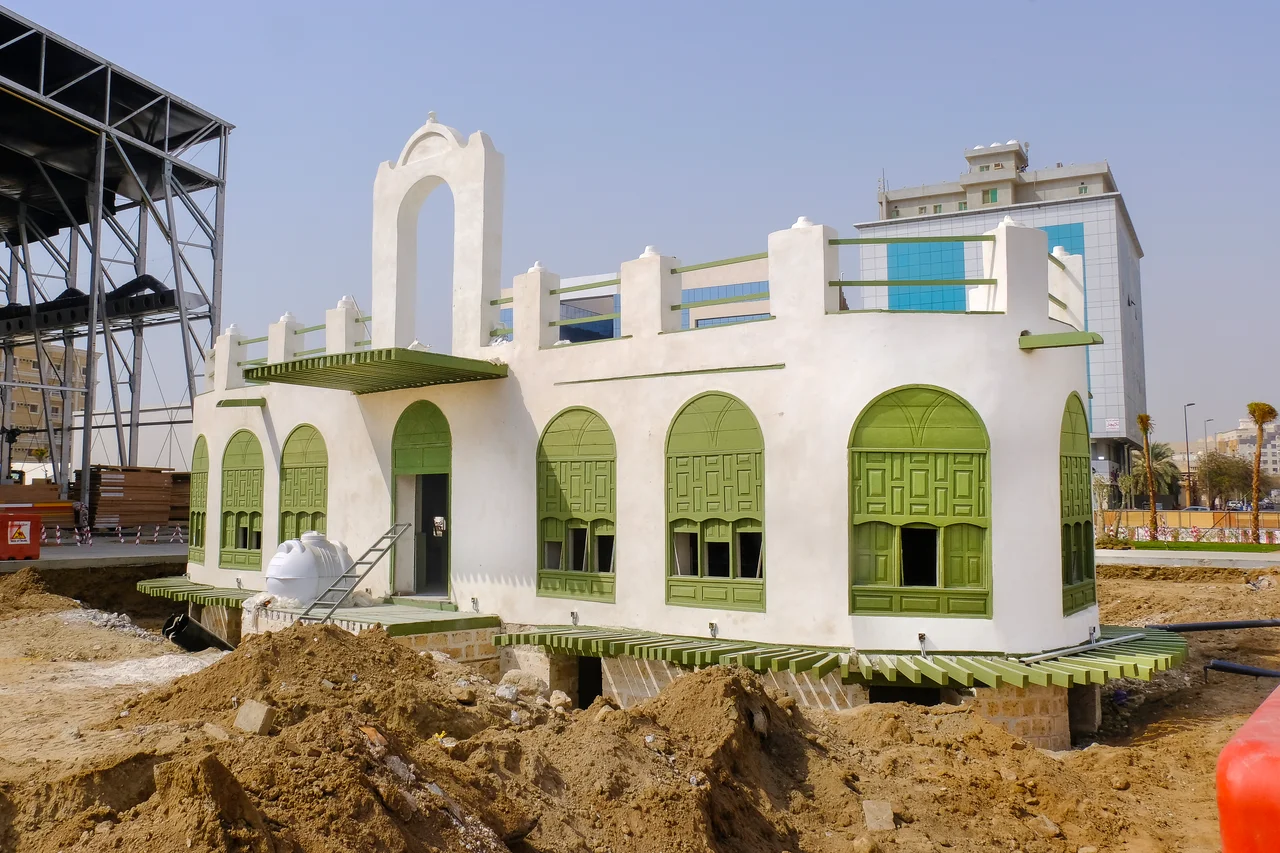
The wooden latticework catches the Red Sea light before the air ever touches it. These are the roshan windows of old Jeddah - screens carved from teak and imported hardwoods that let women watch the street without being seen, that break the afternoon glare into shadow-lace on the floors inside. Behind them rise the coral-stone houses of Al-Balad, some more than 30 meters tall, balanced on foundations built from blocks quarried out of the reef itself. This is the town that Jeddah was before it was the city Jeddah has become, and Arabic has a word for its simple relationship to the metropolis surrounding it: Al-Balad, the town.
The Gate to Mecca
Al-Balad was founded in the 7th century as the port that received pilgrims bound for Mecca - a role it still plays, though the modern terminal is elsewhere now. For more than a thousand years, every Muslim arriving by sea to perform Hajj passed through here first. The defensive walls that once ringed the quarter were torn down in the 1940s, their stones absorbed into newer construction. The oil boom of the 1970s and 1980s emptied it. Wealthy Jeddawis moved north to neighborhoods with parking for large cars and shops stocking designer labels. Al-Balad had neither. It reminded them of poorer decades, and so they left. Poor immigrants moved in. By 2007, much of the original population was gone - but during Ramadan, the streets still filled with people who remembered, or whose parents remembered.
Four Neighborhoods, Each a Direction
The town divides into quarters named like a compass of influences. Al-Mazloum, in the northeast, takes its name from Abdulkarim al-Barzanji, a scholar killed by the Ottoman government - al-Mazloum meaning the wronged. Al-Sham, in the north, points toward the Levant. Al-Yemen, in the south, acknowledges the country whose caravans and migrants arrived by camel from below. Al-Bahr, the sea quarter, opens westward to the water. Each district holds its own houses, each house its own family name. In Al-Yemen stands the Nassif House, built in 1872 - perhaps the district's most famous survivor, a merchant's palace whose rooms once hosted King Abdulaziz when he entered Jeddah in 1925. In Al-Mazloum stands the Al-Shafi'i Mosque, one of the oldest in the city.
The Language of Wood and Coral
The Hejazi architecture that defines Al-Balad solved real problems with real materials. Coral blocks from the Red Sea reef cooled interiors naturally - porous, mineral, forgiving. Imported hardwoods from India and East Africa became the frames of doors and windows, because the scarce trees of the peninsula could not produce beams long enough for houses this tall. The roshan and mushrabiya screens did triple duty: privacy for women, ventilation for hot rooms, diffused daylight for sleeping afternoons. Many of the buildings rise five and six stories. Some have stood for more than a century without serious structural work - their construction, in the words of the UNESCO evaluation that inscribed the district in 2014, in good condition after decades. Walk the alleys in the late afternoon and you hear wood creaking, cats arguing, the call to prayer rolling down from minarets whose bases are older than the United States.
A Cemetery Hidden Behind Trees
On King Fahd Branch Road stands a walled compound shaded by tall trees. The Non-Muslim Cemetery, formerly called the Christian Cemetery, is tended by the Western consulates of Jeddah. It was vandalized after the Battle of Jeddah in 1925, when Ibn Saud's forces took the port from the Hashemites. Among those buried here is Cyril Ousman, the British Vice-consul who was shot and killed by Prince Mishari bin Abdulaziz Al Saud in 1951 - a scandal the kingdom mostly chose to forget. The cemetery is hidden from sight by its own wall and the height of its trees, a small and deliberate piece of history in a city that has otherwise remade itself almost completely. It is the kind of place Al-Balad keeps: quiet, specific, hard to find unless someone tells you where to look.
The Rescue
By the 2000s, Al-Balad was in real danger. Buildings were collapsing. Preservation moved slowly. Then, in May 2019, Crown Prince Mohammed bin Salman announced a multi-billion dollar restoration of 56 historical buildings, with a first stage worth $13.3 million. In October 2023, the Public Investment Fund formed Al Balad Development Company, aligned with Saudi Vision 2030, with a stated mission to transform Historic Jeddah into a global destination. By May 2024, three of the historical houses - Jokhdar House, Al-Rayyis House, and Kedwan House - were being restored as luxury heritage hotels under UNESCO World Heritage Status supervision. The old town is being repopulated, more carefully this time. The roshan windows are being rebuilt by craftsmen trained to do the work the old way. The Saturday souks are coming back. If you are going to visit Jeddah, start here. This is where the city began.
From the Air
Al-Balad (Historic Jeddah) centers near 21.483 N, 39.200 E on the eastern Red Sea coast. King Abdulaziz International Airport (OEJN) sits about 20 km north. The district is a UNESCO World Heritage Site (inscribed 2014). From the air, look for the tight medieval street grid contrasting with the modern city's wide avenues, and the Red Sea visible to the west. Coastal weather can bring summer haze and high humidity; winter is typically clear. The area is dense low-rise - no tall hazards in the historic core itself, but modern Jeddah's skyline rises close around it.
Nearby Stories
- Battle of Fakhkh 12 km away
- Siege of Ta'if 72 km away
- Red Sea 73 km away
- Red Sea Rift 76 km away
- Ghadir Khumm 115 km away
- Ta'if 126 km away
- Hejaz 223 km away
- Operation Moses 229 km away