.jpg)
Alaçatı
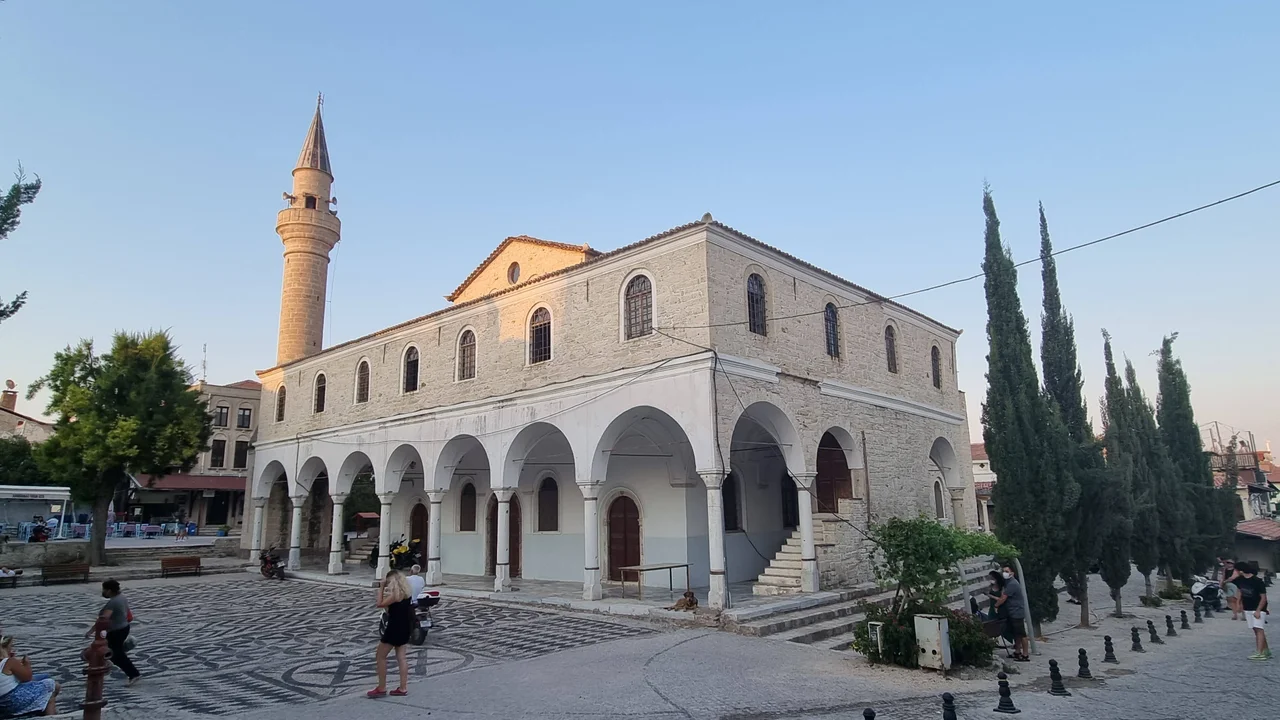
The shutters are the first thing you notice. Painted lilac and pale blue, set into walls of warm cut stone, they line the narrow streets of Alaçatı in a town that looks like it was composed for a photograph. It very nearly was an accident of history. These houses, with their distinctive enclosed bay windows, were built by Greek Orthodox families who lived here for generations and then, within living memory of their grandchildren, were gone. The town they left behind is now one of the most beautiful and most visited corners of the Turkish Aegean, and the beauty and the absence are the same story.
A Town Built on Salt and Stone
Alaçatı sits inland from the sea on the Çeşme peninsula, where the wind almost never stops. The town as it stands was largely shaped from the seventeenth century onward by Greek settlers, and even its name may carry that origin; one theory traces it to the Greek word for salt, alati, a nod to the salt pans and the tax once levied on them. By the late nineteenth century this was overwhelmingly a Greek town: in 1895 the records counted just 132 Muslims among a population of nearly fourteen thousand. The stone houses, the agora at its heart, the workshops and vineyards, all of it was the work of that community, building for a future it expected to keep.
The Year the Town Changed Hands
That future was broken by a decade of war. As the Ottoman Empire crumbled and Greek and Turkish nationalisms collided, the Greeks of the Aegean coast were caught in waves of expulsion, return, and flight. The Greek population was forced out in the years around the First World War, returned briefly during the Greek occupation of Smyrna from 1919 to 1922, then fled again amid the catastrophe that ended the Greco-Turkish War. Under the 1923 Treaty of Lausanne, the displacement was sealed into law as a compulsory exchange of populations. The Orthodox families of Alaçatı left for Greece; Muslim families uprooted from Crete, Macedonia, Thrace, and the Dodecanese were resettled in the houses they left behind. Two communities were unmade and remade by the same treaty, and both carried the loss with them.
Two Towns Named Alatsata
The departed did not forget. Scattered across Greece, refugees from here founded new settlements that kept the old name alive, communities called Nea Alatsata, New Alatsata, in Athens, on Crete, in Euboea and beyond, with others carrying it as far as Boston. Among those born in the town was George Dilboy, a Greek who emigrated to America and became the first Greek-American to win the Medal of Honor, killed in action in France in 1918. The Muslim families who arrived after 1923, themselves exiles from homelands across the sea, built their own attachment to the place over the century that followed. Today Alaçatı belongs to their descendants, a Turkish town that remembers, in its very stones, that it was once something else.
Wind, Wine, and Mastic
What the town kept was its setting. The same relentless wind that once carried laundry off the rooftops now draws windsurfers from around the world to the shallow bay below town, a forgiving stretch of water nicknamed the slalom capital of the world and a regular stop on the professional circuit. Inland, the old viticulture endures in vineyards and small wineries, and the peninsula still produces mastic, the aromatic resin tapped from Pistacia lentiscus trees, turned here into everything from coffee to ice cream. Every April the Herb Festival fills the streets to celebrate the wild greens of the surrounding hills.
A Resort with a Long Memory
Discovery came late and then all at once. When Alaçatı was declared a protected historical site in 2005, its stone houses were spared the demolition that erased so many old Aegean towns, and boutique hotels and street-side restaurants moved into the preserved shells. The New York Times named it one of the places to go in 2010, and the crowds followed. Wander the back lanes today, under cascades of bougainvillea and past the photogenic windmills on the ridge, and the town is undeniably charming. It is also, quietly, a monument, a beautiful place that asks visitors to remember the people who built it and the people who lost it.
From the Air
Alaçatı lies at 38.281°N, 26.374°E on the Çeşme peninsula in İzmir Province, Turkey, a few kilometers inland from its windsurfing bay and just east of the resort town of Çeşme. The nearest airport is Izmir Adnan Menderes (LTBJ), about 75 km east; the Greek island of Chios and its airport (LGHI) lie across the strait to the west. From above, look for the cluster of old stone houses and the windmills on the rise above town, with the wind-raked bay and marina to the south. Best viewed in clear afternoon conditions, when the Aegean wind that defines the place is at its strongest.
Nearby Stories
- Mastichochoria 3.4 km away
- Eğlenhoca 5.6 km away
- Izmir 22 km away
- Temple of Artemis at Ephesus 26 km away
- Destruction of Psara 38 km away
- Fourni 44 km away
- Ftelia 80 km away
- Akhisar Museum 82 km away