
All Hallows-by-the-Tower
Samuel Pepys climbed this church's tower on the second day of the Great Fire of London to look east toward the blaze. What he saw he called the saddest sight of desolation. All Hallows-by-the-Tower had been a church for nearly a thousand years by then, and it survived that night because Admiral William Penn - whose son would later found Pennsylvania - ordered his men from the nearby naval yard to blow up the buildings around the church to make a firebreak. Stand beside All Hallows today, just outside the Tower of London, and you are standing on the oldest continuously sacred ground in the City of London.
Roman Floor, Saxon Arch
In 1926 and 1927 archaeologists working beneath All Hallows uncovered a Roman pavement, set down when this corner of the city was still called Londinium. They also found fragments of three eleventh-century stone crosses and confirmed an Anglo-Saxon arch built into the church's west doorway. The traditional story is that All Hallows began as a daughter church of Barking Abbey, founded by Saint Erkenwald in the seventh century, with the land granted to his sister Abbess Ethelburga. More recent scholarship is more cautious; the surviving arch could have been built any time between the seventh century and the arrival of the Normans, and the stone church it belongs to almost certainly replaced an earlier wooden one. Either way, this is the oldest church inside the Roman walls.
Where the Beheaded Lay
All Hallows stands a hundred metres from the Tower of London, and that geography wrote itself into the parish register. Edward IV made one of its chapels a royal chantry. Bodies of those executed at the Tower were brought here first, sometimes for permanent burial, sometimes temporary. Sir Thomas More's headless body was brought to All Hallows in 1535 after he refused to sign Henry VIII's Act of Supremacy. So was John Fisher, Bishop of Rochester, beheaded a few weeks earlier. Archbishop William Laud, executed in 1645, lay in a vault here for twenty years before his body was moved to his old college at Oxford. The church's registers run unbroken back to the sixteenth century and include the baptism of William Penn in 1644 and, more than a century later, the marriage of the American president-to-be John Quincy Adams to Louisa Catherine Johnson in 1797.
Gunpowder and Fire
In 1650 some barrels of gunpowder being stored in a warehouse next door to the church exploded. The west tower came down, fifty nearby houses were destroyed, and many people died. The tower was rebuilt in 1658. Sixteen years after that came the Great Fire, when Admiral Penn's firebreak saved the church and let Pepys climb the tower to look. Then in 1940, during the Blitz, German bombs gutted the interior. All Hallows had survived the Reformation, the Civil War, the Great Fire, and the centuries between - and a single night of war very nearly finished it. The church was rebuilt and rededicated in 1957, with new carving by the Tasmanian-born wood-carver Ellen Nora Payne added to what had survived.
What the Bombs Left
Many of the older parts of All Hallows came through the war intact. The fifteenth-century outer walls still stand. The Anglo-Saxon arch in the west doorway is still there. Inside, three medieval wooden statues of saints from the fifteenth and sixteenth centuries survive, and so does the baptismal font cover that the great wood-carver Grinling Gibbons made in 1682 for the modest sum of twelve pounds - now regarded as one of the finest pieces of carving in London. The crypt holds a museum that includes that Roman pavement, the church's silver plate, and registers going back to the sixteenth century. The crypt altar is made of plain stone taken from the castle of Richard the Lionheart at Atlit, in the Holy Land.
Tubby Clayton and Toc H
In 1922 the Reverend Philip Clayton - universally known as Tubby - became vicar of All Hallows and brought with him the organisation he had founded during the First World War. Toc H started as a soldiers' rest house in the Belgian town of Poperinghe, behind the Ypres salient, and grew into an international Christian charity dedicated to friendship across class and creed. All Hallows has been the guild church of Toc H ever since. Tubby Clayton served the parish until 1963 and his effigy still rests in the church. The Knollys Rose Ceremony, held every June, begins at All Hallows and processes to the Mansion House, where a single rose is presented to the Lord Mayor as a token quit-rent that dates back to 1381.
Beating the Bounds
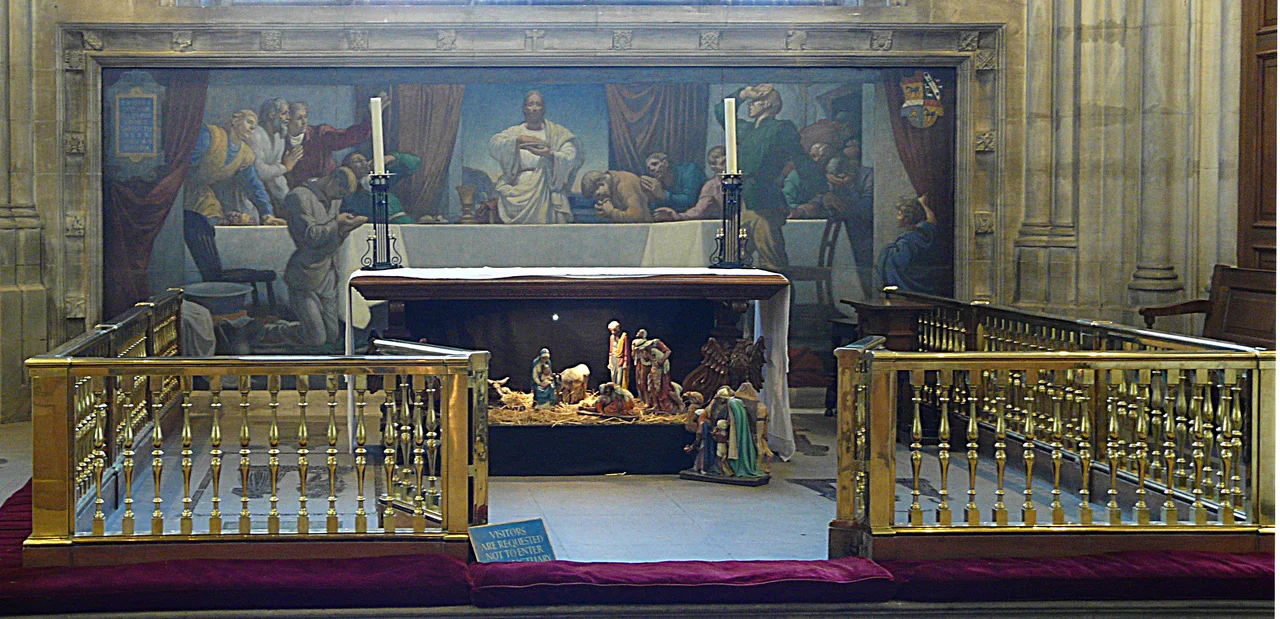
Every Ascension Day the parish still beats the bounds, an ancient ritual in which parishioners walk the perimeter of their parish striking boundary markers with willow wands. At All Hallows the southern boundary runs through the middle of the Thames, so the procession includes a boat trip out into the river to beat the water itself. Outside the church, just to the south, stands the Malta George Cross Memorial. To the east rises the White Tower. The hum of tourists from the Tower of London drifts past. Inside, beneath a post-war reredos by Brian Thomas and an organ first installed by Thomas and Renatus Harris in 1675, the parish goes on doing what it has done since before the Conquest: holding services, ringing chimes, registering births and marriages and deaths in the heart of the oldest part of London.
From the Air
Located at 51.5094 N, 0.0794 W in the City of London on Byward Street, just north-west of the Tower of London. From altitude, look for the distinctive white stone of the Tower complex on the north bank of the Thames; All Hallows sits immediately to the Tower's north-west, with its grey-green spire visible against the office blocks of the City. Tower Bridge is half a mile to the south-east. Nearest airports: London City (EGLC) approximately 4 nautical miles east-south-east; London Heathrow (EGLL) approximately 15 nautical miles west. Best viewed at 1,500 to 3,000 feet.
Nearby Stories
- Stevenage 5.7 km away
- Malling Abbey 5.7 km away
- 1952 Farnborough Airshow Crash 7.7 km away
- Ingatestone Hall 8.2 km away
- Hellfire Caves 9.1 km away
- The Carrington Event: The Solar Storm That Could Happen Again 9.8 km away
- Bletchley Park 16 km away
- Castle Hedingham 23 km away