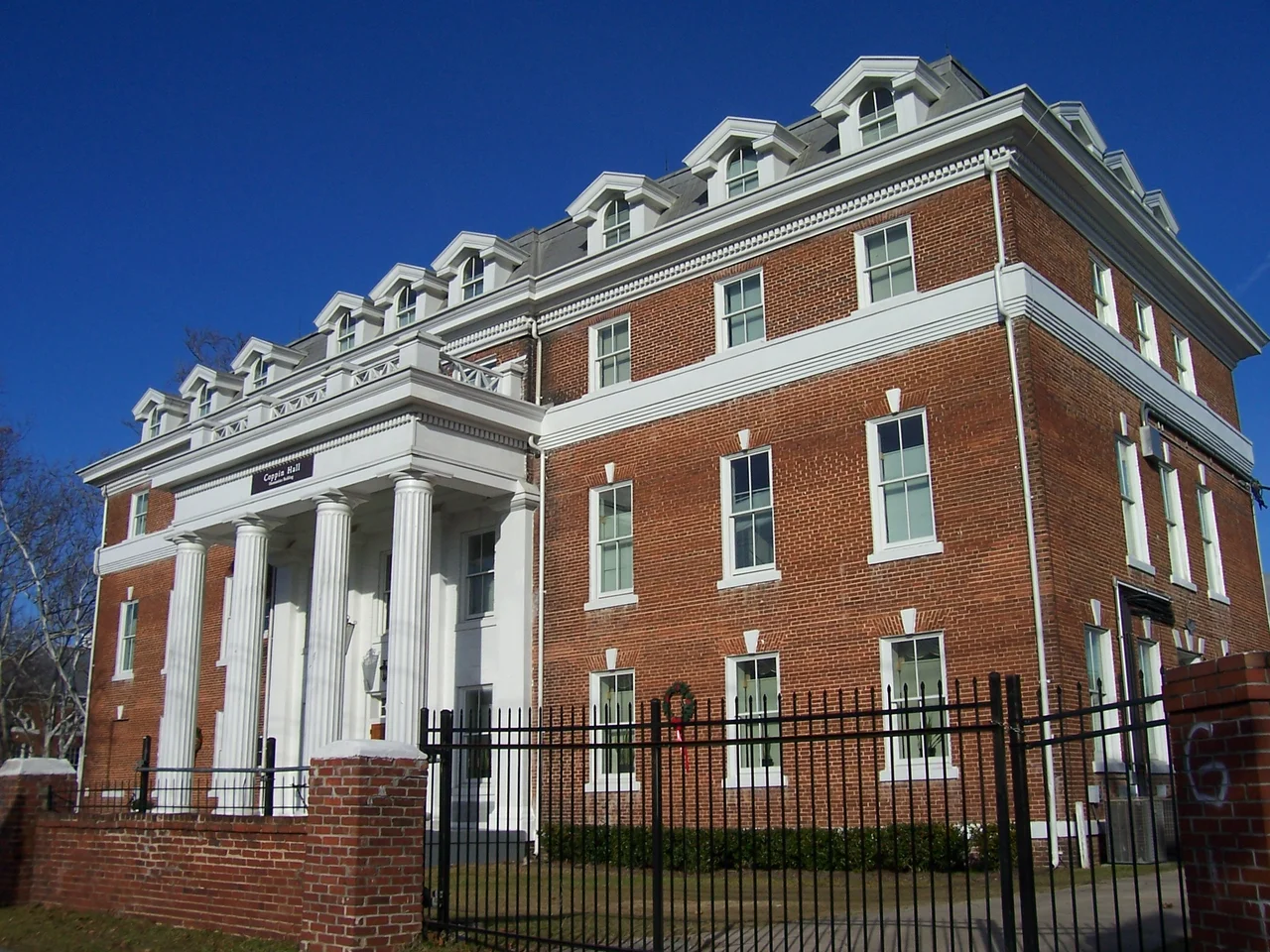

Allen University Historic District
Four years. That is how long Allen University waited after the University of South Carolina formally barred African Americans in 1877 before laying the cornerstone of its own permanent home in Columbia. Ministers of the African Methodist Episcopal Church had founded Payne Institute in 1870 to teach freedmen and their children to read, write, and preach; in 1880 they moved the school to the capital, renamed it for AME founder Richard Allen, and bought ground on what would become 1530 Harden Street. The first major building went up in 1888. The four red-brick structures that ring the campus green today - finished between 1891 and 1941 - are the architecture of a refusal: the refusal to wait for permission, the refusal to ask the state to teach Black children what the state had decided Black children would not be taught.
A Campus the State Would Not Build
The Allen University Historic District covers Arnett Hall, the Chappelle Administration Building, Coppin Hall, the Joseph Simon Flippen Library, and the Canteen Building. Together they are listed on the National Register of Historic Places, added April 14, 1975, and they also fall inside the Waverly Protection Area within Columbia's local preservation system. The campus reads as a coherent Classical Revival ensemble - red brick, white columns, restrained pediments - because that vocabulary was the vocabulary of American public dignity in the late nineteenth century. Building in that style was a deliberate claim: a Black university in the post-Reconstruction South was entitled to look as serious as any other American institution of higher learning, and it would.
The Chappelle Building
The centerpiece of the district is the Chappelle Administration Building, which is also a National Historic Landmark in its own right - one of relatively few structures in South Carolina to carry that highest designation. It was designed by John Anderson Lankford, an architect educated at Tuskegee Institute and Shaw University, known as the Dean of Black Architects, who served as the official architect of the AME Church and produced churches, schools, and lodges for Black congregations across the country at a time when most American firms refused them as clients. Inside Chappelle is a 700-seat auditorium where Mary McLeod Bethune, Martin Luther King Jr., Muhammad Ali, Jesse Jackson, and Langston Hughes have all spoken or performed. In 1944, educators and NAACP lawyers met in that auditorium to plan the strategy that became Brown v. Board of Education ten years later.
Originally a Suburb
When the campus was laid out in the 1880s, this was the leafy edge of Columbia - the Waverly neighborhood, then a streetcar suburb whose Black middle class built churches, fraternal halls, and family homes along Harden, Gervais, and Hampton Streets. Downtown Columbia has since walked up to meet the campus, and Allen now sits within a short walk of the State House. The Waverly Historic District around it preserves the broader fabric: shotgun houses, Queen Anne cottages, and the businesses that served a community sustained for decades by deliberate self-organization. Walking through the district today, the four columns of Chappelle rise above the green like a quiet argument with anybody who ever doubted that Black Columbia could build its own institutions, on its own ground, on its own schedule.
From the Air
Allen University Historic District is centered near 34.011°N, 81.020°W, at 1530 Harden Street in eastern downtown Columbia. From the air the campus reads as a small green quad with four substantial red-brick buildings ringing it, about a mile northeast of the South Carolina State House dome and roughly a mile and a half east of the Congaree River. Columbia Owens Downtown Airport (KCUB) is two miles to the southeast; Columbia Metropolitan (KCAE) lies eight miles southwest. Best viewing altitude is 1,500-2,500 feet AGL on a clear morning, when the columned facade of Chappelle catches direct sun.
Nearby Stories
- Shaw Air Force Base 5.5 km away
- Fairfield County, South Carolina 16 km away
- Newberry Opera House 30 km away
- Graniteville Train Crash: The Night Invisible Death Came to a Mill Town 31 km away
- Orangeburg Massacre 33 km away
- Battle of Hammond's Store 33 km away
- Hartsville, South Carolina 41 km away
- Middleton Place 101 km away