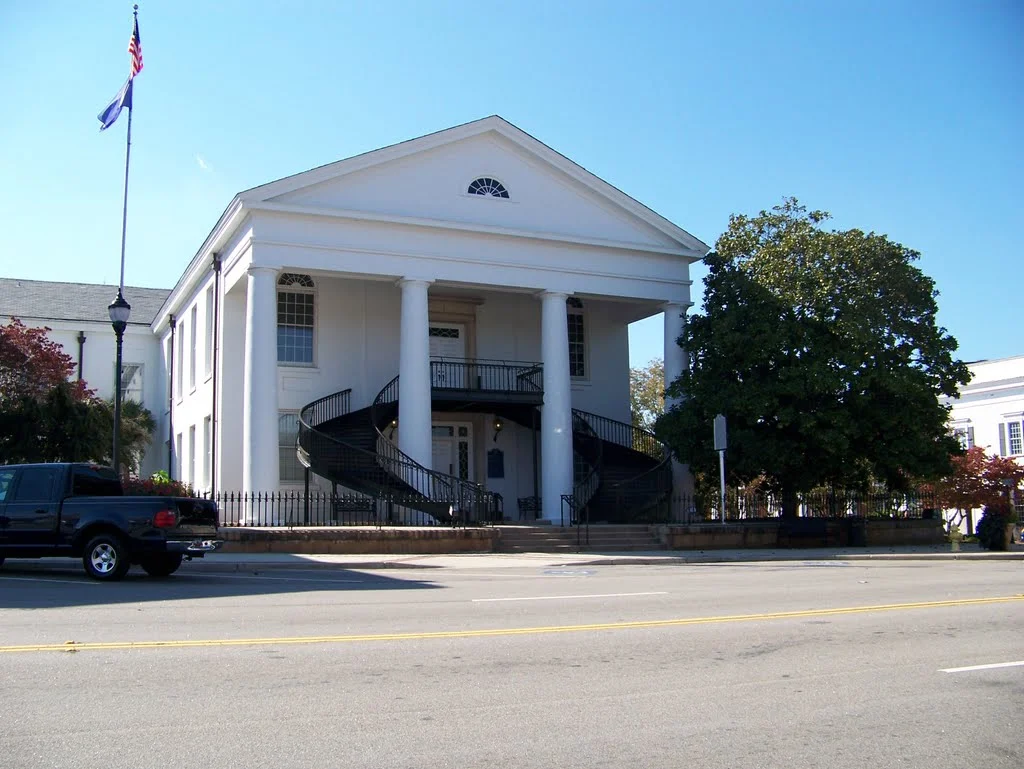

Fairfield County, South Carolina
The story is almost certainly apocryphal, but it is the only story anyone tells. In the winter of 1780, after the Battle of Camden, British General Charles Cornwallis marched north into the rolling South Carolina Piedmont and supposedly looked across the fields and said, "How fair these fields." The county was named for the remark. The house he stayed in still stands. Whether or not Cornwallis ever said the words, the fields themselves were real, and they have been the spine of Fairfield County's history ever since - first as cotton plantations worked by enslaved African Americans, then as Black-majority Reconstruction politics, then as the source of a particular blue-gray granite called "the silk of the trade" that paved the way to monuments around the world.
The Town Clock
The most photographed building in Winnsboro is a strange one. South Carolina's General Assembly authorized the town fathers in 1832 to build a market house no more than thirty feet wide, so wagons could pass on either side. The narrow structure was modeled, deliberately, after Independence Hall in Philadelphia, scaled down to colonial scale and dropped onto the site of an old duck pond. In 1837, a clock was added to the tower. It has been ticking ever since - one of the longest continuously running town clocks in the United States. Across the street stands the County Courthouse, dating to 1823 and designed by Robert Mills, the South Carolina architect who would later design the Washington Monument.
George Barber and the 48th General Assembly
In 1868, after the Civil War, South Carolina's new constitution barred former Confederate fighters from voting. In Fairfield County, 942 white voters were eligible. So were 2,434 Black voters. The election that followed sent George Barber, an African American man, to the South Carolina State Senate. The county sent three more representatives to the state house: Henry Jacob and Henry Johnson, both African American, and L. W. Duvall, who was white. Black political participation continued. By the end of 1870, Fairfield County was one of only two counties in South Carolina that was not in debt - because the Reconstruction government, despite its critics, was running the place capably. During the 1872 presidential election, three companies of U.S. troops were stationed in Fairfield County to prevent the Ku Klux Klan from disrupting voting. The interlude lasted until federal troops withdrew in 1877. The political gains were dismantled. The county census records preserve the names.
The Silk of the Trade
Beneath Fairfield County's fields lies one of the world's finest deposits of monumental granite. Winnsboro blue granite is dense, fine-grained, and a soft luminous blue-gray under polish. Quarrymen called it "the silk of the trade." It has been shipped around the world for more than a century - to buildings, courthouses, and grave markers as far away as Europe. The largest active quarry sits south of Winnsboro. The stone built much of Washington D.C. The Carolina Piedmont's hard granite spine, exposed here in places, is what made the county both poor for agriculture (thin soils over hard rock) and rich in geology.
Nuclear, Granite, and Quiet
The 20th century brought industry of an unusual kind. The Carolinas-Virginia Tube Reactor operated near Parr in the 1960s as a small experimental nuclear power plant. The much larger Virgil C. Summer Nuclear Generating Station came online in 1984 and still produces power for the regional grid. The Ridgeway gold mine ran from 1988 to 1999. Today the county has about 20,948 people - majority African American, mostly rural, spread across 686 square miles of forest and farmland. The Enoree Ranger District of Sumter National Forest covers much of the western county. Lake Wateree State Park anchors the east. From the air, Fairfield County reads as green: fields, forest, and the broad blue eye of Monticello Reservoir, the cooling pond for the nuclear plant, which has itself become a fishery.
From the Air
Fairfield County is centered around 34.4 degrees N, 81.13 degrees W in the central South Carolina Piedmont, north of Columbia. The county seat of Winnsboro sits at the geographic center; Lake Wateree fills the eastern county; Monticello Reservoir is the most distinctive aerial feature in the southwest. Major water features include the Broad River (western boundary) and Catawba River (eastern boundary). Distinctive landmarks: the Virgil C. Summer Nuclear plant cooling tower near Jenkinsville and the Town Clock tower in Winnsboro. Nearest airports: Fairfield County Airport (KFDW) near Winnsboro for general aviation; Columbia Metropolitan (KCAE) 35 nautical miles south for commercial; Charlotte Douglas (KCLT) 70 nautical miles north. Best aerial viewing in fall when hardwood color contrasts with pine forests.
Nearby Stories
- Columbia Canal 9.3 km away
- Newberry Opera House 11 km away
- Battle of Fishing Creek 12 km away
- Shaw Air Force Base 15 km away
- Battle of Blackstock's Farm 24 km away
- Hartsville, South Carolina 39 km away
- Piedmont Atlantic Megaregion 42 km away
- Cheraw, South Carolina 57 km away