.jpg)
Newberry Opera House
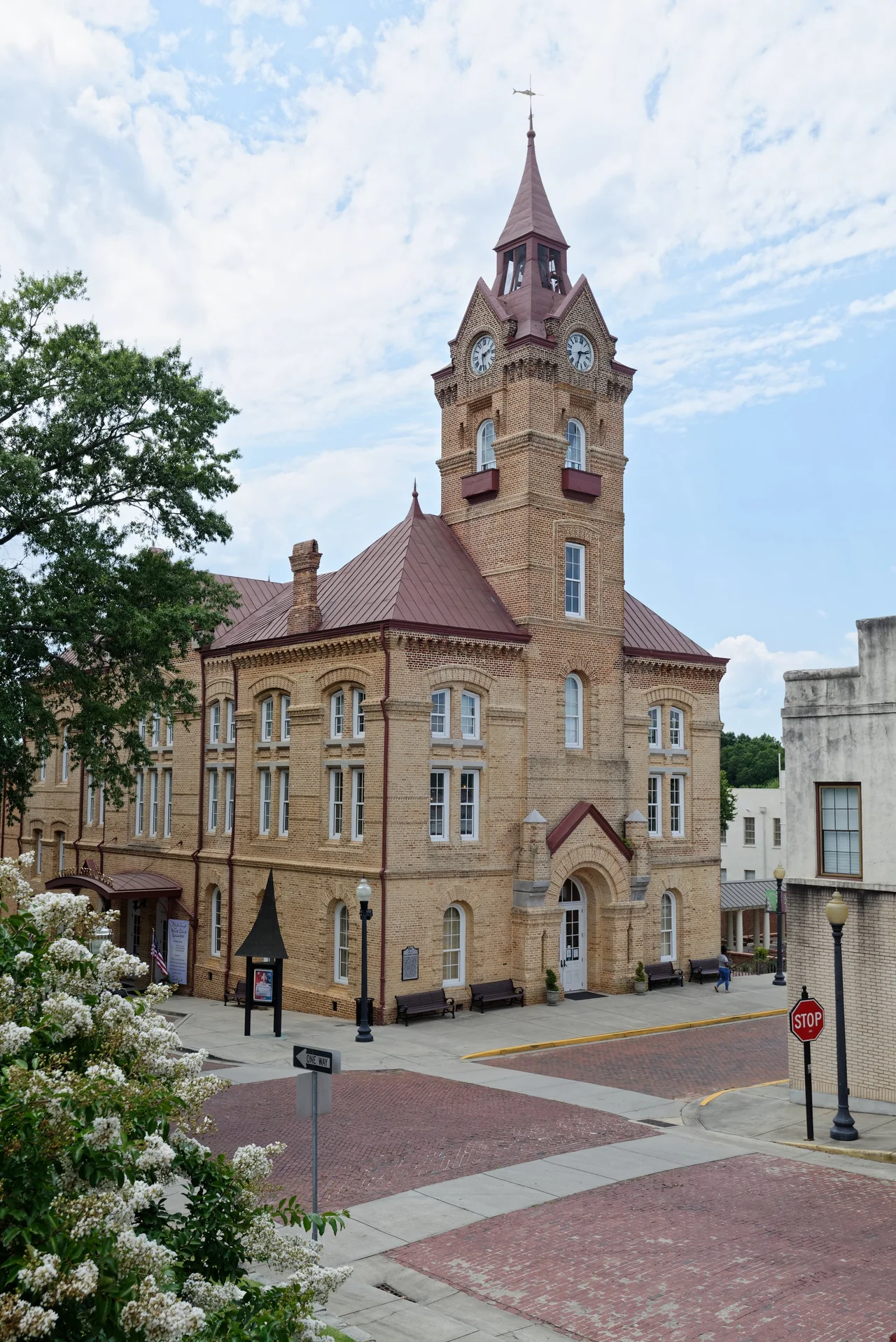
On the second floor, town councilmen argued zoning. On the third floor, Edwin Booth performed Shakespeare. The Newberry Opera House was that kind of building from the day it opened in 1882, a piece of civic ambition pressed into the shape of a French Gothic cathedral and dropped into a cotton town in the South Carolina Midlands. The clock tower stood 130 feet high. The weather vane was a garfish. Below the stage hall, the first floor housed a fire engine, a clerk's office, and three jail cells. Newberry needed a town hall. It got an opera house too, and refused to choose between them.
Three Cells and Four Hundred Seats
The building dedicated in 1882 was designed to do everything at once. The ground floor was the practical municipal kit: fire engine room, town council chambers, a clerk's office, a police officer's post, and three jail cells. Climb the stairs and you found a different world. The auditorium measured 53 by 52 feet, with 426 seats arranged in a horseshoe balcony, a ticket booth, a green room, a cloakroom, and three dressing rooms. The stage came with drop curtains and seven painted scenes. One of those scenes, a landscape, somehow survived all the way to the late twentieth century. The clock tower above it kept time for the town. The garfish weather vane on top spun in whatever wind came down from the Piedmont.
The Entertainment Center of the Midlands
It earned the nickname the local press gave it. Touring companies of New York City plays passed through. Minstrel and variety acts filled the bill alongside famed vocalists, magicians, and mind readers. Boxing exhibitions shared the stage with college commencement exercises. Edwin Booth performed there, brother of John Wilkes and the most celebrated American tragedian of his century. John Barrymore and his family played the Newberry stage, decades before Hollywood would claim them. Tallulah Bankhead came through too, that famously gravel-voiced Alabama actress who could silence a room with a single line. In between the touring acts, the people of Newberry held their own dances and musicales on the same boards. The Opera House was civic infrastructure as much as cultural ornament.
A Silent Beginning and a Segregated End
The first film projected onto the Opera House screen was The Birth of a Nation in 1915, a choice freighted with everything it sounds like. Edison's early talkies arrived in the 1920s, with phonograph records providing the sound, and slowly the movies pushed the stage shows out. The 1920s remodel turned the building into a movie theater. During that era the original horseshoe balcony was reduced in size to create segregated seating across the back of the auditorium, with an outdoor stairway built so Black patrons would enter separately. South Carolina kept those rules in place until integration arrived in the mid-1960s. The Opera House screened its last movie in 1952 after a showing of The Outlaw, and the auditorium went largely dark while the city kept using the first floor.
Almost Demolished, Then Restored
By 1959 there was open talk of tearing the building down. The Newberry Historical Society and several community groups pushed back in 1969, and the next year the Opera House was listed on the National Register of Historic Places. The serious restoration came after the City of Newberry vacated the building in the mid-1990s. The Newberry Opera House Foundation took over the lease and started raising money. Exterior work finished in 1994, interior renovation began in 1996, and a 10,000-square-foot addition created a proper loading dock, an elevator, a rehearsal stage, and dressing rooms suitable for full theatrical productions. Craig Gaulden Davis of Greenville handled the architecture. The total cost came to roughly 5.5 million dollars, and the horseshoe balcony was restored to its original shape.
Still Busy at 426
Willie Nelson has played the restored hall. Michael Bolton has played it. The Newberry Ballet Guild, the South Carolina Opera Company, and the Asheville Lyric Opera all use it. Newberry College stages performances there. The seating capacity remains 426, the same number the 1882 architects designed for, which makes the modern hall an intimate room by touring-circuit standards and part of its appeal. The clock tower still rises above the small downtown of Newberry, garfish weather vane still spinning, second floor still hosting performances on a stage that has carried Edwin Booth, John Barrymore, and now whoever this season's touring company happens to be.
From the Air
Located at 34.28 degrees N, 81.62 degrees W in downtown Newberry, South Carolina, in the Midlands roughly halfway between Columbia and Greenville. The clock tower at 130 feet is the most prominent vertical feature in the small downtown grid. Recommended viewing altitude 3,500 to 5,000 feet AGL. Nearest general aviation airport is Newberry County Airport (KEOE) about 5 nm southwest. Columbia Metropolitan (KCAE) lies roughly 35 nm southeast, and Greenville-Spartanburg International (KGSP) about 60 nm northwest.
Nearby Stories
- Abbeville County Courthouse 10 km away
- Battle of Musgrove Mill 19 km away
- Battle of Great Cane Brake 23 km away
- Columbia Canal 23 km away
- Edgefield, South Carolina 24 km away
- Battle of Rocky Mount 32 km away
- McEntire Joint National Guard Base 38 km away
- Kettle Creek Battlefield 63 km away