
Almorada
The name means anchorage. When the Mahdi, Muhammad Ahmad, chose the small village of Omdurman in 1884 as the headquarters of his new Islamic state, sailboats began arriving at its northern riverbank bringing timber, firewood, and food for the rising capital. They tied up at a stretch of Nile shore near the house of the Mahdi and of his successor Khalifa 'Abdullahi. That stretch of shore became known as Almorada, the Anchorage. The name stuck for a hundred and forty years, outlasting the Mahdist state that coined it, outlasting the British, outlasting two republics and three military governments, and arriving almost intact at the war that came in 2023.
Older Than Omdurman's Capital
Omdurman became the capital of Sudan in 1884, but Almorada may be older than that. The neighborhood is one of the ancient residential districts in the east of the city, and tradition says it was inhabited before the Mahdi ever arrived. Its street grid runs north-south, bounded on the east by Nile Street and divided internally by Almorada Street into East and West Almorada. To the south it ends at Khour Abuanjah; to the north, the neighborhoods of Alhashmab and Alomara pick up. Like most of old Omdurman, the district survived the Battle of Omdurman in 1898, when Kitchener's British-Egyptian force defeated the Mahdist army nearby. Neighborhoods that came out of the nineteenth century tend to have stories like that tucked into every second alley.
The Hottest Big City on Earth
Almorada has a hot desert climate, which in Omdurman means serious business. The city is among the hottest major cities on Earth by annual mean temperature. Mid-summer can exceed 53 degrees Celsius. Six months of the year post monthly highs of at least 38. The monthly high never falls below 30. Only July and August bring meaningful rain; the annual total is about 155 millimeters. Nights cool to an average low of just above 15 Celsius, which is modest relief. This is climate that shapes everything from construction (thick walls, small windows, rooftop sleeping in summer) to rhythm (early morning markets, afternoon dormancy, evening socializing). The Nile, a hundred meters from the district's eastern edge, is the only visual concession to water that the landscape offers.
The Club That Broke the Duopoly
Al-Mourada Football Club is the neighborhood's pride. Sudanese football has for decades been dominated by Al-Hilal and Al-Merrikh, both also based in Omdurman, so thoroughly that nearly every league title in the country's top flight has gone to one or the other. Al-Mourada is one of only two clubs, along with Hilal Alsahil, to have broken that duopoly, winning the Sudanese first division title in 1968. Along with Al-Hilal and Al-Merrikh, Al-Mourada formed what Sudanese football fans called the Omdurman triplet. The club has since declined, relegated over financial difficulties, but its home stadium in the Mourada district is being renovated with the ambition of reaching international standards again. For a neighborhood that defines much of Omdurman's identity, the club is still a civic center.
Dr. Khalda Zahir
Almorada raised Sudan's first Sudanese woman to enter college and medical school. Dr. Khalda Zahir (also rendered Khalda Zahir Surour) went on to active political and social engagement, and she stands in the neighborhood's memory as the kind of figure who makes a district's identity about more than streets and markets. The neighborhood has produced judges, financial secretaries, senators, and religious figures, including the family of Hasan Idrissi and his tomb, which the district still honors. It held a public notary, Dirdiri Mohamed Osman Khaled, and remembered Zahir Surour Elsadati. This is the particular pride of an old district: names that show up in conversations about "who we are" and are meant as both boast and orientation.
Fish Market and Family Park
Al Morada Fish Market, the Abdul Gayoom gate, and Almorada Family Park make up the shorthand of the neighborhood's daily geography. The Dar Al-Riyadh Omdurman on Shari'a Almorada serves community needs. Education runs through Al-Ahfad secondary school and the neighborhood's elementary schools. The social character of Omdurman, as a historic, cultural, and spiritual capital distinct from the colonial gridwork of Khartoum proper, is something the residents of Almorada articulate deliberately: their neighborhood represents older, more diverse, more Sudanese ways of gathering. Football, fish market, park, mosque, school, gate. The pieces are modest. The assembly is ancient.
Through the 2023 War
Omdurman, and with it Almorada, spent nearly two years on the front lines of the Sudanese civil war. The Rapid Support Forces and the Sudanese Armed Forces traded ground block by block, bridge by bridge. Markets burned. Hospitals closed. Many residents fled to Wad-Madani, Port Sudan, Egypt, or Chad. On 20 May 2025, the SAF took full control of Ombada and the rest of Omdurman, ending fighting in Khartoum State. What remains in Almorada now is a neighborhood that has spent nearly 140 years carrying the name of an anchorage where Mahdist sailboats once landed. An anchorage is, by nature, a place that holds still while vessels come and go. Whatever regime, whatever war, whatever economic collapse arrives next, Almorada has been the Anchorage through everything so far. It is a reasonable bet that it will continue to be.
From the Air
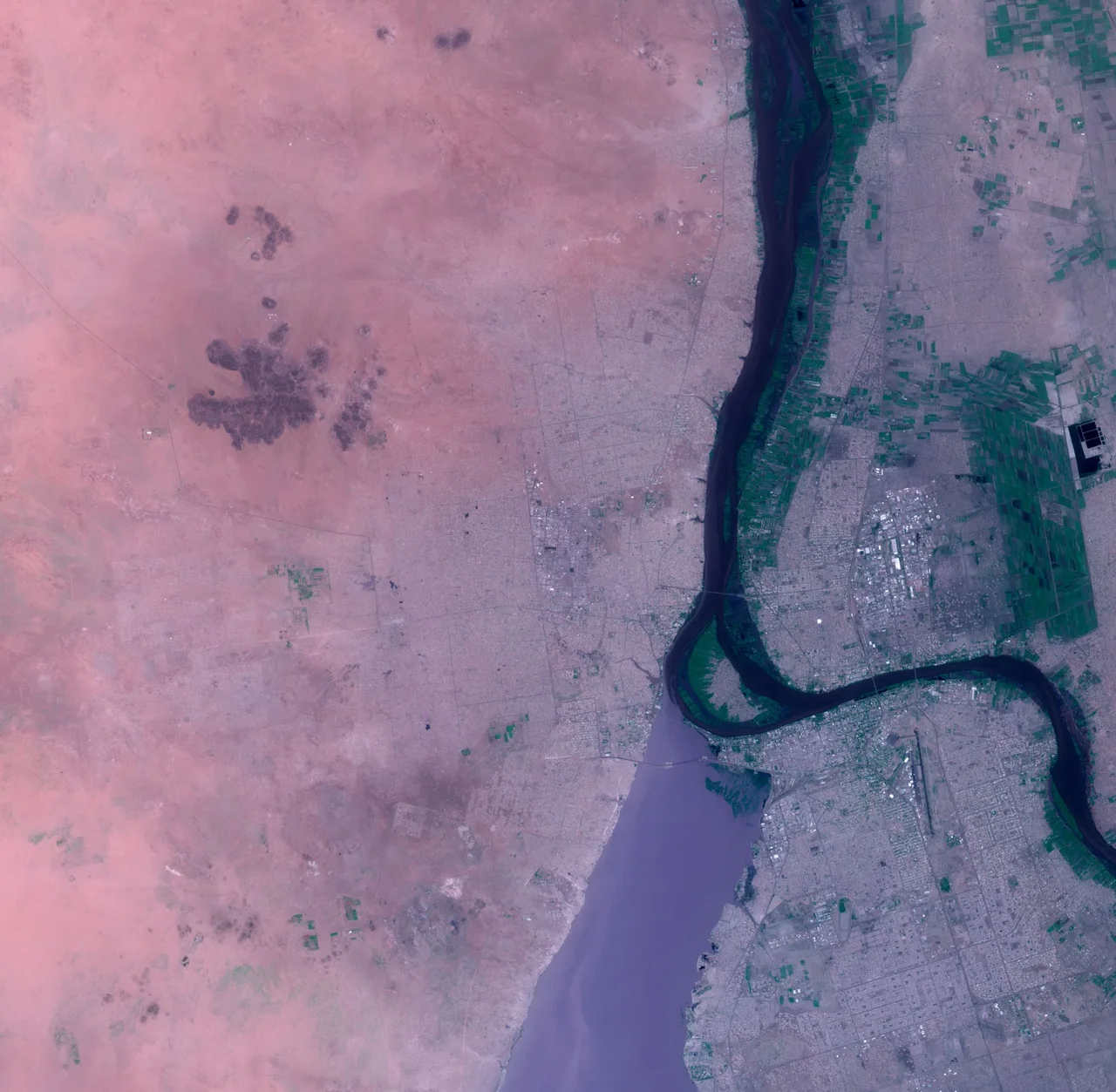
Almorada sits at approximately 15.65°N, 32.48°E in the eastern part of Omdurman, on the western bank of the Nile across from Khartoum proper. Nearest airport is Khartoum International (IATA: KRT, ICAO: HSSS), though it closed during the 2023 civil war. Recommended viewing altitude 4,000-8,000 ft AGL to see the tripartite metropolitan area with Omdurman spreading west, Khartoum south of the Blue-White Nile confluence, and Bahri (Khartoum North) to the northeast.
Nearby Stories
- Kalakla 3.6 km away
- Esh Shaheinab 7.7 km away
- Naqa 39 km away
- Musawwarat es-Sufra 82 km away
- Gezira State 118 km away
- Northern Sudan 196 km away