
Naqa
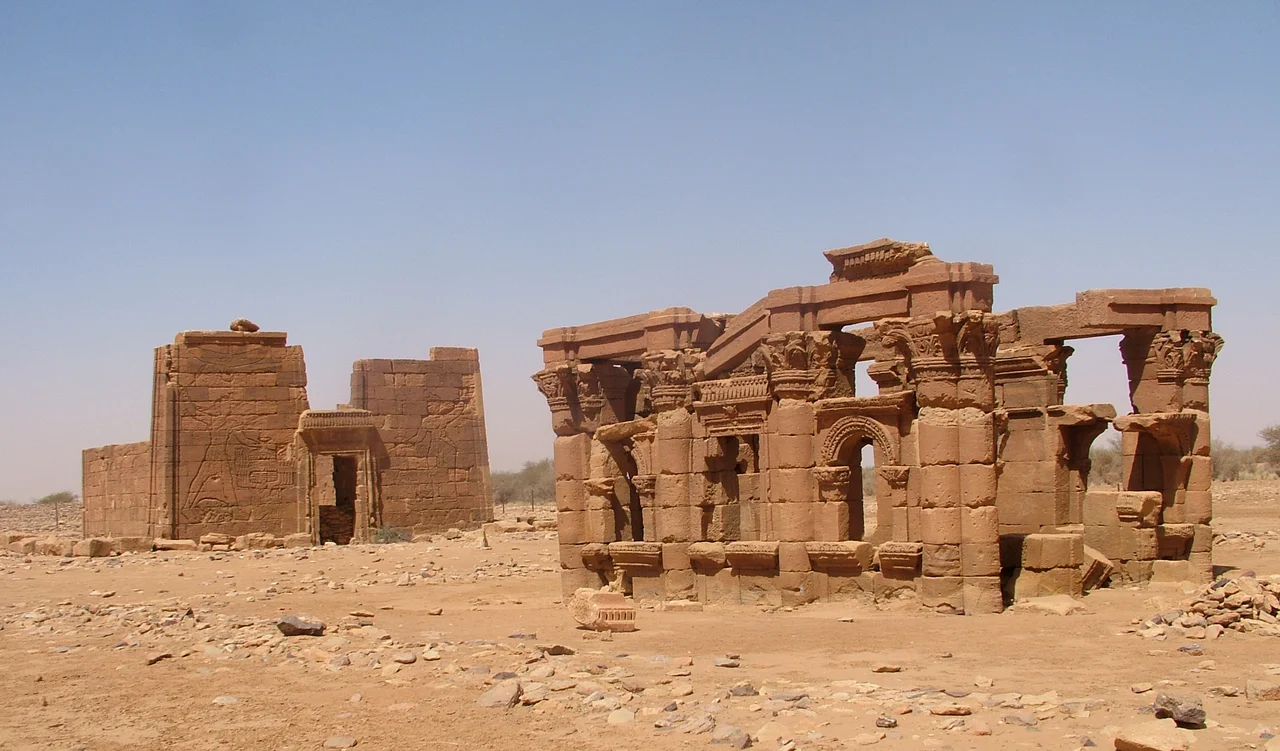
There is a moment when you round the last low ridge of the Butana plateau and Naqa appears all at once: a temple to Amun with a hundred-meter processional way, a smaller temple to Apedemak carved with a three-headed lion god and a four-armed lion god, and, most improbably, a little stone kiosk that looks as if it were lifted from a Roman provincial town and set down in the Sudanese scrub. Three architectural languages on one site. Around 135 BC, a Kushite queen named Shanakdakhete built the oldest temple here. The Kingdom of Meroë was making a statement at Naqa: our gods, their gods, and whatever useful style is crossing the caravan routes this season, we can absorb them all.
A Trading Station in the Butana
The site lies 170 kilometers northeast of Khartoum and 50 kilometers east of the Nile, far enough from the river to require camels or donkeys but close enough to matter. Smaller wadis converge here and feed north into the Wadi Awateib, which joins the Nile at Wad ban Naqa. In the time of the Meroitic kings, from roughly the fourth century BC to the fourth century AD, Naqa functioned as a strategic outpost, a place where caravans traveling east toward the Red Sea or across the Butana grasslands stopped to water their animals and worship. The Kushites built temples here for six centuries. What survives is one of the largest ruined sites in modern Sudan, a testament to a civilization that western histories have persistently underestimated.
The Lion Temple
West of the Amun temple stands the Temple of Apedemak, the lion-headed warrior god specific to Kushite religion. Apedemak was sacred guardian of the royal dead, and anyone who touched the grave of a chief was said to be cursed by him. The pylons at the temple entrance show King Natakamani on one side and Queen Amanitore on the other, both smiting enemies. The queen holds a sword. The king holds an axe. Below their raised arms lions wait to devour the prisoners underfoot. On the edges of the pylons, Apedemak appears in astonishing forms: as a snake rising from a lotus flower, as a three-headed figure, as a four-armed divinity. Inside, he shares wall space with Egyptian Amun and Horus. The Kushites saw no contradiction in worshipping both pantheons. They had their lion god, their own. They also had contacts with Egypt. Why would you not honor both?
The Temple of Amun
King Natakamani, who ruled around the beginning of the Common Era, founded the Amun temple at Naqa, 100 meters in length with several colossal statues of himself. A second Amun temple on the slope of Gebel Naqa, the mountain overlooking the settlement, was begun by Amanikhareqerem in the second or third century AD. It has been under excavation since 2004. Nubian chronology here is deliberately uncertain, with finds often dating differently from inscriptions, and the archaeologists who work this site talk about our understanding of Meroitic rulers the way astronomers talk about dark matter: we know it is there, we know it shapes everything, and we cannot quite see it clearly yet.
The Roman Kiosk
Near the main temple sits a small structure known as the Roman Kiosk, one of the stranger objects in Sudanese archaeology. Its entrance is classically Egyptian, with a lintel crowned by a row of sacred uraeus cobras. But its sides consist of columns with florid Corinthian capitals and arched Roman-style windows, and the goddess Isis who features on its walls has absorbed some characteristics of Hathor. This was the Meroitic Kingdom in its later phase, still clearly Kushite in religion but aware of, and willing to borrow from, the Roman world that had absorbed Egypt to the north. The kiosk is small enough that three or four people can stand inside it comfortably. Its style has no exact parallel anywhere.
The Oldest Temple on the Site
At the foot of the sandstone cliffs of Jabal Naqa stands the temple labeled simply 500, built by Queen Shanakdakhete around 135 BC. This makes it the oldest building here, and the inscriptions on its walls are the oldest known writings in the Meroitic hieroglyphic script, a system we can read phonetically but whose vocabulary remains largely mysterious. The temple was dedicated to the Theban triad of Amun, Mut, and Khonsu, and also to Apedemak. In 1834 the Italian treasure hunter Giuseppe Ferlini reached the pyramids at nearby Meroë and destroyed several in search of gold, a piece of archaeological vandalism whose effects the site still carries. Naqa was less heavily damaged. When UNESCO listed it in 2011 as part of the Island of Meroe World Heritage Site, with Meroë and Musawwarat, the Sudanese government finally had international support for the kind of protection this place deserved, and which the current war threatens again.
From the Air
Naqa is located at 16.27°N, 33.27°E, approximately 170 km northeast of Khartoum and about 50 km east of the Nile in Sudan's Butana plateau. Elevation roughly 400-500 meters, with Gebel Naqa rising modestly above the site. Recommended viewing altitude: 3,500-6,500 feet for visibility of the temple ruins. The site sits in a closed basin with sandstone cliffs to the east. Nearest airports: Khartoum International (HSSS) to the southwest, Shendi (HSSM) nearest to the north. The Butana terrain is semi-arid grassland transitioning to desert; expect dust and haze particularly April-June. The three temples (Amun, Apedemak, and Temple 500) are distributed across roughly a 1-km area.
Nearby Stories
- Esh Shaheinab 28 km away
- Wadi Seidna Air Base 28 km away
- Ghaba 29 km away
- Meroë 46 km away
- Khartoum North 75 km away
- Northern Sudan 174 km away
- Al Qadarif State 269 km away
- Kassala 297 km away