
Musawwarat es-Sufra
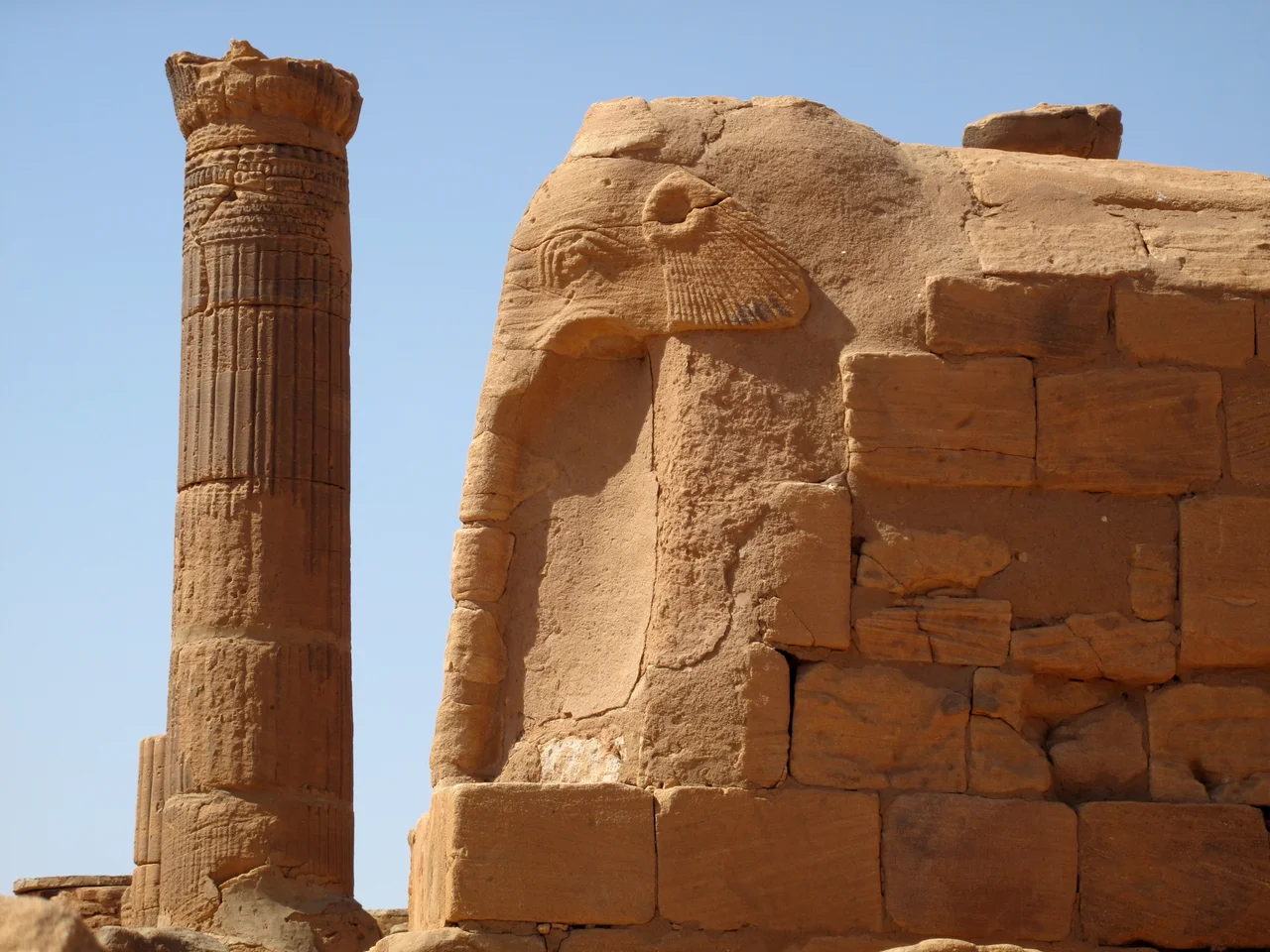
Nowhere else in the ancient Nile world does the elephant appear this often. Not in Egypt, where lions and jackals and the long-horned cattle of the pharaohs dominate the walls. Not in Nubia, not in Meroë itself. But here at Musawwarat es-Sufra, in a sandstone basin 180 kilometers northeast of Khartoum, the elephants are everywhere: on reliefs, as statues, in graffiti scratched by pilgrims in Meroitic and Greek. Whatever this complex was for, elephants were central to it, and twenty-three hundred years after the Kushite king Arnekhamani laid his foundation stones, we still argue about exactly what we are looking at.
The Kingdom That Built It
The Kingdom of Kush ruled from two capitals. First Napata, near the Fourth Cataract, and then, from around 270 BC, Meroë further south. The move made sense. Meroë sat in the Butana, the well-watered plain between the Nile and the Atbara River, with iron ore for smelting and good grazing for cattle and, crucially, a distance from Egypt that protected Kushite culture from increasingly Hellenized Egyptian influence. The Meroitic kings built extensively. Their pyramids at Meroë are smaller and steeper than Egypt's, and there are more of them than all of Egypt's Old Kingdom royal tombs combined. They developed their own script, Meroitic, which remains partially undeciphered. Musawwarat es-Sufra was one of their most ambitious projects, a religious and administrative complex that took generations to complete.
The Lion Temple
King Arnekhamani, who ruled around 235 BC, built the Lion Temple and dedicated it to Apedemak, the lion-headed warrior god who was distinctly Kushite, not Egyptian. The temple is modest in size, 14 meters long, 9 meters wide, 4.7 meters high, with a classical pylon entrance and six column drums, but its walls carry some of the most striking reliefs in Sudan. Elephants and lions parade across the rear interior wall. On the outside walls, Apedemak appears three-headed, an iconographic choice found nowhere else. The temple collapsed in antiquity and stood in pieces for centuries. In the 1960s, a Humboldt University expedition under the archaeologist Fritz Hintze reassembled it stone by stone and added a new roof. It stands today as the first thing visitors see when they arrive at Musawwarat.
The Great Enclosure
West of the Lion Temple, the Great Enclosure sprawls across 45,000 square meters of labyrinthine courtyards, passages, ramps, and low walls. Hintze called its ground plan "without parallel in the entire Nile valley," and after six decades of archaeological investigation, no one has proposed a convincing single purpose for it. The early guesses, a college, a hospital, an elephant-training camp, have fallen in and out of favor. What everyone agrees on is that the complex was religious in some sense. Three temples sit within its walls. Twenty columns survive. Two reservoirs stored water. Walls bear pilgrim graffiti in Meroitic and Greek, centuries of visitors leaving their marks. Sculpted elephants stand here and there. Perhaps this was a pilgrimage site where royal elephants were ritually displayed, where priests and visitors moved through carefully choreographed spaces. Perhaps it was something we have no framework to describe.
The Hafir
Two hundred fifty meters across and 6.3 meters deep, the Great Reservoir at Musawwarat is one of the largest hafirs in Sudan. Hafirs are rainwater collection basins, excavated into the ground to capture and hold as much of the short rainy season's water as possible. They made settled life possible in places like the Butana, where natural water sources are absent or seasonal, and they required collective labor to maintain. Musawwarat's hafir, built alongside the temples, is a reminder that this was not only a religious site. People lived here. Priests, artisans, farmers who worked land irrigated by the reservoir. Elephants drank from it. The complex sits in a closed basin surrounded by low sandstone hills, catching the runoff of a whole watershed, and the hafir was its heart.
Kushite, Not Egyptian
When the first European traveler to describe Musawwarat in detail, Carl Richard Lepsius, arrived in 1844, he read the complex through Egyptian eyes. Western scholarship did the same for more than a century. It is only in recent decades that archaeologists, Sudanese and international together, have fully confronted what Musawwarat actually is: a major achievement of an African civilization that borrowed from Egypt when it suited Kushite purposes but developed its own iconography, architecture, language, and religion. Apedemak was not an Egyptian god. The Meroitic script was not Egyptian writing. The Great Enclosure has no Egyptian counterpart. UNESCO listed Musawwarat, with Meroë and Naqa, as the Island of Meroe World Heritage Site in 2011. Taken together, they represent one of the ancient world's major civilizations, which happened to be African, and which we are still learning to read on its own terms.
From the Air
Musawwarat es-Sufra lies at 16.42°N, 33.32°E, about 180 km northeast of Khartoum in the Butana plateau region of Sudan. Elevation approximately 500 meters. The site sits in a closed sandstone basin approximately 25 km southeast of the Nile and 20 km north of Naqa. Recommended viewing altitude: 3,500-8,000 feet for ground visibility of the temple complex and sandstone hills. The nearest airports are Shendi (HSSM) to the west and Khartoum International (HSSS) to the southwest. The Butana terrain is arid plain with low sandstone outcrops; expect dust storms March-June and limited visibility. The Great Enclosure covers ~45,000 m² and is visible from altitude as a distinctive rectangular footprint in the desert.
Nearby Stories
- Esh Shaheinab 21 km away
- Meroë 26 km away
- Nubian pyramids 62 km away
- Wadi Seidna Air Base 71 km away
- Khartoum North 87 km away
- Northern Sudan 159 km away
- Al Qadarif State 287 km away
- Kassala 304 km away