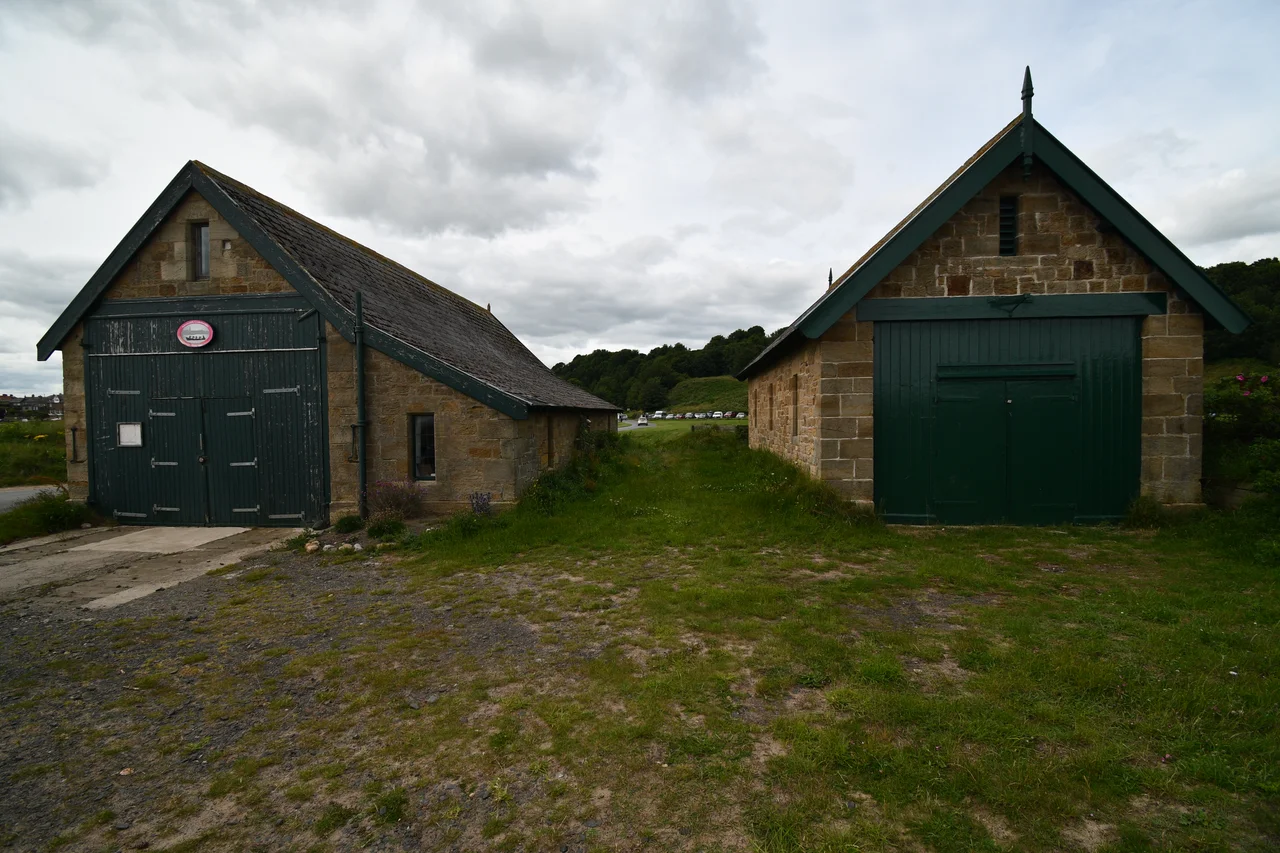

Alnmouth Lifeboat Station
Captain John Ross Ward of the Royal Navy was deliberately rolled into the surf at Alnmouth, and that was the entire point. The Duke of Northumberland had offered one hundred pounds for a lifeboat that would right itself, and James Beeching of Great Yarmouth had won the prize. Now, in the autumn of 1852, the prototype Lucy was being tested in earnest. Ward and a crew of local men rowed her into the breakers next to the golf links. They capsized. The boat flipped back upright. Ward was fished from the sea and given a silver medal. Many subsequent lifeboats would follow Beeching's design, and a small stone boathouse near the mouth of the River Aln became the place where the British self-righting era effectively began.
The Duke's Competition
Algernon Percy, the 4th Duke of Northumberland, was not a man given to half measures. Appointed president of the Royal National Institution for the Preservation of Life from Shipwreck in 1851, he set out a competition with a clear brief: design a lifeboat that could roll, right itself, and continue saving lives. The hundred-pound prize was substantial. James Beeching's winning entry, a 22-foot boat christened Lucy, was presented to the Duchess of Northumberland and delivered to a purpose-built boathouse on Percy land at Alnmouth in September 1852. Two years later, the Duke formally handed the boat and boathouse to the institution he helped lead, which had by then renamed itself the Royal National Lifeboat Institution. The RNLI station at Alnmouth was born almost by accident, the residue of an aristocrat's design contest. By 1860 the Duke had funded a larger boathouse to replace the original, and both buildings still stand at the edge of the dunes.
Ann of Blyth
On 12 June 1860 the brig Ann of Blyth, returning from Memel in Prussia, lay anchored in Alnmouth Bay when a south-east gale tore at her cables. Both parted. The vessel drove ashore. The Alnmouth crew launched their small four-oared lifeboat into surf that would have terrified a steamship captain, and rowed out to the foundering brig. All eight of her men came off alive. The lifeboat had just pulled clear with the last sailor aboard when the brig's masts came down, falling clear of the rescuers by margins that the coxswain probably never described in a letter to his wife. It was the kind of service the Duke had imagined when he wrote the competition rules nine years earlier, and it was repeated, in smaller increments, across eighty-two years on this exposed stretch of coast.
The Captain Who Would Not Leave
The brig Fortuna of Riga ran aground on the Berling Carr on 8 January 1889, on passage from Memel to the Tyne. Three of her crew launched the ship's boat and made it to shore. Rocket apparatus from the beach pulled off five more. Her captain refused to abandon his vessel. For four days he held on as the seas worked at her hull, until the Alnmouth lifeboat Allen Scott finally took him off. The Fortuna broke up not long after. A few decades later, the next lifeboat, the John and Robert C. Mercer, arrived in 1909 from Thames Ironworks, paid for by the legacy of a Lancashire woman named Maria Mercer. She would prove almost ceremonial. Called out just once in twenty-six years, she was the last lifeboat Alnmouth ever launched.
What Remains
Eighty-two years of service, fifteen lives saved, fifteen more crew brought ashore alive. The arithmetic of the Alnmouth station looks modest on paper, but every one of those numbers represents a journey out into a sea that did not welcome small boats. The station closed in 1935. The John and Robert C. Mercer transferred to another station and served six more years before retirement. Today the 1852 and 1860 boathouses still stand on the dunes, used now by the Alnmouth Community Rowing Club. The boats they shelter are pleasure craft. The sea is the same.
From the Air
Alnmouth Lifeboat Station sits at 55.39 degrees north, 1.61 degrees west, at the mouth of the River Aln on the Northumberland coast, about 4.5 miles south-east of Alnwick town. From cruising altitude the broad bay and the wide sweep of golf links provide an easy visual fix. The nearest major airfield is Newcastle International (EGNT), roughly 35 miles south. RAF Boulmer (former airfield, now a radar station) lies just a few miles north. Best viewing comes at lower altitudes in clear conditions, when the twin boathouses and the long sandy bay are visible against the dunes.
Nearby Stories
- Ashington 1.8 km away
- Cheviot Hills 3.4 km away
- Battle of Nesbit Moor (1402) 12 km away
- Hadrian's Wall Path 18 km away
- Berwick-upon-Tweed Lifeboat Station 27 km away
- Saltburn Pier 68 km away
- German submarine U-2367 84 km away
- Alexander L. Kielland (Platform) 271 km away