.jpg)
The Alnwick Garden
The black wrought-iron gates carry a skull and crossbones and a warning: these plants can kill. Behind them, in a walled corner of an enormous formal garden in Northumberland, grow strychnine, ricin, deadly nightshade, hemlock, foxglove. Tour guides remind visitors not to smell anything. They mean it. The Poison Garden was added to the Alnwick Garden in February 2005, and it was the duchess's own idea. Jane Percy wanted her revived gardens to have something no other garden in Britain possessed. She got it. Today the poison plot is the single biggest reason most people pay to enter at all.
The Capability Brown Inheritance
The first garden at Alnwick was laid down in 1750 by the 1st Duke of Northumberland, who hired Capability Brown to landscape the parkland next to Alnwick Castle. Brown was a Northumberland man, born just up the road, and he gave Alnwick the sweeping, naturalistic grounds for which he became famous. The 3rd Duke filled hothouses with pineapples and brought seeds back from continents most of his neighbours had never seen. By the 1850s the 4th Duke had laid out an Italianate garden with a vast conservatory, and by century's end the grounds were at their grandest: yew topiary, avenues of limes, acres of beds. Then came the twentieth century, the Dig for Victory campaign of the Second World War, post-war austerity, and a slow collapse. The working garden closed in 1950 and rotted quietly for half a century.
Jane Percy's £42 Million Bet
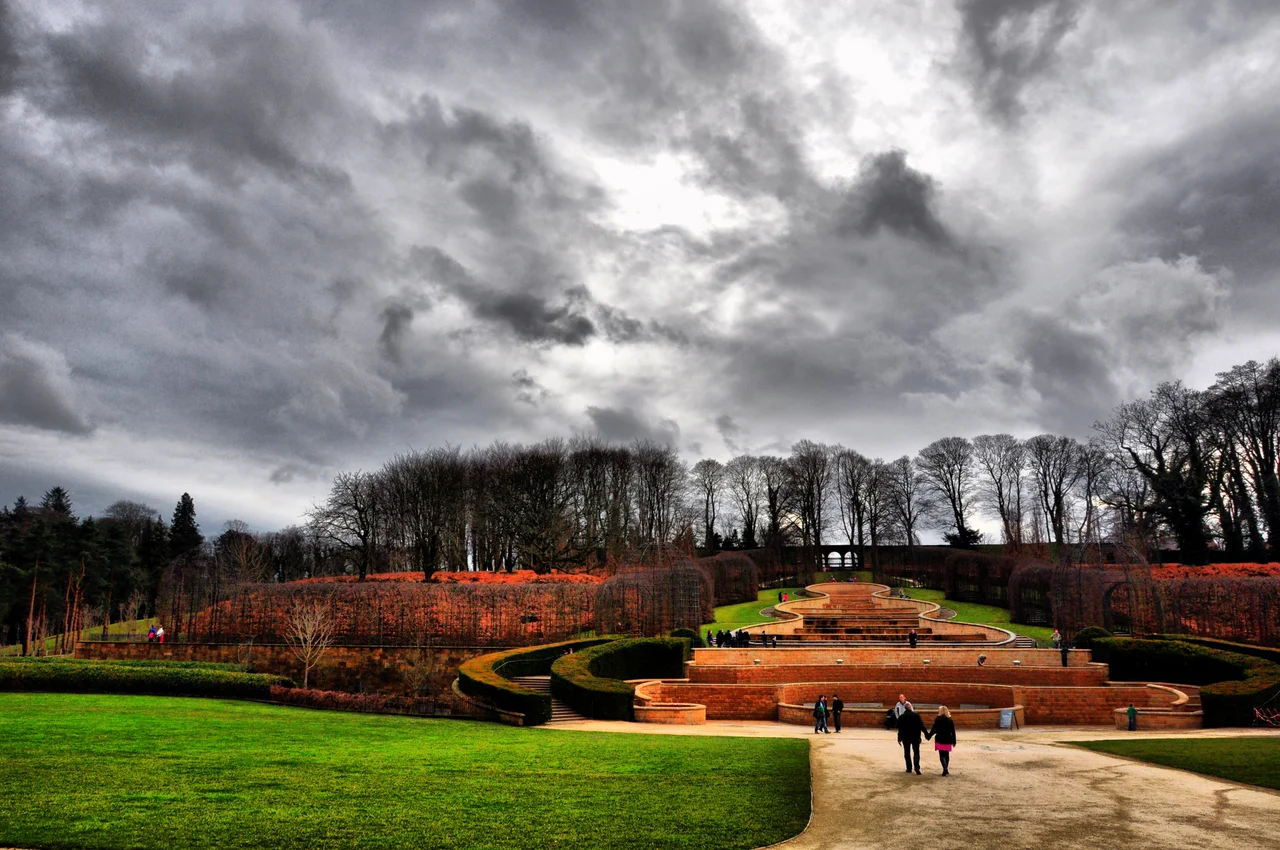
When Jane Percy became Duchess of Northumberland in 1995, she could have left the wreckage alone. Instead she set about reviving it. In 1997 she brought in the Belgian landscape architects Jacques and Peter Wirtz to design what would become the most ambitious new garden built in the United Kingdom since 1945. The first phase opened in October 2001, centred on a stepped water cascade that fires twenty thousand litres a minute down the hillside. A 6,000-square-foot tree house complex with a cafe opened in December 2004, eventually claiming to be the largest in the world. A pavilion and visitor centre with a barrel-vaulted gridshell roof followed in May 2006, designed by Michael Hopkins and Buro Happold. The total bill ran to forty-two million pounds. The 12th Duke gave the 42-acre site and contributed nine million towards the redevelopment. The garden now belongs to a charitable trust, separate from the Northumberland estates that birthed it.
The Poison Garden
The Duchess wanted a hook, something that would distinguish Alnwick from every other restored country garden in Britain. She found it in plants that hurt. The Poison Garden grows Strychnos nux-vomica, the source of strychnine. It grows Ricinus communis, which yields harmless castor oil and lethal ricin from the same seed. There are foxgloves, deadly nightshade, hemlock, and angel's trumpet, Brugmansia, which is hallucinogenic and corrosive. Laburnum drips its yellow chains over the path. The garden also serves a drug-education brief, with managed plantings of cannabis, coca, and the opium poppy Papaver somniferum. Visitors enter only with a guide, do not touch, do not lean in to inhale. The plants that visitors find most surprising are usually the ones already growing in their own gardens at home, quietly waiting to be misidentified.
A Garden Designed to Be Visited
Walking the Alnwick Garden today, you move from the cascade through rose gardens, ornamental gardens, a serpent garden of water sculptures by William Pye, and a bamboo labyrinth. The cherry orchard holds 329 Tai Haku cherries, one of the largest collections of that variety in the world, and it foams white every spring like spilled milk. The tree house above shelters a restaurant in the canopy, reachable by wobbly rope bridges. The Poison Garden remains the headline, but the duchess has built something larger than a single dark joke. She built a garden that argues, repeatedly, that horticulture can be theatre, that plants can be dangerous, and that the public will pay good money to watch both.
From the Air
The Alnwick Garden lies at 55.41 degrees north, 1.70 degrees west, adjacent to Alnwick Castle in northern Northumberland. From the air the garden's geometry is unmistakable: a long rectangular axis with the stepped cascade running down the hillside, the cherry orchard to one side, and the dark glass of the pavilion at the upper end. Newcastle International (EGNT) sits roughly 35 miles to the south. The A1 trunk road slips past just to the west. Best viewing comes at low to mid altitudes in clear weather, when the cascade's water plumes catch the sun.
Nearby Stories
- Ashington 1.8 km away
- Cheviot Hills 3.4 km away
- Battle of Nesbit Moor (1402) 12 km away
- Hadrian's Wall Path 18 km away
- Berwick-upon-Tweed Lifeboat Station 27 km away
- Saltburn Pier 68 km away
- German submarine U-2367 84 km away
- Alexander L. Kielland (Platform) 271 km away