
Alonnisos Marine Park
It started with a documentary maker who noticed what no one else had bothered to measure. In 1976 the German zoologist Thomas Schultze-Westrum ran a series of exploratory missions through the deserted islands northeast of Alonnisos and concluded that this stretch of the Aegean held ecological value found almost nowhere else in the Mediterranean. He proposed that it be protected. Sixteen years later, on May 16, 1992, Greece signed his idea into law. The National Marine Park of Alonnisos Northern Sporades became the first marine park in the country and remains the largest marine protected area in the Mediterranean, roughly 2,260 square kilometers of sea, islands, and rock.
The Rarest Seal Alive
The park exists, above all, for one animal. The Mediterranean monk seal, Monachus monachus, is among the rarest marine mammals on the planet, with only an estimated 440 to 540 mature individuals left in the world. It hauls out and pups in sea caves along steep limestone coasts, exactly the habitat these islands provide in abundance. In 1988 a group of young marine biologists formed the Hellenic Society for the Study and Protection of the Monk Seal, known as MOm, and set up a permanent field team in the reserve. Two years later they opened the first seal health center for the species anywhere in the Mediterranean. The work is slow and the population still precarious, but it is no longer only declining. In 2023, after decades of effort across many countries, the species was downgraded by conservationists from Endangered to Vulnerable, a small word that represents an enormous amount of patience.
When the Fishermen Said Yes
A marine park is only as strong as the people who fish its waters allow it to be. The most remarkable moment in the park's founding was not the presidential decree but a quieter agreement that came before it. After consultation, the fishermen of Alonnisos accepted the idea of a reserve in their own fishing grounds and committed to help protect it. Magnesia Prefecture issued the first protective order in 1986, and the ministries of environment, agriculture, and merchant navy followed. The seal that had long been the fisherman's rival, blamed for torn nets and stolen catch, was now something to be guarded. That shift, from competitor to charge, is the real story of this park, and the reason it has survived where decree alone would have failed.
Two Zones, One Sanctuary
The park divides into two very different worlds. Zone A, the strict core covering some 1,587 square kilometers, encloses the remote islands. Around Piperi, no boat may even approach within three nautical miles; only licensed scientists and park staff may enter, and professional and amateur fishing alike are forbidden. This is the seal's true refuge, left as close to untouched as a place can be. Zone B, about 678 square kilometers, is open to visitors with few restrictions, and it holds the island communities of Patitiri, Palia Alonnisos, Votsi, and Steni Vala. Here swimming, walking, and amateur fishing are allowed within the rules, the gentle ways of meeting the sea on its own terms.
Life on the Edge of Europe
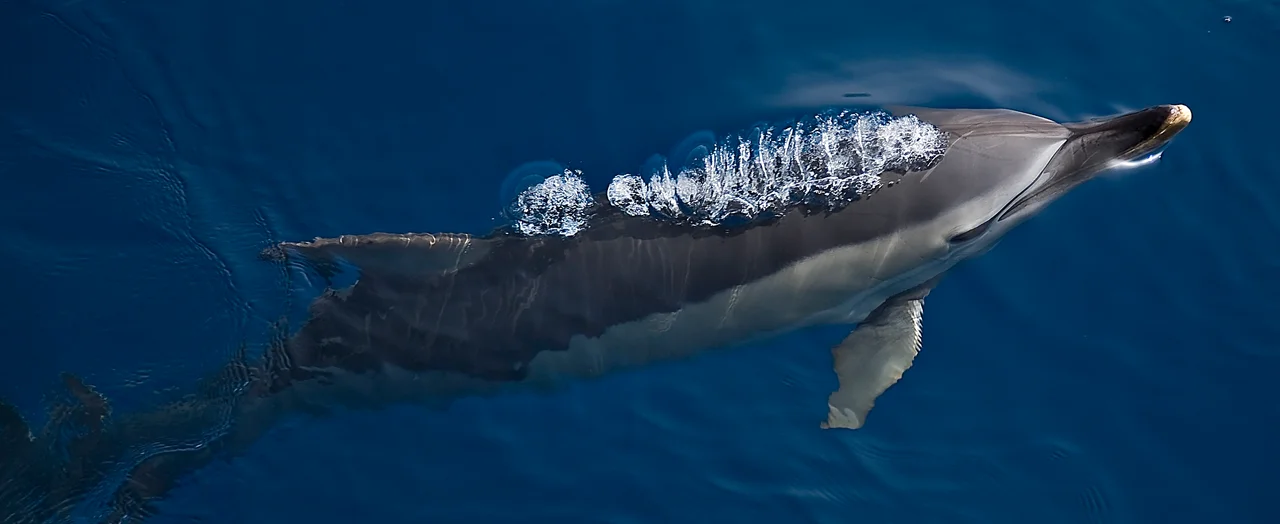
Beyond the seal, the park teems. Its waters hold roughly 300 species of fish and meadows of Posidonia seagrass, the slow-growing underwater plant that anchors the whole ecosystem. Up to 80 species of bird pass through or nest among the cliffs, including Eleonora's falcon and the rare Audouin's gull, while the wild goat of Gioura, found nowhere else, picks its way across the rocks. Out in the deeper channels swim common, striped, and bottlenose dolphins, and on rare days sperm whales and Cuvier's beaked whales surface in waters most of Europe has long since emptied. In August the meltemi blows hard from the north, refreshing the air and roughening the sea, a reminder that this sanctuary endures on the wild margin of the Aegean.
From the Air
The National Marine Park centers roughly on 39.31°N, 24.15°E, spreading across the Northern Sporades northeast of Alonnisos in the northern Aegean Sea. From altitude the park reads as a scatter of pine-dark limestone islands, Peristera, Kyra Panagia, Gioura, Psathoura, Piperi, and Skantzoura, set in unusually clear blue water, with 22 smaller islets and rocks between them. There is no airfield within the park; the nearest airport is Skiathos (LGSK) to the southwest. Note that Piperi and its surrounding waters are a no-approach zone. Summer brings strong northerly meltemi winds that can build significant sea state across the open channels.
Nearby Stories
- Skiathos Castle 12 km away
- Agia Anna (Evvia) 19 km away
- Skyros 42 km away
- Battle of Athos 64 km away
- Battle of Potidaea 75 km away
- Aegean Sea 84 km away
- Battle of Spartolos 106 km away
- Sigri (village) 107 km away