.jpg)
Amba Geshen
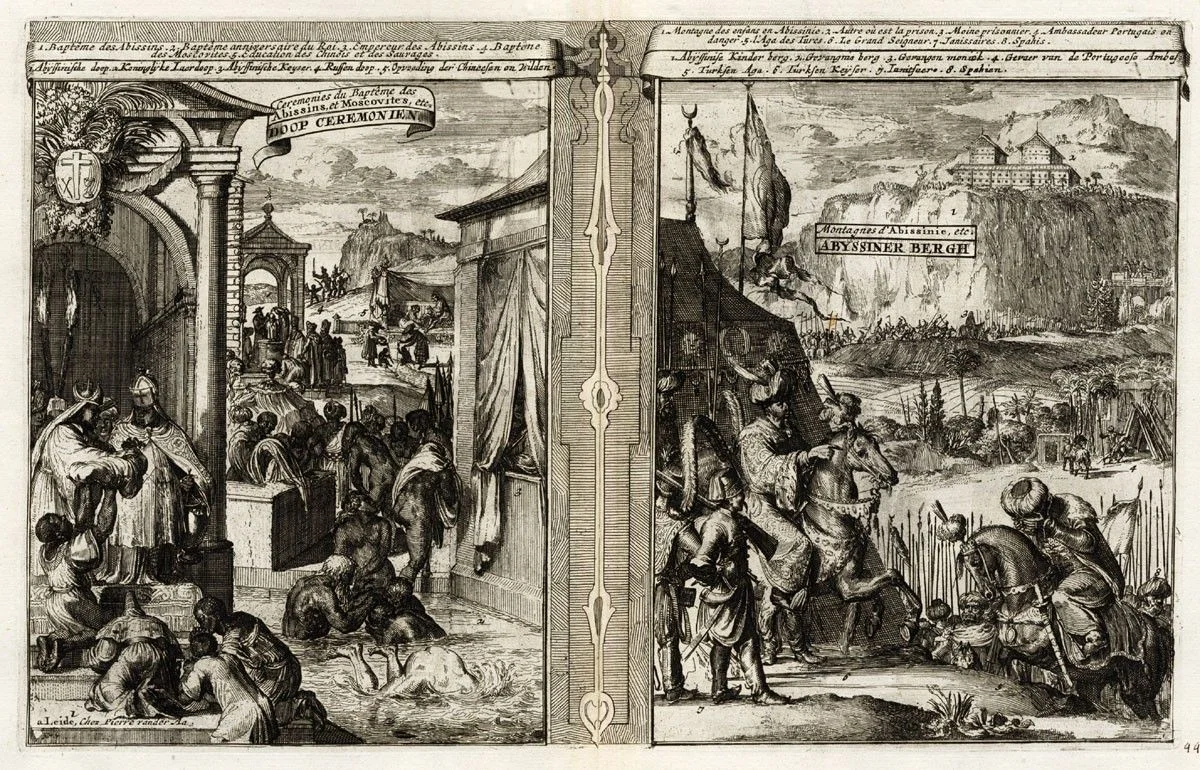
The mountain has the shape of a cross when seen from above, and for centuries it held an entire branch of Ethiopia's royal family as prisoners. When a new emperor took the throne of the Solomonic Dynasty, his brothers, uncles, and cousins were marched up the one narrow path to the summit of Amba Geshen and told they would never leave. Some spent decades on the flat-topped peak reading, praying, and fathering children who would themselves be born into captivity. One of them, Zarʾa Yāʿqob, spent almost thirty years up there before he was called down in 1434 to become emperor. The scriptorium he kept on the mountain produced manuscripts of outstanding quality, including the Golden Codex. Amba Geshen was a prison, a library, and a treasury all at once.
The Mountain of Princes
Rising in what is now the Ambassel district of the Amhara Region, northwest of Dessie, Amba Geshen belongs to a very Ethiopian type of landscape: the amba, a sheer-sided mesa with a flat top that functions as a natural fortress. The Portuguese missionary Manoel de Almeida, writing in the seventeenth century, described a precipitous rock cliff all the way around, with only a single path to the summit - a place called Macaraquer. Once you reached the top, he wrote, there was a natural pool, a freshwater spring, and a scattering of wild cedar and kosso brush. Two churches had been built on the summit: Egzyabeher Ab, begun under Emperor Lalibela, and Tekle Maryam, finished in the sixteenth century by Emperor Lebna Dengel. The mountain was a self-contained kingdom in miniature, sustaining its royal captives for generations.
Why Imprison Brothers
The practice is first reliably recorded during the reign of Jin Asgad, who sent his own brothers and sons to Amba Geshen. The logic was brutal and practical. In a dynasty without clear rules of succession, every royal male was a potential claimant - which meant every royal male was a potential threat. Better to pen them on a mountain than let them raise armies in the provinces. When the throne fell vacant, messengers would climb the single path to fetch whichever prince the council favored. The rest stayed behind. Emperor Na'od finally ended the practice, but the descendants of Emperor Takla Maryam remained under guard even into the reign of Gelawdewos, punished for an old betrayal of Emperor Baeda Maryam I. Royal captivity on the amba lasted, in some form, for centuries.
The Fall of 1540
Because the summit was impregnable, the imperial treasury was also kept there. This made it a target. In 1531 and again in 1533, the armies of Ahmad ibn Ibrahim, the Muslim conqueror whom Ethiopians called Ahmed Gragn, tried to take Amba Geshen. Both attempts failed - the cliffs were that steep. In 1540 he finally succeeded. The Futuh al-Habasha, the Arabic chronicle of the conquest, records that Ahmad's men put the entire garrison and all the civilians on the summit to death. A library, a treasury, and a royal prison fell together in a single afternoon. Ethiopians today believe a piece of the True Cross, gifted to Emperor Dawit I by the Venetian Republic and said to have been buried on the mountain by Saint Helena of Constantinople, may still lie there somewhere beneath the tin-roofed churches Thomas Pakenham found when he climbed the amba in 1955.
A Mountain in European Imagination
Something about Amba Geshen fired the European imagination. The earliest account to reach England was published by Samuel Purchas in Purchas, His Pilgrimage, where the summit appeared as Mount Amara - a place where kings kept their sons in a kind of paradise-prison. Thomas Pakenham argued that this description shaped John Milton's vision of Paradise in Paradise Lost, and through Milton, Samuel Taylor Coleridge's Mount Abora in Kubla Khan. Samuel Johnson took the idea further. In Rasselas, his 1759 philosophical novel, an Ethiopian prince is confined to a mountain sanctuary called the Happy Valley, escapes, and wanders the world looking for satisfaction he cannot find. Johnson drew on the travel account of the Jesuit Jerónimo Lobo. So when Coleridge dreamed his Kubla Khan and Johnson wrote his Rasselas, they were both, in a sense, writing about this mountain in northern Ethiopia.
Gishen Mariam Today
The mountain is still called Gishen Mariam, and it is still venerated as a place where the True Cross may rest. When Pakenham climbed it in 1955, both churches on the summit had been rebuilt with tin roofs - humble materials for a summit that once held princes and treasure. Pilgrims still make the steep walk up Macaraquer. The amba that inspired Milton, Coleridge, and Johnson is not a ruin; it is a working place of worship, standing in a landscape that still produces ambas, still produces pilgrims, still produces the stories that outlast empires.
From the Air
Amba Geshen stands at 11.4986 N, 39.3184 E in northern Ethiopia, northwest of Dessie in the Amhara highlands. The flat-topped amba rises dramatically from the surrounding terrain, visible as a distinctive mesa at cruising altitudes. Recommended viewing altitude 13,000-16,000 feet to clear the Ethiopian Highlands. Nearest significant airfield is Combolcha (HAMK), about 70 km southeast; Bahir Dar (HABD) lies to the west. Mountain wave turbulence and afternoon convective buildup are common in this terrain - morning flights offer best visibility.
Nearby Stories
- Wollo Province 30 km away
- Lalibela 33 km away
- Debre Tabor 72 km away
- Amhara Region 80 km away
- Fasilides 87 km away
- Adal Sultanate 182 km away
- Battle of Embabo 246 km away
- Dallol (hydrothermal system) 281 km away