
Dallol (hydrothermal system)
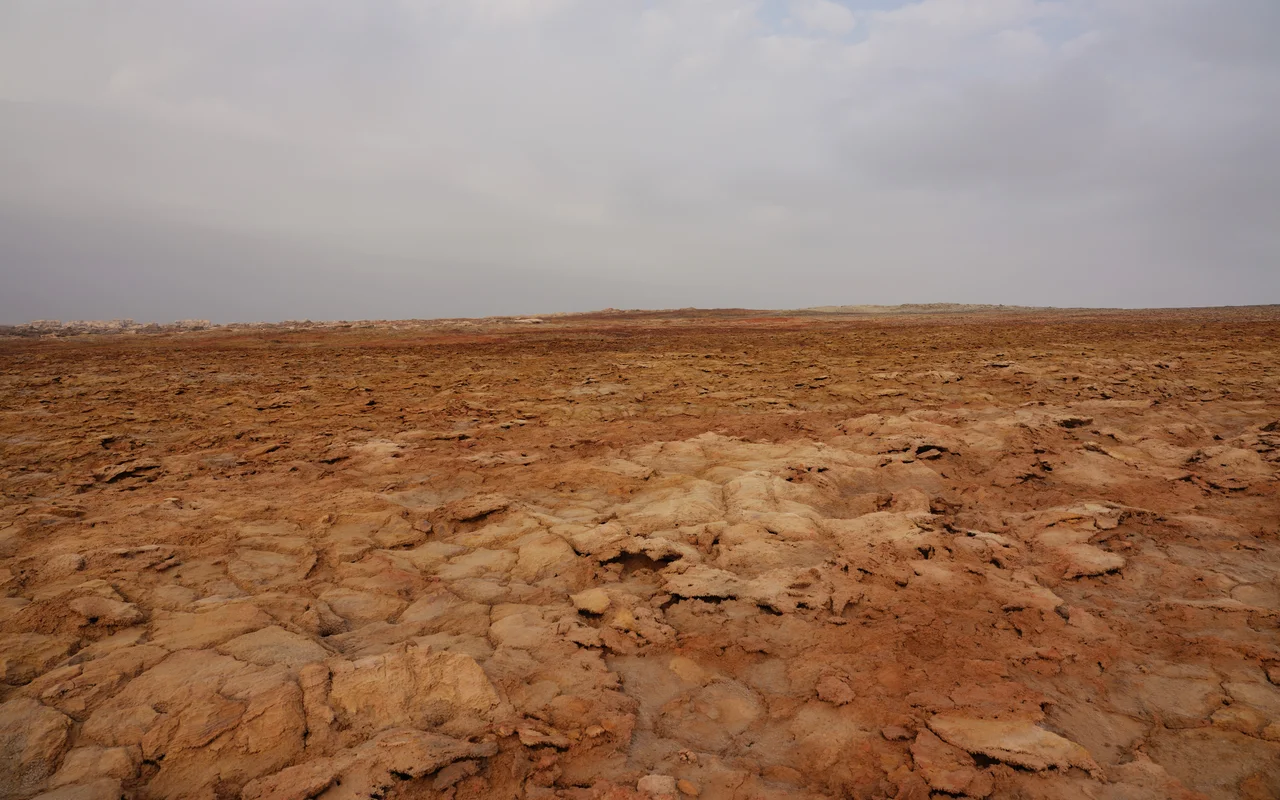
The Afar people gave this place a name that means 'dissolution' or 'disintegration.' In the language of the salt plains, Dallol is what happens to solid things that touch these waters. That is not metaphor. The hydrothermal pools of Dallol have a pH below zero - more acidic than battery acid - and dissolve flesh, bone, and most laboratory glass. The colours range from lime green to sulphur yellow to blood red, and they shift from week to week as new springs open and old ones go dry. Dallol sits in the Danakil Depression of Ethiopia, 125 metres below sea level, on salt flats that used to be the Red Sea.
Below Sea Level, On Land
The Dallol volcano and its surrounding salt flats form the lowest known subaerial volcanic vent system in the world - 45 metres or more below sea level at the vents themselves. The ground beneath Dallol is a salt dome, formed when basaltic magma intruded into an ancient marine sedimentary sequence. The salt was laid down in kilometre-thick layers during the periods when the Red Sea flooded the depression - four times in the Middle and Late Pleistocene, the last time about 30,000 years ago. Phreatic eruptions - steam explosions driven by groundwater meeting magma - reshaped the surface in 1926, forming the 30-metre-diameter crater at Dallol's centre. In 2004 the shallow magma chamber beneath the mountain deflated and fed an intrusion south beneath the rift. The most recent signs of activity came in January 2011 - possibly a degassing event from deep below the surface.
The Colours Are Not Alive
Colourful hot springs are, in most places on Earth, painted by microorganisms - the bacteria that give Yellowstone's Grand Prismatic Spring its iridescent rings. Dallol is different. The colours here come from inorganic iron chemistry: oxidation, precipitation, mineral deposition. The yellow is native sulphur. The brown is oxidised iron from older, inactive springs. The white is salt. The lime green is iron in a different oxidation state. The chemistry is so hostile that when French and Spanish scientists examined the multi-extreme ponds in 2019 - publishing their findings in Nature Ecology and Evolution - they found no life at all. The combination of hyperacidity, hypersalinity, and high magnesium concentrations (which catalyses the denaturation of biomolecules) pushes conditions past what any known organism can survive. A later study reported ultra-small structures identified as Nanohaloarchaea entombed in mineral deposits, which may represent the only life that has ever made the attempt.
An Ocean Being Born
What makes Dallol geologically profound is not its extremity but its meaning. This is one of only two places on Earth where a mid-ocean ridge can be studied on land - the other is Iceland. The Afar Depression around Dallol sits at a tectonic triple junction where the Red Sea spreading ridge, the Gulf of Aden ridge, and the East African Rift converge. The Nubian plate and the Danakil microplate are pulling apart at about 18 millimetres per year in the south and 8 in the north. What we are watching, in slow motion, is the birth of a new ocean. In perhaps 10 million years the Danakil Depression will be sea. The salt flats and the acid ponds and the geysers are stages of that process - marine sediments from the last flooding, hot springs where new oceanic crust is trying to form. In 2022 the International Union of Geological Sciences named the Danakil Rift depression one of the world's 100 geological heritage sites. The citation: 'the ongoing birth of an ocean witnessed through tectonics and volcanism in an extreme evaporite arid environment.'
The Italians Who Came for Sulphur
The first documented industrial activity at Dallol was Italian. During the colonial period - particularly after Italy seized control of Eritrea in 1885 and parts of the Danakil coast soon after - Italian entrepreneurs came to extract sulphur and potash from the exposed mineral fields. They stayed only as long as the heat and the toxic fumes allowed them. A small settlement grew up at the Dallol crater itself. By the 1930s the place was named, with heavy irony, the hottest inhabited settlement ever recorded - its average annual temperature approaching 35 C, its highest daily temperatures regularly above 40 degrees year-round. It became a ghost town during and after the Second World War. The mining equipment rusted into the salt. Nothing in that climate can stop rust, though the salt itself preserves iron better than most soils.
Mars on Earth
In 2017 the New York Times ran a piece titled 'Gazing into Danakil Depression's Mirror, and Seeing Mars Stare Back.' NASA scientists have used Dallol as a terrestrial analogue for Martian hydrothermal systems - the thought being that if life could evolve in conditions this hostile, it might have done so on Mars in the planet's wet past. The 2019 Nature paper suggesting no life exists in the multi-extreme ponds complicated that line of reasoning. Absence of life in Dallol's hottest, saltiest, most acidic fluids does not prove anything definitive about Mars, but it pushes back against the assumption that life will survive anywhere water exists. Dallol is not a place. It is a boundary condition - the edge of what Earth can support, visible on the ground, in colour. A guide walking on its salt terraces is walking on a surface that has no analogue anywhere else in the world.
From the Air
Dallol sits at 14.24N, 40.30E in Ethiopia's Afar Region, 125m below sea level. The nearest airport is Mekele (HAMK/MQX) about 250 km southwest at 2,250m elevation - note the extreme altitude differential. The Danakil Depression is remote, stiflingly hot (summer highs above 50C), and has historically been subject to security warnings - armed tourist attacks occurred in 2012 and 2017. Air access is primarily by organized expedition overflight. Recommended viewing altitude 6,000-8,000 ft AGL for the colour palette and salt terraces. Extreme heat may affect aircraft performance at low altitude.
Nearby Stories
- Debre Maryam Qorqor 42 km away
- Adulis 75 km away
- Southern Red Sea region 85 km away
- Tigray Province 86 km away
- Attacks on the Sounion 104 km away
- Mekelle 105 km away
- Italian Eritrea 120 km away
- Italian Submarine Guglielmotti (1938) 202 km away